Department of Hepatobiliary and Pancreatic Surgery, the Second Affiliated Hospital of Fujian Medical University, Quanzhou, 362000, China.
Department of Radiology, Quanzhou First Hospital Affiliated to Fujian Medical University, Quanzhou, 362000, China.
World J Surg Oncol. 2022 Jun 6;20(1):182. doi: 10.1186/s12957-022-02649-4.
Since there is still controversy about the comparison of the efficacy and safety of RH and RFA in the treatment of recurrent liver cancer, we conducted a meta-analysis to compare the efficacy and safety, in order to provide evidence-based evidence for future research and clinical treatment.
We searched PubMed, Embase, and Cochrane Library from the establishment of the database to Feb 2021. We included studies that reported liver cancer patients underwent repeated hepatectomy (RH) or radiofrequency ablation (RFA), and we excluded duplicate publications, research without full text, incomplete information, or inability to conduct data extraction, animal experiments, reviews, and systematic reviews. The STATA 15.1 was used to analyze the data.
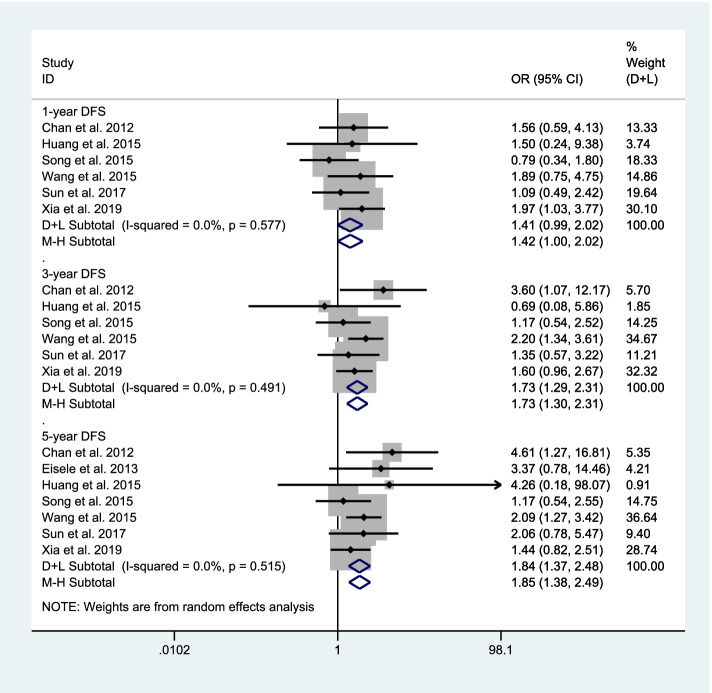
The pooled results show that the 3-year and 5-year overall survival (OS) rate of the repeated hepatectomy group was significantly higher than the radiofrequency ablation group (odds ratio (OR) = 1.95, 95% confidence interval (CI):1.47-2.60, P ≤ 0.001; OR = 1.65, 95% CI: 1.12-2.43, P = 0.012). Similarly, the pooled results show that the 3-year and 5-year disease-free survival (DFS) rate of the repeated hepatectomy group was significantly higher than the radiofrequency ablation group (OR = 1.73, 95% CI: 1.30-2.31, P ≤ 0.001; OR = 1.84, 95% CI: 1.38-2.49, P ≤ 0.001). However, there is no significant difference in the 1-year OS and DFS rate of repeated hepatectomy group and radiofrequency ablation group. Additionally, the pooled results show that the postoperative Clavien-Dindo (CD) grade II or higher complication rate of the repeated hepatectomy group was significantly higher than the radiofrequency ablation group (OR = 2.80, 95% CI: 1.37-5.75, P = 0.005).
Based on the pooled results of 8 existing retrospective studies, RH has a higher OS rate and DFS rate in the treatment of recurrent liver cancer, while the postoperative complication rate of RFA is lower. When survival is the primary goal, RH should be the first choice for recurrent liver cancer.
由于关于重复肝切除术(RH)和射频消融术(RFA)治疗复发性肝癌的疗效和安全性比较仍存在争议,我们进行了一项荟萃分析以比较其疗效和安全性,以期为未来的研究和临床治疗提供循证依据。
我们检索了从数据库建立到 2021 年 2 月的 PubMed、Embase 和 Cochrane Library。我们纳入了报告肝癌患者接受重复肝切除术(RH)或射频消融术(RFA)治疗的研究,并排除了重复发表的研究、无全文的研究、信息不完整的研究、无法进行数据提取的研究、动物实验、综述和系统综述。采用 STATA 15.1 进行数据分析。
汇总结果显示,重复肝切除术组的 3 年和 5 年总生存率(OS)明显高于射频消融术组(比值比(OR)=1.95,95%置信区间(CI):1.47-2.60,P≤0.001;OR=1.65,95%CI:1.12-2.43,P=0.012)。同样,汇总结果显示,重复肝切除术组的 3 年和 5 年无病生存率(DFS)明显高于射频消融术组(OR=1.73,95%CI:1.30-2.31,P≤0.001;OR=1.84,95%CI:1.38-2.49,P≤0.001)。然而,重复肝切除术组和射频消融术组的 1 年 OS 和 DFS 率无显著差异。此外,汇总结果显示,重复肝切除术组术后 Clavien-Dindo(CD)分级 II 或更高的并发症发生率明显高于射频消融术组(OR=2.80,95%CI:1.37-5.75,P=0.005)。
基于 8 项现有回顾性研究的汇总结果,RH 治疗复发性肝癌的 OS 率和 DFS 率更高,而 RFA 的术后并发症发生率较低。当生存是主要目标时,RH 应作为复发性肝癌的首选治疗方法。