He Xian, Zhou Ming-Xi, Cheng Cheng, Li Shan-Shan, Gao Yuan, Ma Zhi-Tao, Song Xin-Hua, Bai Zhao-Fang, Zou Zheng-Sheng, Xiao Xiao-He, Wang Jia-Bo, Lu Ya-Wen
School of Pharmacy and Chemistry, Dali University, Dali, China.
School of Traditional Chinese Medicine, Capital Medical University, Beijing, China.
Front Pharmacol. 2022 May 20;13:896198. doi: 10.3389/fphar.2022.896198. eCollection 2022.
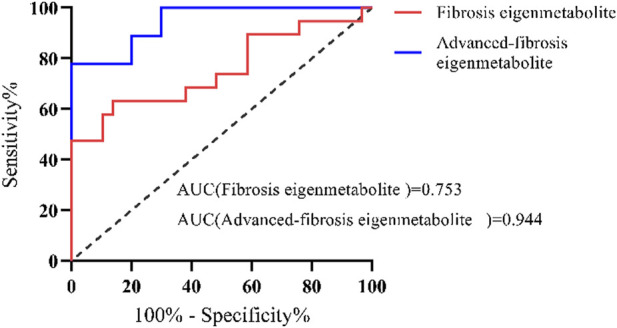
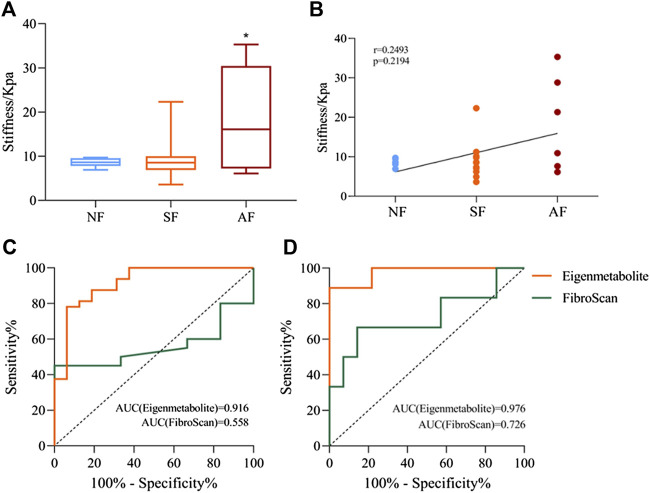
Chronic drug-induced liver injury (DILI) is a rare but under-researched adverse drug reaction-related disease, which is highly likely to progress into liver fibrosis and even cirrhosis. In this study, metabolomics was used to screen out characteristic metabolites related to the histological progression of fibrosis in chronic DILI and analyze the metabolic changes during the development of fibrosis to explain the underlying mechanism. Chronic DILI patients who underwent liver biopsy were divided into different fibrosis grades. Serum was analyzed by untargeted metabolomics to find serological characteristic metabolite fingerprints. The screened fingerprints were validated by the validation group patients, and the identification ability of fingerprints was compared using FibroScan. A total of 31 metabolites associated with fibrosis and 11 metabolites associated with advanced fibrosis were identified. The validation group confirmed the accuracy of the two metabolite fingerprints [area under the curve (AUC) value 0.753 and 0.944]. In addition, the fingerprints showed the ability to distinguish the grades of fibrosis by comparing using FibroScan. The metabolite fingerprint pathway showed that bile acid synthesis is disturbed while lipid metabolism is extremely active, resulting in an overload of lipid metabolites in the occurrence and development of chronic DILI-associated fibrosis. Our metabolomic analysis reveals the unique metabolomic fingerprints associated with chronic DILI fibrosis, which have potential clinical diagnostic and prognostic significances. The metabolomic fingerprints suggest the disturbance of the lipid metabolites as the most important factor in the development of DILI fibrosis.
慢性药物性肝损伤(DILI)是一种罕见但研究不足的药物不良反应相关疾病,极有可能进展为肝纤维化甚至肝硬化。在本研究中,代谢组学被用于筛选出与慢性DILI纤维化组织学进展相关的特征性代谢物,并分析纤维化发展过程中的代谢变化,以解释其潜在机制。对接受肝活检的慢性DILI患者进行不同纤维化分级。通过非靶向代谢组学分析血清,以找到血清学特征性代谢物指纹图谱。筛选出的指纹图谱在验证组患者中进行验证,并使用FibroScan比较指纹图谱的识别能力。共鉴定出31种与纤维化相关的代谢物和11种与晚期纤维化相关的代谢物。验证组证实了两种代谢物指纹图谱的准确性[曲线下面积(AUC)值分别为0.753和0.944]。此外,通过与FibroScan比较,指纹图谱显示出区分纤维化分级的能力。代谢物指纹图谱途径表明,胆汁酸合成受到干扰,而脂质代谢极为活跃,导致脂质代谢物在慢性DILI相关纤维化的发生和发展过程中过载。我们的代谢组学分析揭示了与慢性DILI纤维化相关的独特代谢组学指纹图谱,具有潜在的临床诊断和预后意义。代谢组学指纹图谱表明脂质代谢物紊乱是DILI纤维化发展的最重要因素。