Gao Ning, Li Xuebiao, Kong Minjian, Ni Ming, Wei Dongdong, Zhu Xian, Wang Yifan, Hong Ze, Dong Aiqiang
Department of Cardiovascular Surgery, The Second Affiliated Hospital of Zhejiang University School of Medicine, Hangzhou, China.
Front Nutr. 2022 May 19;9:910949. doi: 10.3389/fnut.2022.910949. eCollection 2022.
Although studies suggest that concentrations of serum 25-hydroxyvitamin D (25(OH)D) are lower in individuals with Heart Failure (HF), the beneficial effects of vitamin D supplementation are controversial. Therefore, in this study, we aimed to determine whether there is a causal relationship between serum Vitamin D (VD) levels and HF.
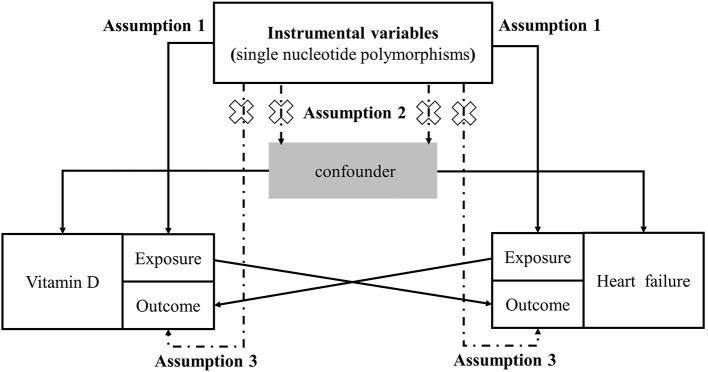
We obtained genetic instruments from the largest available genome-wide association study (GWAS) of European descent for 25(OH)D (443, 734 individuals) to investigate the association with HF (47,309 cases, 930,014 controls), and vice versa. Two-sample bidirectional Mendelian Randomization (MR) analysis was performed to infer the causality. In addition to the primary analysis using inverse variance-weighted (IVW) MR, we applied five additional methods to control for pleiotropy [MR-Egger, weighted median, Maximum-likelihood, MR-robust adjusted profile score (MR-RAPS) and MR-pleiotropy residual sum and outlier (MR-PRESSO)] and compared their respective MR estimates. We also performed a sensitivity analysis to ensure that our results were robust.
Mendelian randomized analysis showed that increased serum 25(OH)D was associated with a lower risk of HF in the IVW method (odds ratio [OR] = 0. 81;95%CI, 0.70-0.94, = 0.006). In the reverse MR analyses, the genetic predisposition to HF was negatively correlated with serum 25(OH)D level (OR = 0. 89;95%CI, (0.82-0.97), = 0.009).
Our study revealed the possible causal role of 25(OH)D on decreasing the risk for HF. Meanwhile, reverse MR analysis suggested that HF may be associated with lower vitamin D levels, it could be the potential implications for dietary recommendations.
尽管研究表明心力衰竭(HF)患者的血清25-羟基维生素D(25(OH)D)浓度较低,但补充维生素D的有益效果仍存在争议。因此,在本研究中,我们旨在确定血清维生素D(VD)水平与HF之间是否存在因果关系。
我们从规模最大的欧洲血统全基因组关联研究(GWAS)中获取了与25(OH)D相关的遗传工具(443,734人),以研究其与HF(47,309例病例,930,014例对照)的关联,反之亦然。进行两样本双向孟德尔随机化(MR)分析以推断因果关系。除了使用逆方差加权(IVW)MR进行的主要分析外,我们还应用了另外五种方法来控制多效性[MR-Egger、加权中位数、最大似然法、MR稳健调整轮廓得分(MR-RAPS)和MR多效性残差和异常值(MR-PRESSO)],并比较了它们各自的MR估计值。我们还进行了敏感性分析,以确保我们的结果是稳健的。
孟德尔随机化分析表明,采用IVW方法时,血清25(OH)D升高与HF风险降低相关(比值比[OR]=0.81;95%可信区间,0.70-0.94,P=0.006)。在反向MR分析中,HF的遗传易感性与血清25(OH)D水平呈负相关(OR=0.89;95%可信区间,0.82-0.97,P=0.009)。
我们的研究揭示了25(OH)D在降低HF风险方面可能的因果作用。同时,反向MR分析表明HF可能与较低的维生素D水平相关,这可能对饮食建议具有潜在意义。