Department of Orthopaedics, Peking University Third Hospital, 49 North Garden Road, Haidian District, Beijing, 100191, China.
Beijing Key Laboratory of Spinal Disease Research, Beijing, China.
J Transl Med. 2021 Jul 10;19(1):300. doi: 10.1186/s12967-021-02973-5.
The coronavirus disease 2019 (COVID-19) pandemic has struck globally and is exerting a devastating toll on humans. The pandemic has led to calls for widespread vitamin D supplementation in public. However, evidence supporting the role of vitamin D in the COVID-19 pandemic remains controversial.
We performed a two-sample Mendelian randomization (MR) analysis to analyze the causal effect of the 25-hydroxyvitamin D [25(OH)D] concentration on COVID-19 susceptibility, severity and hospitalization traits by using summary-level GWAS data. The causal associations were estimated with inverse variance weighted (IVW) with fixed effects (IVW-fixed) and random effects (IVW-random), MR-Egger, weighted edian and MR Robust Adjusted Profile Score (MR.RAPS) methods. We further applied the MR Steiger filtering method, MR Pleiotropy RESidual Sum and Outlier (MR-PRESSO) global test and PhenoScanner tool to check and remove single nucleotide polymorphisms (SNPs) that were horizontally pleiotropic.
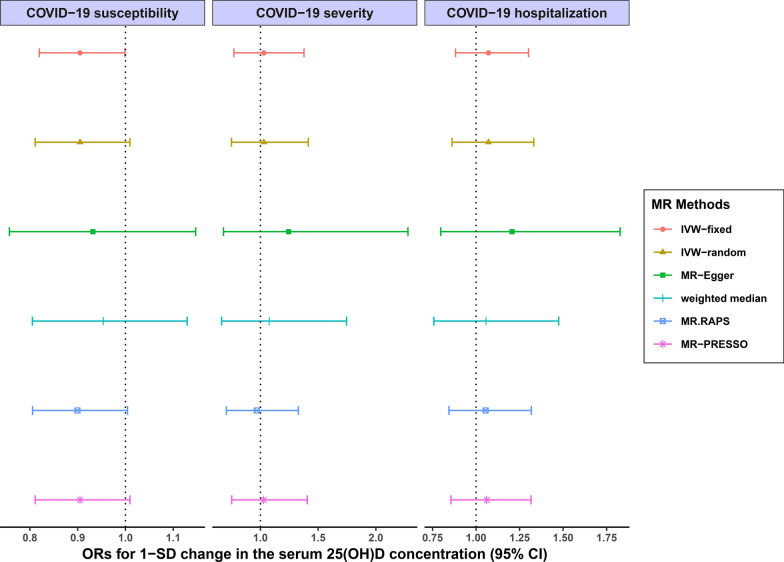
We found no evidence to support the causal associations between the serum 25(OH)D concentration and the risk of COVID-19 susceptibility [IVW-fixed: odds ratio (OR) = 0.9049, 95% confidence interval (CI) 0.8197-0.9988, p = 0.0473], severity (IVW-fixed: OR = 1.0298, 95% CI 0.7699-1.3775, p = 0.8432) and hospitalized traits (IVW-fixed: OR = 1.0713, 95% CI 0.8819-1.3013, p = 0.4878) using outlier removed sets at a Bonferroni-corrected p threshold of 0.0167. Sensitivity analyses did not reveal any sign of horizontal pleiotropy.
Our MR analysis provided precise evidence that genetically lowered serum 25(OH)D concentrations were not causally associated with COVID-19 susceptibility, severity or hospitalized traits. Our study did not provide evidence assessing the role of vitamin D supplementation during the COVID-19 pandemic. High-quality randomized controlled trials are necessary to explore and define the role of vitamin D supplementation in the prevention and treatment of COVID-19.
2019 年冠状病毒病(COVID-19)大流行在全球范围内肆虐,给人类带来了毁灭性的打击。大流行导致人们呼吁广泛补充维生素 D。然而,支持维生素 D 在 COVID-19 大流行中的作用的证据仍然存在争议。
我们通过使用汇总水平 GWAS 数据,进行了两样本 Mendelian 随机化(MR)分析,以分析 25-羟维生素 D [25(OH)D]浓度对 COVID-19 易感性、严重程度和住院特征的因果作用。使用固定效应(IVW-固定)和随机效应(IVW-随机)、MR-Egger、加权中位数和 MR 稳健调整轮廓评分(MR.RAPS)方法估计因果关系。我们还应用了 MR Steiger 过滤方法、MR Pleiotropy RESidual Sum and Outlier(MR-PRESSO)全局检验和 PhenoScanner 工具来检查和去除水平多效性的单核苷酸多态性(SNP)。
我们没有发现证据支持血清 25(OH)D 浓度与 COVID-19 易感性[IVW-固定:优势比(OR)=0.9049,95%置信区间(CI)0.8197-0.9988,p=0.0473]、严重程度(IVW-固定:OR=1.0298,95%CI 0.7699-1.3775,p=0.8432)和住院特征(IVW-固定:OR=1.0713,95%CI 0.8819-1.3013,p=0.4878)之间存在因果关系,使用经过 Bonferroni 校正的 p 值为 0.0167 的异常值去除集。敏感性分析未发现任何水平多效性的迹象。
我们的 MR 分析提供了精确的证据,表明遗传降低的血清 25(OH)D 浓度与 COVID-19 的易感性、严重程度或住院特征没有因果关系。我们的研究没有提供评估 COVID-19 大流行期间维生素 D 补充作用的证据。需要高质量的随机对照试验来探索和确定维生素 D 补充在 COVID-19 的预防和治疗中的作用。