Kandeel Mahmoud, El-Deeb Wael
Department of Biomedical Sciences, College of Veterinary Medicine, King Faisal University, Al-Hofuf 31982, Al-Ahsa, Saudi Arabia.
Department of Pharmacology, Faculty of Veterinary Medicine, Kafrelshikh University, Kafr El-Shikh 33516, Egypt.
Bioinorg Chem Appl. 2022 May 27;2022:6422208. doi: 10.1155/2022/6422208. eCollection 2022.
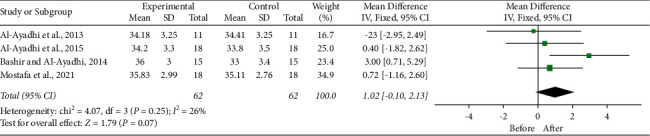
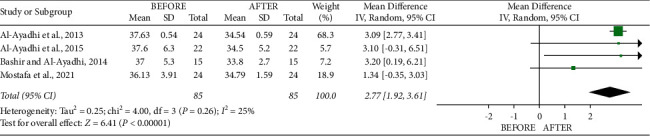
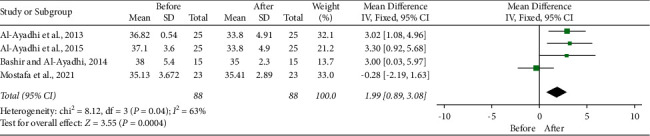
Camel milk is better tolerated than the milk of other ruminants, potentially expanding its consumer appeal. It also contains essential vitamins, minerals, and immunoglobulins, providing the milk with antioxidant, antibacterial, and antiviral properties. These properties may reduce oxidative stress in camel milk consumers, ameliorating many conditions, including those of the CNS, such as autism spectrum disorders (ASDs). We performed a meta-analysis of randomized controlled trials (RCTs) in which camel milk administration (boiled or raw) was examined as an ASD treatment intervention. The primary endpoint was participants' total autism scores, determined using the Childhood Autistic Responsiveness Scale (CARS). A comparison of the responsiveness in these ASD intervention groups yielded a mean difference (MD) of 1.99 (0.89, 3.08) in those consuming boiled camel milk, MD = 2.77 (1.92, 3.61) in raw camel milk consumers, and MD = -1.02 (-0.10, 2.13) in cow milk consumers. Heterogeneity was notably low among the examined studies. Treatment of ASD with raw and boiled camel milk resulted in significantly lower CARS scores than the placebo. Our findings support the development of larger, more populated RCTs to establish camel milk's overall potential as a therapeutic intervention for CNS disorders.
骆驼奶比其他反刍动物的奶更易被耐受,这可能会扩大其对消费者的吸引力。它还含有必需的维生素、矿物质和免疫球蛋白,赋予了骆驼奶抗氧化、抗菌和抗病毒特性。这些特性可能会减轻饮用骆驼奶者的氧化应激,改善多种病症,包括中枢神经系统疾病,如自闭症谱系障碍(ASD)。我们对随机对照试验(RCT)进行了荟萃分析,其中将给予骆驼奶(煮沸或生奶)作为一种自闭症谱系障碍治疗干预措施进行了研究。主要终点是参与者的总自闭症评分,使用儿童自闭症反应量表(CARS)来确定。这些自闭症谱系障碍干预组的反应性比较结果显示,饮用煮沸骆驼奶者的平均差值(MD)为1.99(0.89,3.08),饮用生骆驼奶者的MD = 2.77(1.92,3.61),饮用牛奶者的MD = -1.02(-0.10,2.13)。在所研究的各项研究中,异质性显著较低。用生骆驼奶和煮沸骆驼奶治疗自闭症谱系障碍导致的儿童自闭症反应量表评分显著低于安慰剂。我们的研究结果支持开展规模更大、样本量更多的随机对照试验,以确定骆驼奶作为中枢神经系统疾病治疗干预手段的总体潜力。