Chen Huiyi, Chen Feng, Jiang Ying, Zhang Lu, Hu Guizhen, Sun Furong, Zhang Miaoping, Ji Yao, Chen Yanting, Che Gang, Zhou Xu, Zhang Yu
Department of Children Rehabilitation, Yuebei People's Hospital, Affiliated Hospital of Shantou University Medical College, Shaoguan, China.
Guangdong Key Laboratory of Age-Related Cardiac and Cerebral Diseases, Department of Neurology, Affiliated Hospital of Guangdong Medical University, Zhanjiang, China.
Front Aging Neurosci. 2022 May 20;14:881239. doi: 10.3389/fnagi.2022.881239. eCollection 2022.
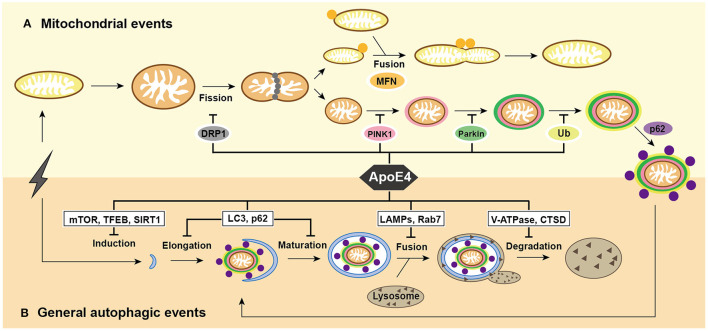
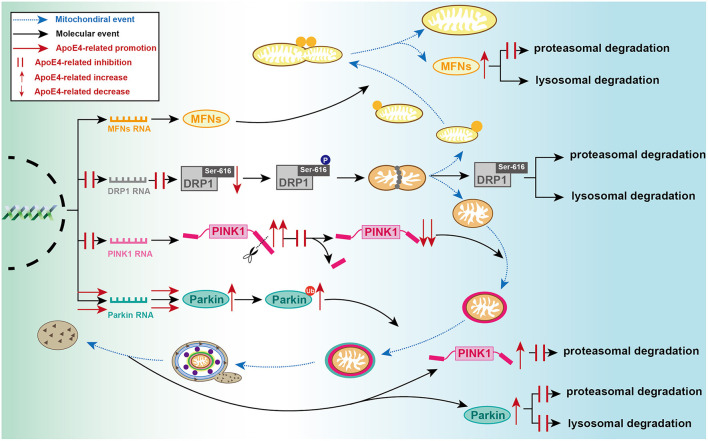
Alzheimer's disease (AD) is one of the major worldwide causes of dementia that is characterized by irreversible decline in learning, memory loss, and behavioral impairments. Mitophagy is selective autophagy through the clearance of aberrant mitochondria, specifically for degradation to maintain energy generation and neuronal and synaptic function in the brain. Accumulating evidence shows that defective mitophagy is believed to be as one of the early and prominent features in AD pathogenesis and has drawn attention in the recent few years. ε4 allele is the greatest genetic determinant for AD and is widely reported to mediate detrimental effects on mitochondria function and mitophagic process. Given the continuity of the physiological process, this review takes the mitochondrial dynamic and mitophagic core events into consideration, which highlights the current knowledge about the molecular alterations from an -genotype perspective, synthesizes ApoE4-associated regulations, and the cross-talk between these signaling, along with the focuses on general autophagic process and several pivotal processes of mitophagy, including mitochondrial dynamic (DRP1, MFN-1), mitophagic induction (PINK1, Parkin). These may shed new light on the link between ApoE4 and AD and provide novel insights for promising mitophagy-targeted therapeutic strategies for AD.
阿尔茨海默病(AD)是全球范围内导致痴呆的主要原因之一,其特征为学习能力不可逆下降、记忆丧失和行为障碍。线粒体自噬是通过清除异常线粒体进行的选择性自噬,特别是为了维持大脑中的能量生成以及神经元和突触功能而进行降解。越来越多的证据表明,线粒体自噬缺陷被认为是AD发病机制中的早期突出特征之一,并在最近几年引起了关注。ε4等位基因是AD最大的遗传决定因素,广泛报道其对线粒体功能和线粒体自噬过程具有有害影响。鉴于生理过程的连续性,本综述考虑了线粒体动态变化和线粒体自噬的核心事件,从基因型角度突出了当前关于分子改变的知识,综合了载脂蛋白E4相关的调控以及这些信号之间的相互作用,同时关注一般自噬过程和线粒体自噬的几个关键过程,包括线粒体动态变化(动力蛋白1,线粒体融合蛋白1)、线粒体自噬诱导(PTEN诱导激酶1,帕金蛋白)。这些可能为载脂蛋白E4与AD之间的联系提供新的线索,并为有前景的针对线粒体自噬的AD治疗策略提供新的见解。