Do Phuong Thao, Chen Li-Ying, Chan Lung, Hu Chaur-Jong, Chien Li-Nien
International Ph.D. Program for Cell Therapy and Regeneration Medicine, College of Medicine, Taipei Medical University, Taipei, Taiwan.
Department of Pediatrics, Hanoi Medical University, Hanoi, Vietnam.
Front Neurol. 2022 May 20;13:880661. doi: 10.3389/fneur.2022.880661. eCollection 2022.
The incidence of ischemic stroke has been increasing in the young population over the past 20 years. Poststroke epilepsy (PSE) is a common complication after stroke. However, few population-based studies with sufficient follow-up have investigated factors associated with PSE, especially factors related to comorbidities and unhealthy lifestyles in the modern young population. Accordingly, this study aimed to determine the long-term incidence and these risk factors for PSE young adults.
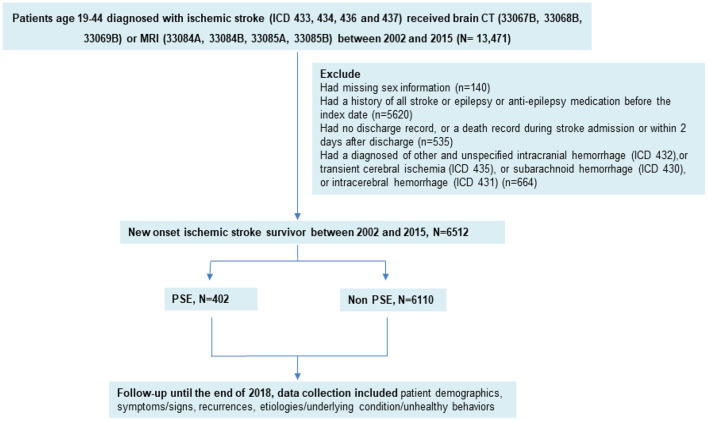
This cohort study was conducted using data from the Taiwan National Health Insurance Research Database (NHIRD) from 2002 to 2018. All patients aged between 19 and 44 years and diagnosed with ischemic stroke from 2002 to 2015 were retrospectively enrolled with a follow-up of at least 3 years. Multivariable Cox regression models were performed to identify predictors of PSE, including patients' demographics, baseline conditions, stroke severity, etiologies, comorbidities, and unhealthy behaviors.
Among 6,512 ischemic stroke patients, 402 cases (6.2%) developed PSE who were with a mean follow-up period of 8.3 years (SD = 4.3 years). During the overall follow-up, stroke severity and manifestations were associated with PSE, including National Institutes of Health Stroke Scale (NIHSS) score ≥10 (aHR, 1.98; 95% CI, 1.50-2.61), seizure at first stroke admission [adjusted hazard ratio (aHR), 57.39; 95% confidence interval (CI), 43.02-76.55], length of hospital stay ≥14 days (aHR, 1.60; 95% CI, 1.26-2.02), recurrent stroke (aHR, 2.32; 95% CI, 1.85-2.90), aphasia (aHR, 1.77; 95% CI, 1.20-2.60), and malignancy (aHR, 2.05; 95% CI, 1.30-3.24). Furthermore, stroke patients with drug abuse were 2.90 times more likely to develop PSE than those without (aHR, 2.90; 95% CI, 1.53-5.50). By contrast, statin use (aHR, 0.62; 95% CI, 0.48-0.80) was associated with a lower risk of PSE. The risk factors at 1-year and 5-year PSE were similar to that of an overall follow-up.
Stroke severity, aphasia, malignancy, and drug abuse were associated increased risk of PSE and statin use may protect against PSE in young adults. Reducing the severity of stroke, statin use and controlling unhealthy behaviors might be able to decrease the development of PSE. Since PSE is associated with poor outcomes, early identification or intervention of PSE based on the risk factors might reduce the harmful effects of PSE.
在过去20年中,青年人群缺血性卒中的发病率一直在上升。卒中后癫痫(PSE)是卒中后常见的并发症。然而,很少有基于人群且随访充分的研究调查与PSE相关的因素,特别是现代青年人群中与合并症和不健康生活方式相关的因素。因此,本研究旨在确定青年成人PSE的长期发病率及这些危险因素。
本队列研究使用了2002年至2018年台湾国民健康保险研究数据库(NHIRD)的数据。回顾性纳入了2002年至2015年期间年龄在19至44岁之间且被诊断为缺血性卒中的所有患者,并进行了至少3年的随访。采用多变量Cox回归模型来确定PSE的预测因素,包括患者的人口统计学特征、基线状况、卒中严重程度、病因、合并症和不健康行为。
在6512例缺血性卒中患者中,402例(6.2%)发生了PSE,平均随访期为8.3年(标准差=4.3年)。在整个随访期间,卒中严重程度和表现与PSE相关,包括美国国立卫生研究院卒中量表(NIHSS)评分≥10(调整后风险比[aHR],1.98;95%置信区间[CI],1.50 - 2.61)、首次卒中入院时癫痫发作(调整后风险比[aHR],57.39;95%置信区间[CI],43.