Chi Nai-Fang, Kuan Yi-Chun, Huang Yao-Hsien, Chan Lung, Hu Chaur-Jong, Liu Hung-Yi, Chiou Hung-Yi, Chien Li-Nien
Department of Neurology, School of Medicine, College of Medicine, Taipei Medical University, Taipei, Taiwan, Republic of China.
Department of Neurology, Shuang Ho Hospital, Taipei Medical University, Taipei, Taiwan, Republic of China.
Clin Epidemiol. 2018 Aug 21;10:1001-1011. doi: 10.2147/CLEP.S168169. eCollection 2018.
This study aimed to develop and validate a prognostic model for the 1-year risk of late poststroke epilepsy (PSE).
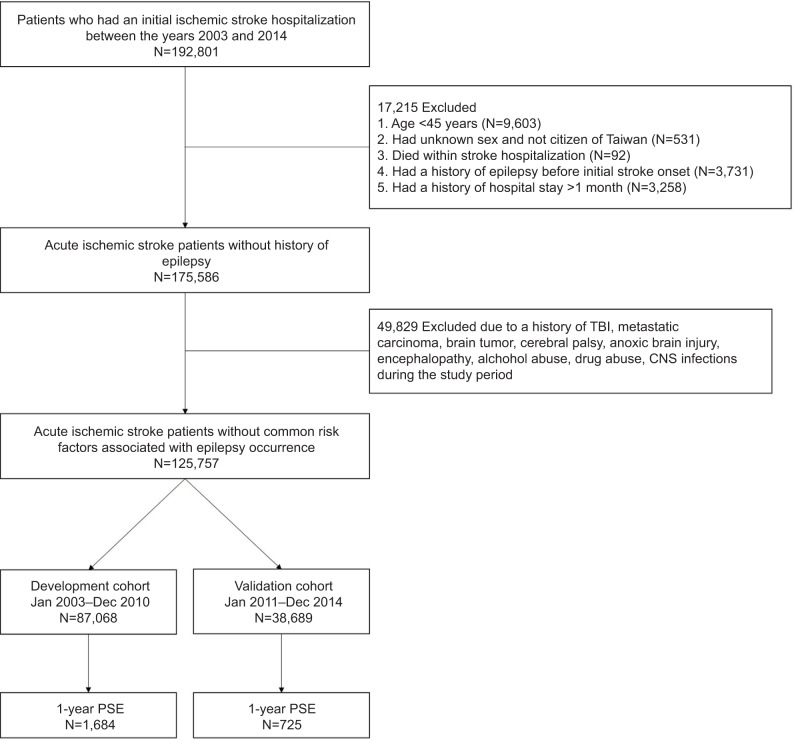
We included patients initially diagnosed with ischemic stroke between 2003 and 2014 in a National Health Insurance claims-based cohort in Taiwan. Patients were further divided into development and validation cohorts based on their year of stroke diagnosis. Multivariable Cox regression with backward elimination was used to analyze the association between 1-year PSE and risk factors before and on stroke admission.
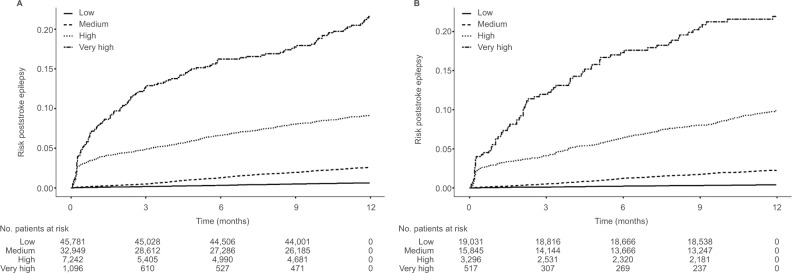
In total, 1,684 (1.93%) and 725 (1.87%) ischemic stroke patients comprising the development and validation cohorts, respectively, experienced late PSE within 1 year after stroke. Seven clinical variables were examined to be independently associated with 1-year risk of PSE. We developed a risk score called "PSEiCARe" ranging from 0 to 16 points, comprising the following factors: prolonged hospital stay (>2 weeks, 1 point), seizure on admission (6 points), elderly patients (age ≥80 years, 1 point), intensive care unit stay on admission (3 points), cognitive impairment (dementia, 2 points), atrial fibrillation (2 points), and respiratory tract infection (pneumonia) on admission (1 point). Patients were further classified into low-, medium-, high-, and very-high-risk groups. The incidence (per 100 person-years) was 0.64 (95% CI: 0.56-0.71) for the low-risk, 2.62 (95% CI: 2.43-2.82) for the medium-risk, 10.3 (95% CI: 9.48-11.3) for the high-risk, and 28.2 (95% CI: 24.0-33.0) for the very-high-risk groups. Discrimination and calibration were satisfactory, with a Harrell's of 0.762 in the development model and 0.792 in the validation model.
PSEiCARe is an easy-to-use prognostic score that integrates patient characteristics and clinical factors on stroke admission to predict 1-year PSE risk; it has the potential to assist individualized patient management and improve clinical practice, thereby preventing the occurrence of late PSE.
本研究旨在开发并验证一种预测卒中后晚期癫痫(PSE)1年风险的模型。
我们纳入了2003年至2014年期间在台湾一个基于国民健康保险理赔的队列中最初被诊断为缺血性卒中的患者。根据卒中诊断年份,患者被进一步分为开发队列和验证队列。采用多变量Cox回归和向后逐步淘汰法分析卒中前及入院时1年PSE与危险因素之间的关联。
开发队列和验证队列中分别有1684例(1.93%)和725例(1.87%)缺血性卒中患者在卒中后1年内发生晚期PSE。经检查,7个临床变量与PSE的1年风险独立相关。我们开发了一个名为“PSEiCARe”的风险评分,范围为0至16分,包括以下因素:住院时间延长(>2周,1分)、入院时癫痫发作(6分)、老年患者(年龄≥80岁,1分)、入院时入住重症监护病房(3分)、认知障碍(痴呆,2分)、心房颤动(2分)和入院时呼吸道感染(肺炎,1分)。患者被进一步分为低、中、高和极高风险组。低风险组的发病率(每100人年)为0.64(95%CI:0.56 - 0.71),中风险组为2.62(95%CI:2.43 - 2.82),高风险组为10.3(95%CI:9.48 - 11.3),极高风险组为28.2(95%CI:24.0 - 33.0)。区分度和校准效果良好,开发模型的Harrell's c为0.762,验证模型为0.792。
PSEiCARe是一种易于使用的预后评分,它整合了患者特征和卒中入院时的临床因素以预测1年PSE风险;它有可能辅助个体化患者管理并改善临床实践,从而预防晚期PSE的发生。