Department of Microbiology and Immunology, University of California, San Francisco, San Francisco, CA 94158, USA.
Section of Microbiology, University of Copenhagen, Universitetsparken 15, 2100 Copenhagen, Denmark.
Nucleic Acids Res. 2022 Jun 24;50(11):6414-6422. doi: 10.1093/nar/gkac462.
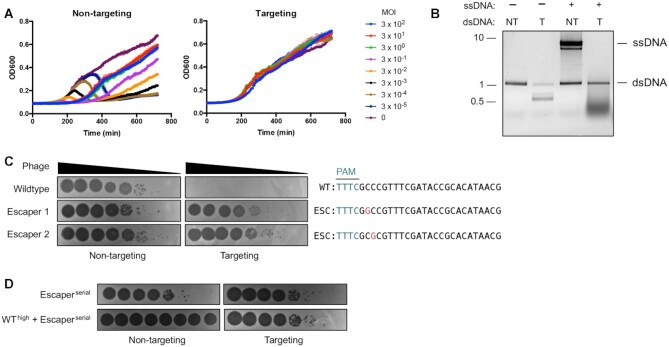
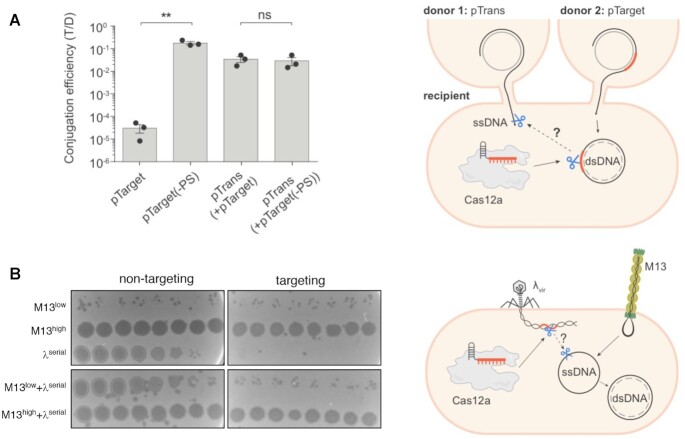
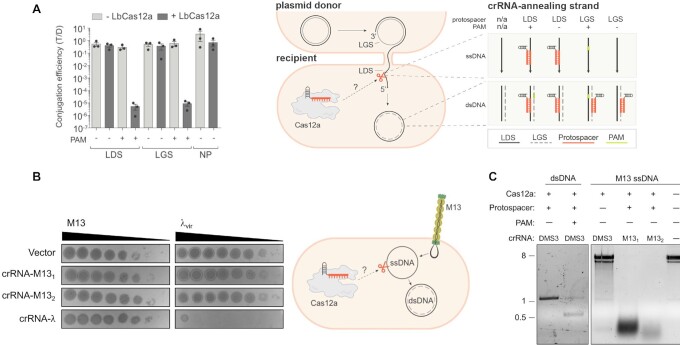
CRISPR-Cas12a (Cpf1) is a bacterial RNA-guided nuclease that cuts double-stranded DNA (dsDNA) at sites specified by a CRISPR RNA (crRNA) guide. Additional activities have been ascribed to this enzyme in vitro: site-specific (cis) single-stranded DNA (ssDNA) cleavage and indiscriminate (trans) degradation of ssDNA, RNA, and dsDNA after activation by a complementary target. The ability of Cas12a to cleave nucleic acids indiscriminately has been harnessed for many applications, including diagnostics, but it remains unknown if it contributes to bacterial immunity. Here, we provide evidence that cleavage of ssDNA in cis or in trans by Cas12a is insufficient to impact immunity. Using LbCas12a expressed in either Pseudomonas aeruginosa or Escherichia coli, we observed that cleavage of dsDNA targets did not elicit cell death or dormancy, suggesting insignificant levels of collateral damage against host RNA or DNA. Canonical immunity against invasive dsDNA also had no impact on the replicative fitness of co-infecting dsDNA phage, ssDNA phage or plasmid in trans. Lastly, crRNAs complementary to invasive ssDNA did not provide protection, suggesting that ssDNA cleavage does not occur in vivo or is insignificant. Overall, these results suggest that CRISPR-Cas12a immunity predominantly occurs via canonical targeting of dsDNA, and that the other activities do not significantly impact infection outcomes.
CRISPR-Cas12a (Cpf1) 是一种细菌 RNA 指导的核酸内切酶,可在 CRISPR RNA (crRNA) 引导下切割双链 DNA (dsDNA)。体外已鉴定出该酶的其他活性:在互补靶标激活后,可特异性(顺式)切割单链 DNA (ssDNA) 和非特异性(反式)降解 ssDNA、RNA 和 dsDNA。Cas12a 切割核酸的非特异性已被用于许多应用,包括诊断,但它是否有助于细菌免疫仍不清楚。在这里,我们提供的证据表明,Cas12a 在顺式或反式切割 ssDNA 不足以影响免疫。使用在铜绿假单胞菌或大肠杆菌中表达的 LbCas12a,我们观察到 dsDNA 靶标切割不会引起细胞死亡或休眠,这表明对宿主 RNA 或 DNA 的附带损伤水平微不足道。针对入侵 dsDNA 的经典免疫也不会对共感染的 dsDNA 噬菌体、ssDNA 噬菌体或质粒的复制适应性产生影响。最后,与入侵 ssDNA 互补的 crRNA 不能提供保护,这表明 ssDNA 切割不会在体内发生或不重要。总的来说,这些结果表明,CRISPR-Cas12a 免疫主要通过靶向 dsDNA 发生,而其他活性对感染结果没有显著影响。