NPSY-Lab.VR, Department of Human Sciences, University of Verona, Lungadige Porta Vittoria, 17, 37129, Verona, Italy.
Groupe d'Imagerie Neurofonctionnelle, Institut des Maladies Neurodégénératives-UMR 5293, CNRS, CEA University of Bordeaux, CS 33076, Bordeaux, France.
Brain Struct Funct. 2022 Dec;227(9):3161-3171. doi: 10.1007/s00429-022-02511-z. Epub 2022 Jun 7.
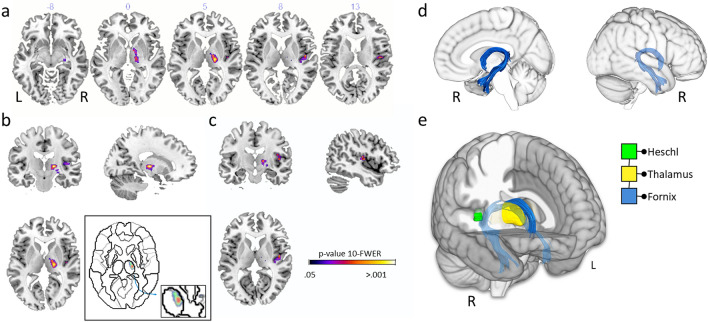
Personal neglect is a disorder in the perception and representation of the body that causes the patients to behave as if the contralesional side of their body does not exist. This clinical condition has not been adequately investigated in the past as it has been considered a symptom of unilateral spatial neglect, which has mainly been studied with reference to extrapersonal space. Only a few studies with small samples have investigated the neuroanatomical correlates of personal neglect, and these have mainly focused on discrete cortical lesions and modular accounts, as well as being based on the hypothesis that this disorder is associated with somatosensory and spatial deficits. In the present study, we tested the novel hypothesis that personal neglect may be associated not only with discrete cortical and subcortical lesions, but also with disconnections of white matter tracts. We performed an advanced lesion analyses in a large sample of 104 right hemisphere damaged patients, 72 of whom were suffering from personal neglect. Results from the analyses of the grey and white matter were controlled for co-occurrent clinical variables such as extrapersonal neglect, anosognosia for hemiplegia and motor deficits, along with other lesion-related variables such as lesion size and the interval from the lesion onset to neuroimaging recordings. Our results reveal that personal neglect is associated with lesions in a medial network which involves the temporal cortex (Heschl's gyrus), the ventro-lateral nuclei of the thalamus and the fornix. This suggests that personal neglect involves a convergence between sensorimotor processes, spatial representation and the processing of self-referred information (episodic memory).
个人忽略是一种对身体的感知和表现的障碍,导致患者表现得好像他们身体的对侧不存在。这种临床情况在过去没有得到充分的研究,因为它被认为是单侧空间忽略的症状,而单侧空间忽略主要是参照外在空间进行研究的。只有少数几个样本量较小的研究调查了个人忽略的神经解剖学相关性,这些研究主要集中在离散的皮质损伤和模块解释上,并且基于这样的假设,即这种障碍与躯体感觉和空间缺陷有关。在本研究中,我们测试了一个新的假设,即个人忽略可能不仅与离散的皮质和皮质下损伤有关,还与白质束的断开有关。我们在一个由 104 名右半球损伤患者组成的大样本中进行了先进的损伤分析,其中 72 名患者患有个人忽略。对灰质和白质的分析结果控制了共发性临床变量,如外在空间忽略、偏瘫和运动缺陷的否认,以及其他与损伤相关的变量,如损伤大小和从损伤发生到神经影像学记录的时间间隔。我们的结果表明,个人忽略与一个涉及颞叶皮层(Heschl 回)、丘脑腹外侧核和穹窿的内侧网络的损伤有关。这表明个人忽略涉及感觉运动过程、空间表现和自我参照信息(情景记忆)的处理之间的融合。