Zelis N, Roumans-van Oijen A M M, Buijs J, van Kraaij D J W, van Kuijk S M J, de Leeuw P W, Stassen P M
Department of Internal Medicine and Gastroenterology, Zuyderland Medical Centre, Sittard-Geleen, The Netherlands.
Department of Internal Medicine, Division of General Internal Medicine, Section Acute Medicine, Maastricht University Medical Centre, Maastricht University, Maastricht, The Netherlands.
Neth Heart J. 2022 Dec;30(12):559-566. doi: 10.1007/s12471-022-01700-z. Epub 2022 Jun 7.
The risk of major adverse cardiovascular events (MACE) for older emergency department (ED) patients presenting with non-cardiac medical complaints is unknown. To apply preventive measures timely, early identification of high-risk patients is incredibly important. We aimed at investigating the incidence of MACE within one year after their ED visit and the predictive value of high-sensitivity cardiac troponin T (hs-cTnT) and N‑terminal pro-B-type natriuretic peptide (NT-proBNP) for subsequent MACE.
This is a substudy of a Dutch prospective cohort study (RISE UP study) in older (≥ 65 years) medical ED patients who presented with non-cardiac complaints. Biomarkers were measured upon ED arrival. Cox-regression analysis was used to determine the predictive value of the biomarkers, when corrected for other possible predictors of MACE, and area under the curves (AUCs) were calculated.
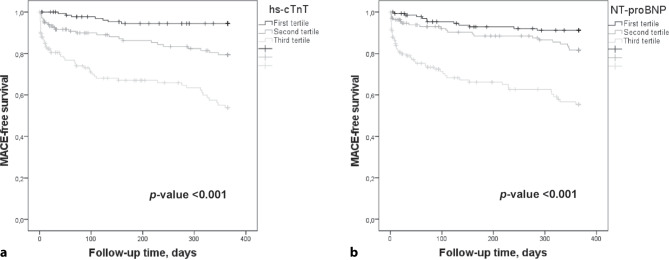
Of 431 patients with a median age of 79 years, 86 (20.0%) developed MACE within 1 year. Both hs-cTnT and NT-proBNP were predictive of MACE with an AUC of 0.74 (95% CI 0.68-0.80) for both, and a hazard ratio (HR) of 2.00 (95% CI 1.68-2.39) and 1.82 (95% CI 1.57-2.11) respectively. Multivariate analysis correcting for other possible predictors of MACE revealed NT-proBNP as an independent predictor of MACE.
Older medical ED patients are at high risk of subsequent MACE within 1 year after their ED visit. While both hs-cTnT and NT-proBNP are predictive, only NT-proBNP is an independent predictor of MACE. It is likely that early identification of those at risk offers a window of opportunity for prevention.
因非心脏疾病就诊的老年急诊科患者发生主要不良心血管事件(MACE)的风险尚不清楚。为了及时采取预防措施,早期识别高危患者极为重要。我们旨在调查这些患者急诊就诊后1年内MACE的发生率,以及高敏心肌肌钙蛋白T(hs-cTnT)和N端前脑钠肽(NT-proBNP)对后续MACE的预测价值。
这是一项荷兰前瞻性队列研究(RISE UP研究)的子研究,研究对象为年龄≥65岁、因非心脏疾病就诊的老年急诊科患者。在患者到达急诊科时检测生物标志物。使用Cox回归分析确定生物标志物的预测价值,并在校正其他可能的MACE预测因素后计算曲线下面积(AUC)。
431例患者的中位年龄为79岁,其中86例(20.0%)在1年内发生了MACE。hs-cTnT和NT-proBNP均对MACE具有预测性,二者的AUC均为0.74(95%CI 0.68-0.80),危险比(HR)分别为2.00(95%CI 1.68-2.39)和1.82(95%CI 1.57-2.11)。校正其他可能的MACE预测因素后的多变量分析显示,NT-proBNP是MACE的独立预测因素。
老年急诊科患者在急诊就诊后1年内发生后续MACE的风险很高。虽然hs-cTnT和NT-proBNP均具有预测性,但只有NT-proBNP是MACE的独立预测因素。早期识别这些高危患者可能为预防提供机会窗口。