UK Health Security Agency, London, UK.
WHO Collaborating Centre for Gonorrhoea and Other STIs, Örebro University, Örebro, Sweden.
BMC Infect Dis. 2022 Jun 7;22(1):524. doi: 10.1186/s12879-022-07509-w.
The European Gonococcal Antimicrobial Surveillance Programme (Euro-GASP) performs annual sentinel surveillance of Neisseria gonorrhoeae susceptibility to therapeutically relevant antimicrobials across the European Union/European Economic Area (EU/EEA). We present the Euro-GASP results from 2019 (26 countries), linked to patient epidemiological data, and compared with data from previous years.
Agar dilution and minimum inhibitory concentration (MIC) gradient strip methodologies were used to determine the antimicrobial susceptibility (using EUCAST clinical breakpoints, where available) of 3239 N. gonorrhoeae isolates from 26 countries across the EU/EEA. Significance of differences compared with Euro-GASP results in previous years was analysed using Z-test and the Pearson's χ2 test was used to assess significance of odds ratios for associations between patient epidemiological data and antimicrobial resistance.
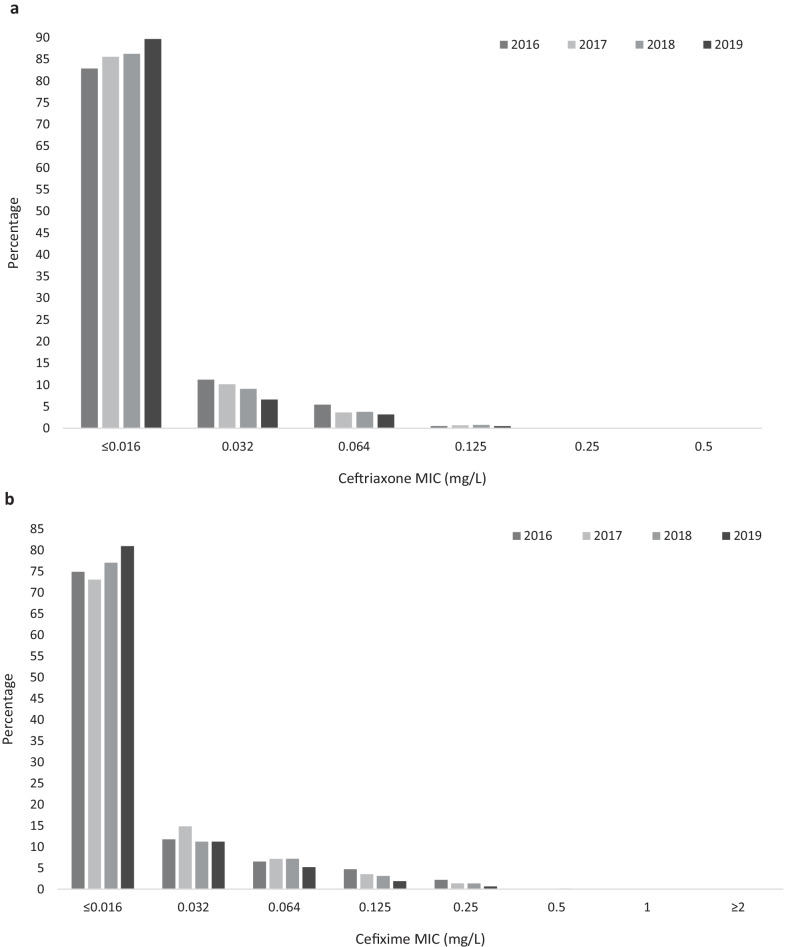
European N. gonorrhoeae isolates collected between 2016 and 2019 displayed shifting MIC distributions for; ceftriaxone, with highly susceptible isolates increasing over time and occasional resistant isolates each year; cefixime, with highly-susceptible isolates becoming increasingly common; azithromycin, with a shift away from lower MICs towards higher MICs above the EUCAST epidemiological cut-off (ECOFF); and ciprofloxacin which is displaying a similar shift in MICs as observed for azithromycin. In 2019, two isolates displayed ceftriaxone resistance, but both isolates had MICs below the azithromycin ECOFF. Cefixime resistance (0.8%) was associated with patient sex, with resistance higher in females compared with male heterosexuals and men-who-have-sex-with-men (MSM). The number of countries reporting isolates with azithromycin MICs above the ECOFF increased from 76.9% (20/26) in 2016 to 92.3% (24/26) in 2019. Isolates with azithromycin MICs above the ECOFF (9.0%) were associated with pharyngeal infection sites. Following multivariable analysis, ciprofloxacin resistance remained associated with isolates from MSM and heterosexual males compared with females, the absence of a concurrent chlamydial infection, pharyngeal infection sites and patients ≥ 25 years of age.
Resistance to ceftriaxone and cefixime remained uncommon in EU/EEA countries in 2019 with a significant decrease in cefixime resistance observed between 2016 and 2019. The significant increase in azithromycin "resistance" (azithromycin MICs above the ECOFF) threatens the effectiveness of the dual therapy (ceftriaxone + azithromycin), i.e., for ceftriaxone-resistant cases, currently recommended in many countries internationally and requires close monitoring.
欧洲淋球菌抗菌监测计划(Euro-GASP)每年对欧盟/欧洲经济区(EU/EEA)治疗相关抗菌药物的淋病奈瑟菌敏感性进行哨点监测。我们报告了 2019 年(26 个国家)的 Euro-GASP 结果,这些结果与患者流行病学数据相关联,并与往年数据进行了比较。
使用琼脂稀释和最小抑菌浓度(MIC)梯度条方法,对来自 EU/EEA 26 个国家的 3239 株淋病奈瑟菌分离株进行抗菌药物敏感性测定(使用 EUCAST 临床断点,如适用)。使用 Z 检验分析与前几年 Euro-GASP 结果的差异,并使用 Pearson χ2 检验评估患者流行病学数据与抗菌药物耐药性之间关联的优势比的显著性。
2016 年至 2019 年间收集的欧洲淋病奈瑟菌分离株对头孢曲松的 MIC 分布发生了变化,表现为高度敏感分离株的数量随着时间的推移而增加,每年都有耐药分离株出现;对头孢克肟的敏感性逐渐升高;对阿奇霉素的敏感性逐渐降低,MIC 向 EUCAST 流行病学截止值(ECOFF)以上的更高 MIC 转移;对环丙沙星的敏感性也发生了类似的 MIC 变化,与阿奇霉素的变化相似。2019 年,有两株分离株对头孢曲松耐药,但两株分离株的 MIC 均低于阿奇霉素的 ECOFF。头孢克肟耐药(0.8%)与患者性别相关,女性比异性恋男性和男男性接触者(MSM)中的耐药率更高。报告阿奇霉素 MIC 高于 ECOFF 的分离株的国家数量从 2016 年的 76.9%(20/26)增加到 2019 年的 92.3%(24/26)。阿奇霉素 MIC 高于 ECOFF(9.0%)的分离株与咽感染部位有关。多变量分析后,与女性相比,MSM 和异性恋男性的分离株仍与环丙沙星耐药相关,同时无衣原体感染、咽感染部位和≥25 岁的患者。
2019 年,欧盟/欧洲经济区国家对头孢曲松和头孢克肟的耐药性仍然罕见,2016 年至 2019 年间头孢克肟耐药性显著下降。阿奇霉素“耐药性”(阿奇霉素 MIC 高于 ECOFF)显著增加,威胁到双重治疗(头孢曲松+阿奇霉素)的有效性,目前在许多国家国际上推荐用于治疗头孢曲松耐药的病例,需要密切监测。