Center for Evidence-Based Healthcare (ZEGV), Faculty of Medicine, University Hospital Carl Gustav Carus and Carl Gustav Carus, TU Dresden, Fetscherstr. 74, 01307, Dresden, Germany.
Tumorzentrum Regensburg - Institut für Qualitätssicherung und Versorgungsforschung, Universität Regensburg, Regensburg, Germany.
BMC Cancer. 2022 Jun 7;22(1):621. doi: 10.1186/s12885-022-09731-w.
Treatment of cancer patients in certified cancer centers, that meet specific quality standards in term of structures and procedures of medical care, is a national treatment goal in Germany. However, convincing evidence that treatment in certified cancer centers is associated with better outcomes in patients with pancreatic cancer is still missing.
We used patient-specific information (demographic characteristics, diagnoses, treatments) from German statutory health insurance data covering the period 2009-2017 and hospital characteristics from the German Standardized Quality Reports. We investigated differences in survival between patients treated in hospitals with and without pancreatic cancer center certification by the German Cancer Society (GCS) using the Kaplan-Meier estimator and Cox regression with shared frailty.
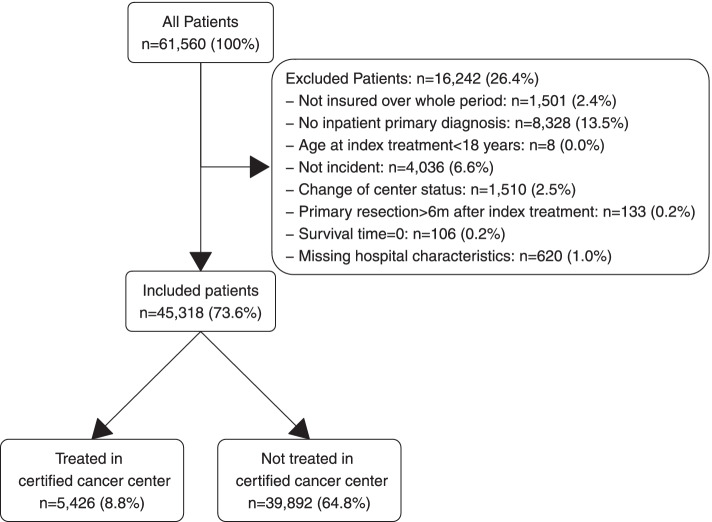
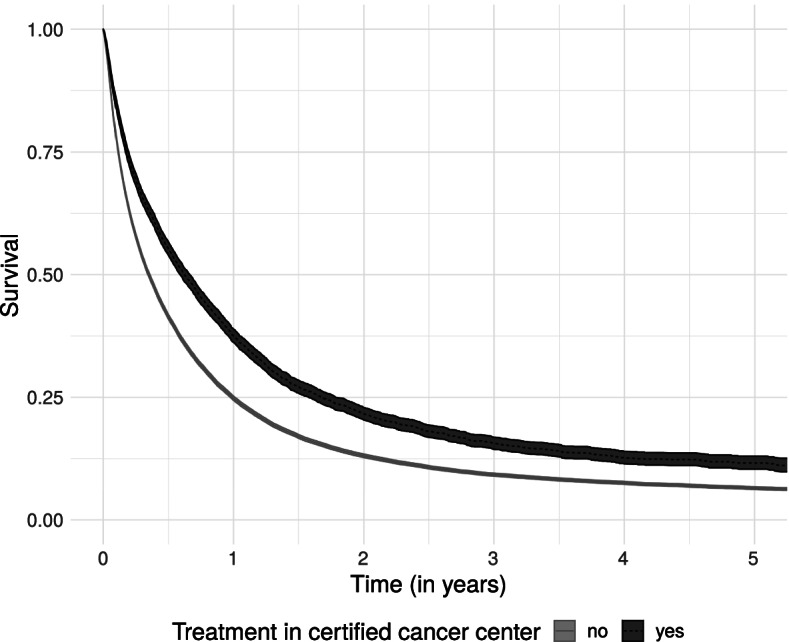
The final sample included 45,318 patients with pancreatic cancer treated in 1,051 hospitals (96 GCS-certified, 955 not GCS-certified). 5,426 (12.0%) of the patients were treated in GCS-certified pancreatic cancer centers. Patients treated in certified and non-certified hospitals had similar distributions of age, sex, and comorbidities. Median survival was 8.0 months in GCS-certified pancreatic cancer centers and 4.4 months in non-certified hospitals. Cox regression adjusting for multiple patient and hospital characteristics yielded a significantly lower hazard of long-term, all-cause mortality in patients treated in GCS-certified pancreatic centers (Hazard ratio = 0.89; 95%-CI = 0.85-0.93). This result remained robust in multiple sensitivity analyses, including stratified estimations for subgroups of patients and hospitals.
This robust observational evidence suggests that patients with pancreatic cancer benefit from treatment in a certified cancer center in terms of survival. Therefore, the certification of hospitals appears to be a powerful strategy to improve patient outcomes in pancreatic cancer care.
ClinicalTrials.gov ( NCT04334239 ).
在德国,将癌症患者治疗于符合医疗结构和程序特定质量标准的认证癌症中心是国家治疗目标。然而,仍缺乏令人信服的证据表明,在胰腺癌患者中,经认证的癌症中心治疗与更好的结果相关。
我们使用了德国法定健康保险数据中涵盖 2009-2017 年期间的患者特定信息(人口统计学特征、诊断、治疗)和德国标准化质量报告中的医院特征。我们使用 Kaplan-Meier 估计器和具有共享脆弱性的 Cox 回归,调查了在德国癌症协会(GCS)认证的和未认证的癌症中心治疗的患者之间的生存差异。
最终样本包括 45318 名在 1051 家医院(96 家 GCS 认证,955 家未认证)接受胰腺癌治疗的患者。其中 5426 名(12.0%)患者在 GCS 认证的胰腺癌中心接受治疗。在认证和未认证的医院接受治疗的患者在年龄、性别和合并症方面的分布相似。在 GCS 认证的胰腺癌中心治疗的患者中位生存期为 8.0 个月,在未认证的医院治疗的患者中位生存期为 4.4 个月。在调整了多个患者和医院特征后,Cox 回归分析显示,在 GCS 认证的胰腺癌中心治疗的患者长期全因死亡率的风险显著降低(危险比=0.89;95%可信区间=0.85-0.93)。这一结果在包括对患者和医院亚组的分层估计的多次敏感性分析中仍然稳健。
这项强有力的观察性证据表明,胰腺癌患者从认证癌症中心的治疗中获益,提高了生存。因此,医院的认证似乎是提高胰腺癌治疗患者结局的有力策略。
ClinicalTrials.gov(NCT04334239)。