. Departamento de Anatomia e Imagem, Faculdade de Medicina, Universidade Federal de Minas Gerais - UFMG - Belo Horizonte (MG) Brasil.
. Departamento do Aparelho Locomotor, Faculdade de Medicina, Universidade Federal de Minas Gerais - UFMG - Belo Horizonte (MG) Brasil.
J Bras Pneumol. 2022 Jun 6;48(4):e20210329. doi: 10.36416/1806-3756/e20210329. eCollection 2022.
To investigate the correlation of HRCT findings with pulmonary metabolic activity in the corresponding regions using 18F-FDG PET/CT and inflammatory markers in patients with systemic sclerosis (SSc)-associated interstitial lung disease (ILD).
This was a cross-sectional study involving 23 adult patients with SSc-associated ILD without other connective tissue diseases. The study also involved 18F-FDG PET/CT, HRCT, determination of serum chemokine levels, clinical data, and pulmonary function testing.
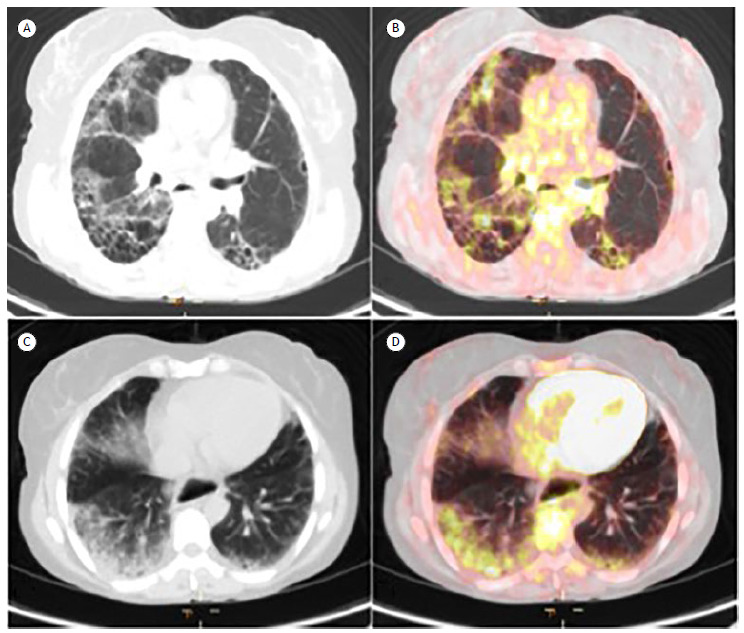
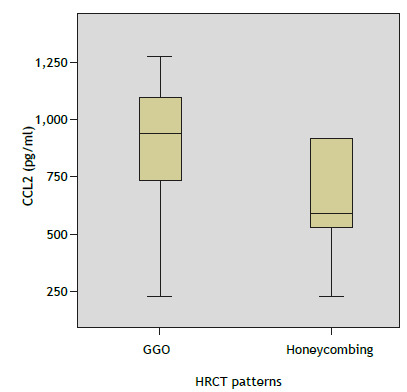
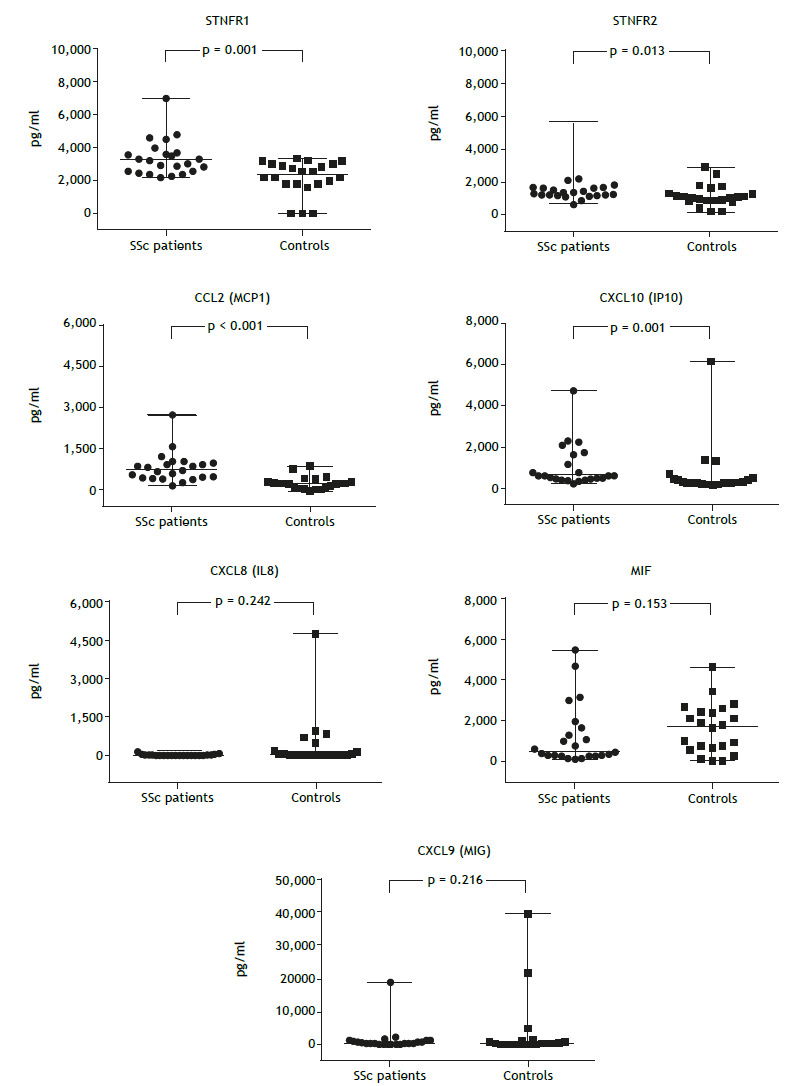
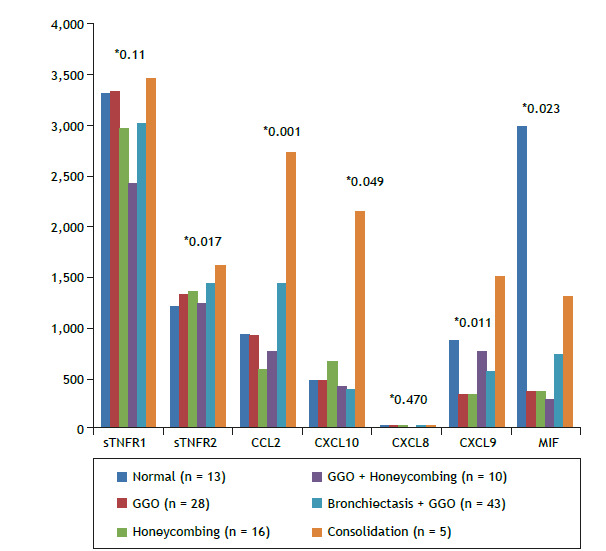
In this cohort of patients with long-term disease (disease duration, 11.8 ± 8.7 years), a nonspecific interstitial pneumonia pattern was found in 19 (82.6%). Honeycombing areas had higher median standardized uptake values (1.95; p = 0.85). Serum levels of soluble tumor necrosis factor receptor 1, soluble tumor necrosis factor receptor 2, C-C motif chemokine ligand 2 (CCL2), and C-X-C motif chemokine ligand 10 were higher in SSc patients than in controls. Serum levels of CCL2-a marker of fibroblast activity-were correlated with pure ground-glass opacity (GGO) areas on HRCT scans (p = 0.007). 18F-FDG PET/CT showed significant metabolic activity for all HRCT patterns. The correlation between serum CCL2 levels and GGO on HRCT scans suggests a central role of fibroblasts in these areas, adding new information towards the understanding of the mechanisms surrounding cellular and molecular elements and their expression on HRCT scans in patients with SSc-associated ILD.
18F-FDG PET/CT appears to be unable to differentiate the intensity of metabolic activity across HRCT patterns in chronic SSc patients. The association between CCL2 and GGO might be related to fibroblast activity in these areas; however, upregulated CCL2 expression in the lung tissue of SSc patients should be investigated in order to gain a better understanding of this association.
使用 18F-FDG PET/CT 及炎症标志物研究系统性硬化症(SSc)相关间质性肺病(ILD)患者肺部代谢活性与相应区域高分辨率 CT(HRCT)表现的相关性。
这是一项横断面研究,纳入了 23 例无其他结缔组织病的 SSc 相关 ILD 成年患者。研究还包括 18F-FDG PET/CT、HRCT、血清趋化因子水平测定、临床资料和肺功能检测。
在这组患有长期疾病(病程 11.8±8.7 年)的患者中,19 例(82.6%)存在非特异性间质性肺炎模式。蜂窝区域的标准化摄取值中位数更高(1.95;p=0.85)。与对照组相比,SSc 患者的可溶性肿瘤坏死因子受体 1、可溶性肿瘤坏死因子受体 2、C-C 基序趋化因子配体 2(CCL2)和 C-X-C 基序趋化因子配体 10 血清水平更高。血清 CCL2-成纤维细胞活性标志物-与 HRCT 扫描中的纯磨玻璃密度(GGO)区域相关(p=0.007)。18F-FDG PET/CT 显示所有 HRCT 模式均存在显著代谢活性。血清 CCL2 水平与 HRCT 扫描中的 GGO 之间的相关性表明,成纤维细胞在这些区域中起核心作用,为理解 SSc 相关 ILD 患者细胞和分子成分及其在 HRCT 扫描中的表达机制提供了新信息。
18F-FDG PET/CT 似乎无法区分慢性 SSc 患者 HRCT 模式之间代谢活性的强度。CCL2 与 GGO 的关联可能与这些区域的成纤维细胞活性有关;然而,应进一步研究 SSc 患者肺组织中上调的 CCL2 表达,以更好地理解这种关联。