Department of Epidemiology, Erasmus MC University Medical Center, Rotterdam, The Netherlands.
Department of Child and Adolescent Psychiatry/Psychology, Erasmus MC University Medical Center, Rotterdam, The Netherlands.
Soc Psychiatry Psychiatr Epidemiol. 2022 Dec;57(12):2469-2479. doi: 10.1007/s00127-022-02308-9. Epub 2022 Jun 8.
Psychosocial health problems, such as social isolation, loneliness, depression and anxiety, have gained attention during the COVID-19 pandemic and are commonly co-occurring. We investigated the network of psychosocial health constructs during the COVID-19 pandemic.
This study included 4553 participants (mean age: 68.6 ± 11.2 years, 56% women) from the prospective Rotterdam Study, who filled out a questionnaire between April and July 2020, the time of the first COVID-19 wave in the Netherlands. Psychosocial health constructs included were depressive symptoms (Center for Epidemiological Studies Depression scale), anxiety symptoms (Hospital Anxiety and Depression scale), loneliness (University of California, Los Angeles loneliness scale), social connectedness (five items) and pandemic-related worry (five items). We estimated mixed graphical models to assess the network of items of these constructs and whether age and sex affected the network structure.
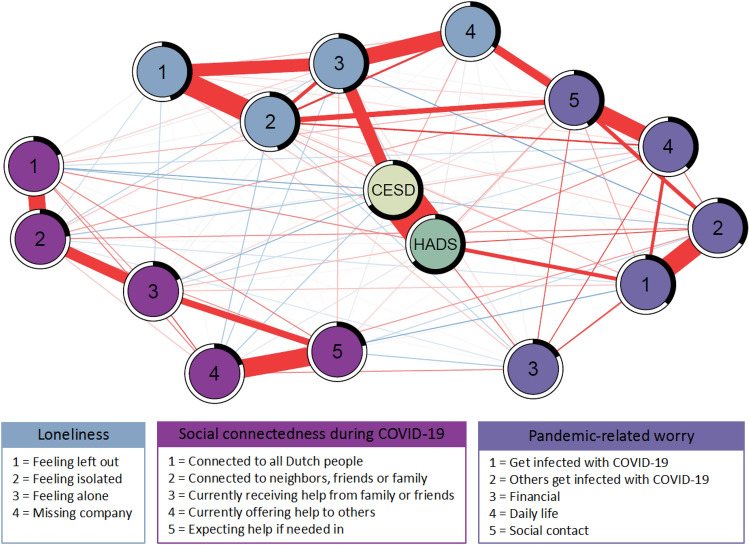
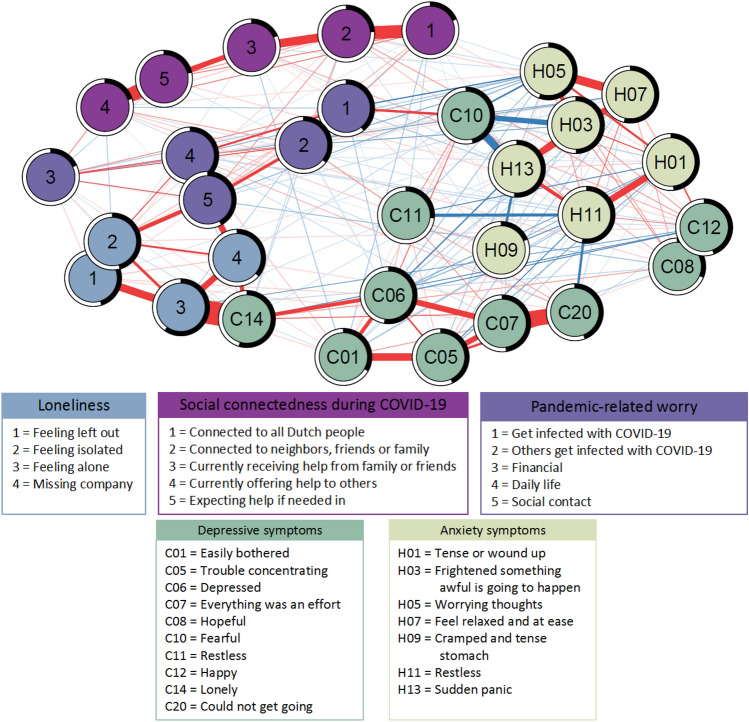
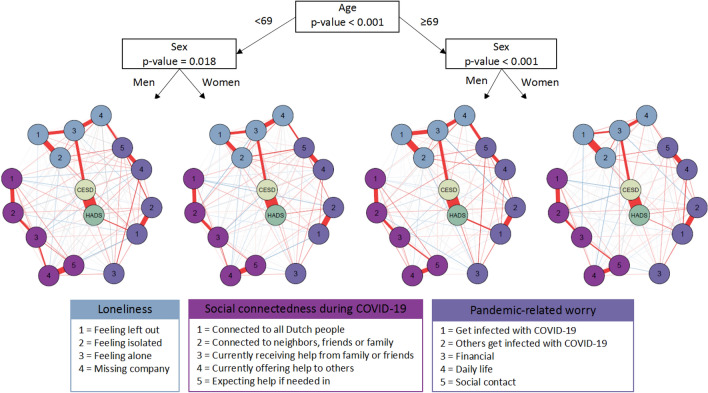
Within the network of psychosocial constructs, a higher depressive symptoms score was particularly associated with items of loneliness and social connectedness, whereas overall anxiety was particularly associated with items of pandemic-related worry. Between people from different sex and age, the network structure significantly altered.
This study demonstrates that within the same network of psychosocial health constructs, depressive symptom score is particularly associated with loneliness and social connectedness, whereas anxiety symptom score is associated with pandemic-related worry during the first COVID-19 lockdown. Our results support that psychosocial constructs should be considered in conjunction with one another in prevention and treatment efforts in clinical care, and that these efforts need to be tailored to specific demographic groups.
在 COVID-19 大流行期间,社会隔离、孤独、抑郁和焦虑等心理社会健康问题引起了关注,且这些问题通常同时发生。我们调查了 COVID-19 大流行期间心理社会健康结构的网络。
本研究纳入了前瞻性鹿特丹研究中的 4553 名参与者(平均年龄:68.6±11.2 岁,56%为女性),他们于 2020 年 4 月至 7 月期间在荷兰首次 COVID-19 浪潮期间填写了一份问卷。心理社会健康结构包括抑郁症状(流行病学研究中心抑郁量表)、焦虑症状(医院焦虑和抑郁量表)、孤独感(加州大学洛杉矶分校孤独量表)、社交联系(五个项目)和与大流行相关的担忧(五个项目)。我们估计了混合图形模型,以评估这些结构的项目网络,以及年龄和性别是否影响网络结构。
在心理社会结构的网络中,较高的抑郁症状评分特别与孤独和社交联系的项目相关,而整体焦虑特别与与大流行相关的担忧项目相关。在不同性别和年龄的人群之间,网络结构发生了显著变化。
本研究表明,在相同的心理社会健康结构网络中,抑郁症状评分特别与孤独和社交联系相关,而焦虑症状评分与 COVID-19 封锁期间的与大流行相关的担忧相关。我们的研究结果支持在临床护理中应将心理社会结构相互结合起来考虑,并且这些努力需要针对特定的人口统计学群体进行调整。