Semati Ali, Zare Azimeh, Zare Marjan, Mirahmadizadeh Alireza, Ebrahimi Mostafa
Non-Communicable Diseases Research Center, Shiraz University of Medical Sciences, Shiraz, Iran.
Department of Anesthesiology, Gerash University of Medical Sciences, Gerash, Fars, Iran.
Can J Infect Dis Med Microbiol. 2022 May 30;2022:4965411. doi: 10.1155/2022/4965411. eCollection 2022.
Using time series and spatiotemporal analyses, this study aimed to establish an Early Warning System (EWS) for COVID-19 in Fars province Iran.
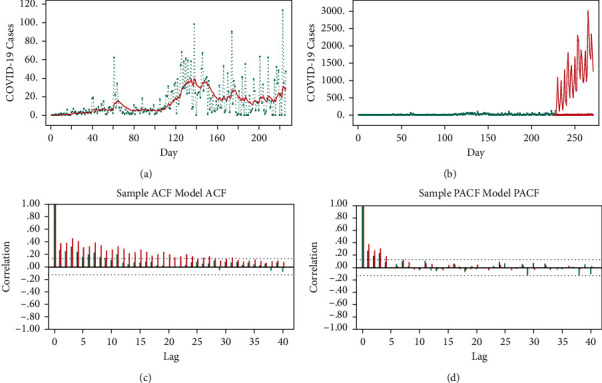
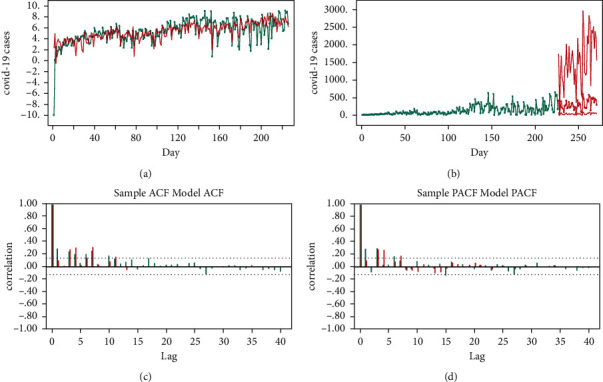
A EWS was conducted on (i) daily basis city-level time series data including 53 554 cases recorded during 18 February-30 September 2020, which were applied to forecast COVID-19 cases during 1 October-14 November 2020, and (ii) the spatiotemporal analysis, which was conducted on the forecasted cases to predict spatiotemporal outbreaks of COVID-19.
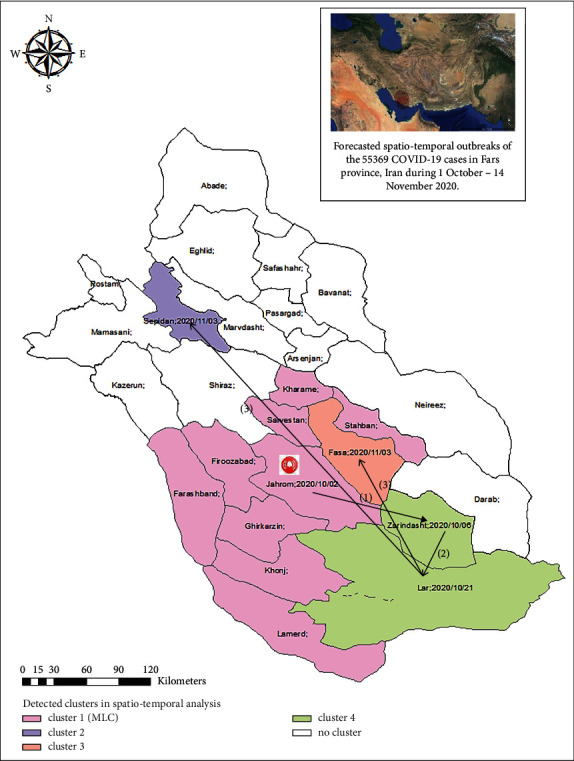
A total of 55 369 cases were forecasted during 1 October-14 November 2020, most of which (26.9%) occurred in Shiraz. In addition, 65.80% and 34.20% of the cases occurred in October and November, respectively. Four significant spatiotemporal outbreaks were predicted, with the Most Likely Cluster (MLC) occurring in ten cities during 2-22 October ( < 0.001 for all). Moreover, subgroup analysis demonstrated that Zarrindasht was the canon of the epidemic on 6 October (=0.04). As a part of EWS, the epidemic was triggered from Jahrom, involving the MLC districts in the center, west, and south parts of the province. Then, it showed a tendency to move towards Zarrindasht in the south and progress to Lar in the southernmost part. Afterwards, it simultaneously progressed to Fasa and Sepidan in the central and northwestern parts of the province, respectively.
EWS, which was established based on the current protocol, alarmed policymakers and health managers on the progression of the epidemic and on where and when to implement medical facilities. These findings can be used to tailor province-level policies to servile the ongoing epidemic in the area; however, governmental level effort is needed to control the epidemic at a larger scale in the future.
本研究采用时间序列和时空分析方法,旨在建立伊朗法尔斯省新冠肺炎早期预警系统(EWS)。
EWS基于以下两方面开展:(i)每日城市层面的时间序列数据,包括2020年2月18日至9月30日记录的53554例病例,用于预测2020年10月1日至11月14日的新冠肺炎病例;(ii)时空分析,对预测病例进行分析以预测新冠肺炎的时空爆发情况。
2020年10月1日至11月14日共预测到55369例病例,其中大部分(26.9%)发生在设拉子。此外,65.80%和34.20%的病例分别发生在10月和11月。预测到4次显著的时空爆发,最可能聚集区(MLC)于10月2日至22日在10个城市出现(所有情况P<0.001)。此外,亚组分析表明,10月6日扎林达什特是疫情的中心(P=0.04)。作为EWS的一部分,疫情从贾赫罗姆引发,涉及该省中部、西部和南部的MLC地区。然后,它显示出向南朝着扎林达什特移动并向最南部的拉尔发展的趋势。之后,它同时分别向该省中部的法萨和西北部的塞皮丹发展。
基于当前方案建立的EWS向政策制定者和卫生管理人员警示了疫情的发展情况以及在何处和何时实施医疗设施。这些发现可用于制定省级政策以应对该地区当前的疫情;然而,未来需要政府层面的努力以在更大范围内控制疫情。