Wagner Maude, Guimond Anne-Josée, Kubzansky Laura D, Zhang Yingzhe, Bennett David A, Barnes Lisa L, Grodstein Francine
Rush Alzheimer's Disease Center, Rush University Medical Center, Chicago, Illinois, USA.
Department of Social and Behavioral Sciences, Harvard T.H. Chan School of Public Health, Boston, Massachusetts, USA.
Innov Aging. 2022 Apr 1;6(3):igac019. doi: 10.1093/geroni/igac019. eCollection 2022.
Identifying potential intervention strategies to reduce cognitive decline, particularly among older African Americans at high risk for Alzheimer's dementia, is critical. This study aimed to investigate whether depressive symptoms, purpose in life, and their interrelations are associated with cognitive decline in older African Americans.
We included older African Americans from the Minority Aging Research Study ( = 748) and Rush Memory and Aging Project ( = 109), without dementia at baseline. We assessed associations of depressive symptoms, purpose in life, and their interrelations, with baseline levels and change in global cognition using linear mixed-effects models.
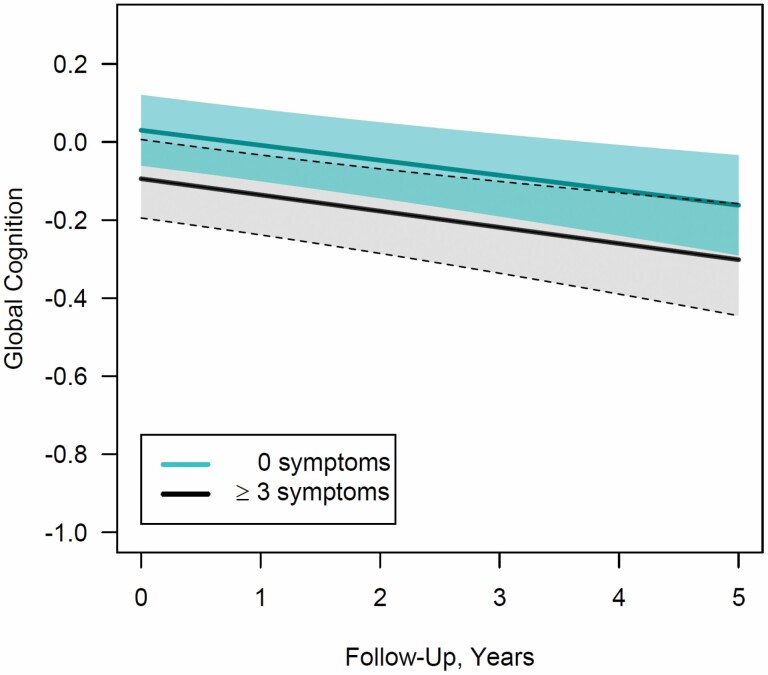
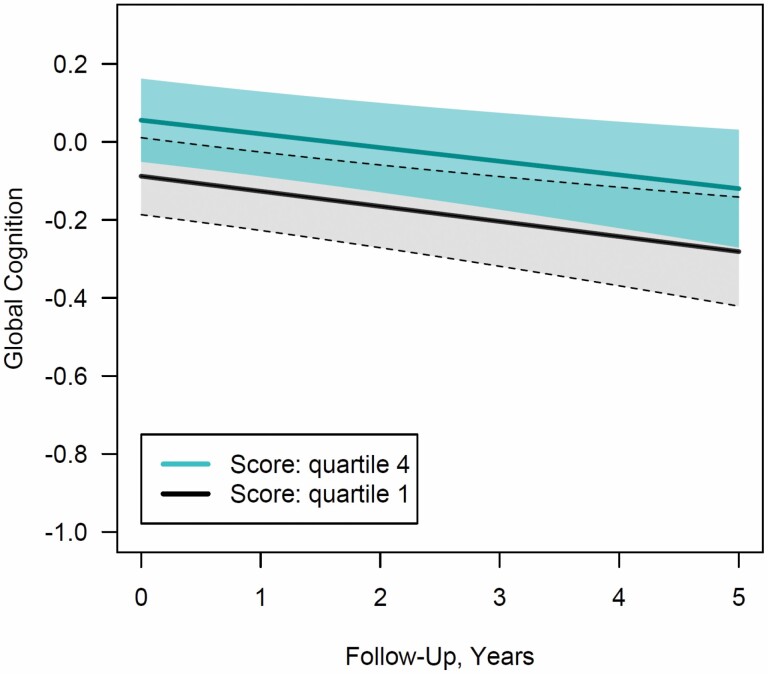
At baseline, each unit increment in depressive symptoms was related to worse initial global cognition (mean difference = -0.03 standard unit; = .003), while higher purpose in life was related to better cognition (mean difference = 0.12; = .002). Further, participants with ≥1 depressive symptom who had a purpose in life score above the median appeared to have better global cognition (mean difference = 0.10; = .01), compared to those with depressive symptoms but lower levels of purpose in life. However, we did not find relations of depressive symptoms or purpose in life with rates of cognitive decline over time, likely due to the modest follow-up.
In older African Americans, we found that lower depressive symptoms and greater purpose in life were independently related to higher initial levels of global cognition, but not cognitive decline. Preliminary findings of higher global cognition in individuals with depressive symptoms but greater purpose in life merit further investigation if purpose may eventually be considered as an intervention.
确定潜在的干预策略以减少认知衰退,尤其是在患阿尔茨海默病痴呆症高风险的老年非裔美国人中,这一点至关重要。本研究旨在调查抑郁症状、生活目的及其相互关系是否与老年非裔美国人的认知衰退有关。
我们纳入了来自少数族裔衰老研究(n = 748)和拉什记忆与衰老项目(n = 109)的无痴呆症的老年非裔美国人。我们使用线性混合效应模型评估了抑郁症状、生活目的及其相互关系与全球认知的基线水平和变化之间的关联。
在基线时,抑郁症状每增加一个单位与初始全球认知较差有关(平均差异 = -0.03标准单位;P = 0.003),而较高的生活目的与较好的认知有关(平均差异 = 0.12;P = 0.002)。此外,与那些有抑郁症状但生活目的水平较低的人相比,有≥1种抑郁症状且生活目的得分高于中位数的参与者似乎有更好的全球认知(平均差异 = 0.10;P = 0.01)。然而,我们没有发现抑郁症状或生活目的与随时间的认知衰退率之间的关系,可能是由于随访时间较短。
在老年非裔美国人中,我们发现较低的抑郁症状和较高的生活目的分别与较高的初始全球认知水平有关,但与认知衰退无关。如果生活目的最终可能被视为一种干预措施,那么有抑郁症状但生活目的较强的个体具有较高全球认知这一初步发现值得进一步研究。