Department of Psychology, University of British Columbia, Vancouver, Canada; Department of Social and Behavioral Sciences, Harvard T.H. Chan School of Public Health, Boston, MA, United States of America; Lee Kum Sheung Center for Health and Happiness, Harvard T.H. Chan School of Public Health, Boston, MA, United States of America; Human Flourishing Program, Institute for Quantitative Social Science, Harvard University, Cambridge, MA, United States of America.
Department of Social and Behavioral Sciences, Harvard T.H. Chan School of Public Health, Boston, MA, United States of America.
Prev Med. 2020 Oct;139:106172. doi: 10.1016/j.ypmed.2020.106172. Epub 2020 Jun 25.
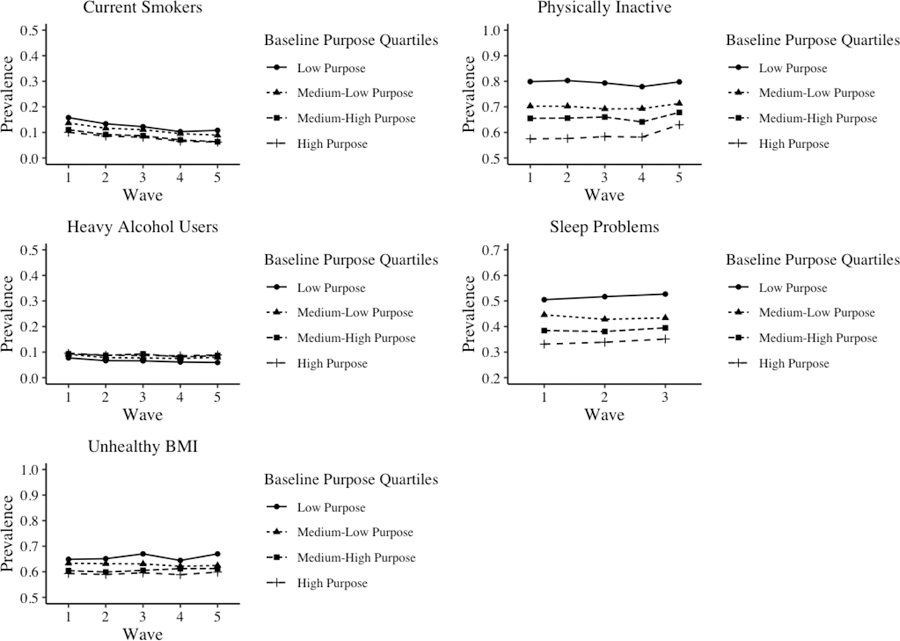
Accumulating evidence shows that a higher sense of purpose in life is associated with lower risk of chronic conditions and premature mortality. Health behaviors might partially explain these findings, however, the prospective association between sense of purpose and health behaviors is understudied. We tested whether a higher sense of purpose at baseline was associated with lower likelihood of developing unhealthy behaviors over time. Prospective data were from the Health and Retirement Study, a national sample of U.S. older adults. Our sample included 13,770 adults assessed up to five times across eight years. Among people who met recommended guidelines for a given health behavior outcome at baseline, those in the top versus lowest quartile of purpose in life had 24% lower likelihood of becoming physically inactive (95% CI: 0.68-0.85), 33% lower likelihood of developing sleep problems (95% CI: 0.58-0.79), and 22% lower likelihood of developing unhealthy body mass index (BMI) (95% CI: 0.69-0.87) in sociodemographic-adjusted models. Further there was a marginal reduction in smoking relapse (HR = 0.65, 95% CI: 0.41-1.03) and no association with heavy alcohol use (HR = 1.02, 95% CI: 0.81-1.29). Findings for physical inactivity, sleep problems, and unhealthy BMI remained evident after further adjusting for baseline health status and depression. Our results, suggest that a sense of purpose in life might emerge (with further research) as a valuable target to consider for interventions aimed at helping older adults maintain some health behaviors.
越来越多的证据表明,更高的生活目标感与更低的慢性病风险和早逝风险相关。健康行为可能部分解释了这些发现,但生活目标感与健康行为之间的前瞻性关联研究还不够充分。我们检验了基线时更高的生活目标感是否与随着时间的推移发展为不健康行为的可能性降低有关。前瞻性数据来自美国老年人健康与退休研究(Health and Retirement Study),这是一项美国老年人的全国性样本。我们的样本包括在八年中评估了多达五次的 13770 名成年人。在基线时符合给定健康行为结果建议指南的人群中,生活目标感最高和最低四分位数的人群中,体力活动减少的可能性低 24%(95%CI:0.68-0.85),出现睡眠问题的可能性低 33%(95%CI:0.58-0.79),不健康体重指数(BMI)的可能性低 22%(95%CI:0.69-0.87)。在社会人口因素调整模型中,吸烟复发的风险也有边际降低(HR=0.65,95%CI:0.41-1.03),与大量饮酒无关(HR=1.02,95%CI:0.81-1.29)。在进一步调整基线健康状况和抑郁状况后,体力活动减少、睡眠问题和不健康 BMI 的发现仍然存在。我们的研究结果表明,生活目标感可能会出现(随着进一步研究),成为帮助老年人保持某些健康行为的干预措施的一个有价值的目标。