Li Hong-Qi, Feng Yi-Wei, Yang Yu-Xiang, Leng Xin-Yi, Zhang Prof Can, Chen Shi-Dong, Kuo Kevin, Huang Shu-Yi, Zhang Xue-Qing, Dong Yi, Han Xiang, Cheng Xin, Cui Mei, Tan Lan, Dong Qiang, Yu Jin-Tai
Department of Neurology and Institute of Neurology, Huashan Hospital, State Key Laboratory of Medical Neurobiology and MOE Frontiers Center for Brain Science, Shanghai Medical College, Fudan University, Shanghai, China.
Department of Medicine and Therapeutics, Prince of Wales Hospital, The Chinese University of Hong Kong, Hong Kong, China.
J Stroke. 2022 May;24(2):236-244. doi: 10.5853/jos.2021.01340. Epub 2022 May 31.
To explore the causal relationships of elements of the exposome with ischemic stroke and its subtypes at the omics level and to provide evidence for stroke prevention.
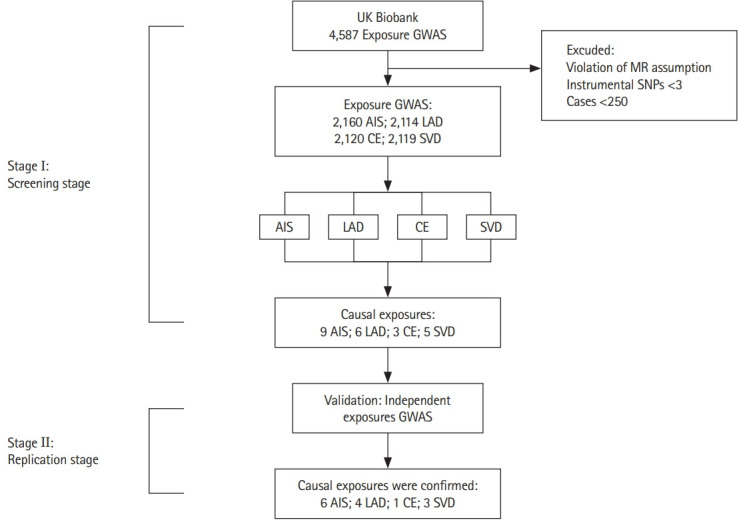
We conducted a Mendelian randomization study between exposure and any ischemic stroke (AIS) and its subtypes (large-artery atherosclerotic disease [LAD], cardioembolic stroke [CE], and small vessel disease [SVD]). The exposure dataset was the UK Biobank involving 361,194 subjects, and the outcome dataset was the MEGASTROKE consortium including 52,000 participants.
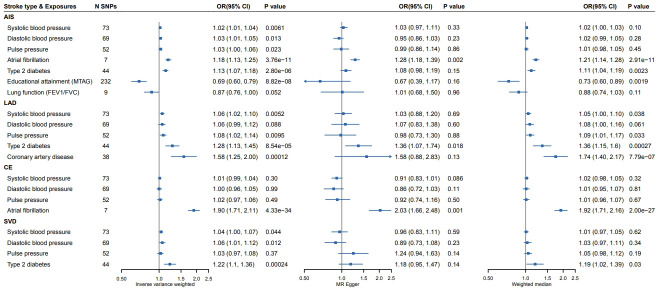
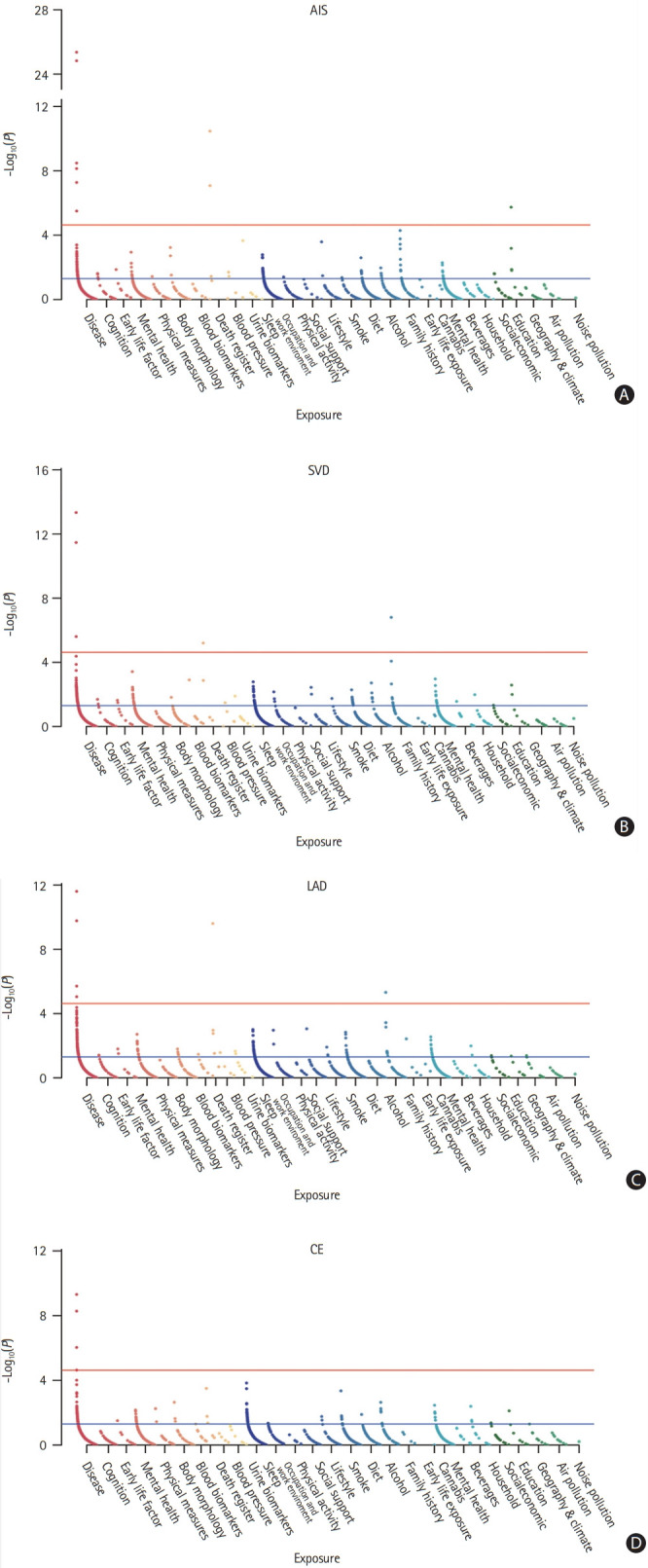
We found that higher blood pressure (BP) (systolic BP: odds ratio [OR], 1.02; 95% confidence interval [CI], 1.01 to 1.04; diastolic BP: OR, 1.03; 95% CI, 1.01 to 1.05; pulse pressure: OR, 1.03; 95% CI, 1.00 to 1.06), atrial fibrillation (OR, 1.18; 95% CI, 1.13 to 1.25), and diabetes (OR, 1.13; 95% CI, 1.07 to 1.18) were significantly associated with ischemic stroke. Importantly, higher education (OR, 0.69; 95% CI, 0.60 to 0.79) decreased the risk of ischemic stroke. Higher systolic BP (OR, 1.06; 95% CI, 1.02 to 1.10), pulse pressure (OR, 1.08; 95% CI, 1.02 to 1.14), diabetes (OR, 1.28; 95% CI, 1.13 to 1.45), and coronary artery disease (OR, 1.58; 95% CI, 1.25 to 2.00) could cause LAD. Atrial fibrillation could cause CE (OR, 1.90; 95% CI, 1.71 to 2.11). For SVD, higher systolic BP (OR, 1.04; 95% CI, 1.00 to 1.07), diastolic BP (OR, 1.06; 95% CI, 1.01 to 1.12), and diabetes (OR, 1.22; 95% CI, 1.10 to 1.36) were causal factors.
The study revealed elements of the exposome causally linked to ischemic stroke and its subtypes, including conventional causal risk factors and novel protective factors such as higher education.
在组学水平上探索暴露组因素与缺血性卒中及其亚型之间的因果关系,为卒中预防提供依据。
我们在暴露因素与任何缺血性卒中(AIS)及其亚型(大动脉粥样硬化疾病[LAD]、心源性栓塞性卒中[CE]和小血管疾病[SVD])之间进行了孟德尔随机化研究。暴露数据集为英国生物银行,涉及361,194名受试者,结局数据集为MEGASTROKE联盟,包括52,000名参与者。
我们发现,较高的血压(BP)(收缩压:优势比[OR],1.02;95%置信区间[CI],1.01至1.04;舒张压:OR,1.03;95%CI,1.01至1.05;脉压:OR,1.03;95%CI,1.00至1.06)、心房颤动(OR,1.18;95%CI,1.13至1.25)和糖尿病(OR,1.13;95%CI,1.07至1.18)与缺血性卒中显著相关。重要的是,高等教育(OR,0.69;95%CI,0.60至0.79)可降低缺血性卒中风险。较高的收缩压(OR,1.06;95%CI,1.02至1.10)、脉压(OR,1.08;95%CI,1.02至1.14)、糖尿病(OR,1.28;95%CI,1.13至1.45)和冠状动脉疾病(OR,1.58;95%CI,1.25至2.00)可导致LAD。心房颤动可导致CE(OR,1.90;95%CI,1.71至2.11)。对于SVD,较高的收缩压(OR,1.04;95%CI,1.00至1.07)、舒张压(OR,1.06;95%CI,1.01至1.12)和糖尿病(OR,1.22;95%CI,1.10至1.36)是因果因素。
该研究揭示了暴露组中与缺血性卒中及其亚型存在因果联系的因素,包括传统的因果风险因素和诸如高等教育等新的保护因素。