Université de Paris, Paris, France; Assistance Publique-Hôpitaux de Paris, Hôpital Saint-Louis, Hemato-oncologie, Paris.
Assistance Publique-Hôpitaux de Paris, Hopital Saint-Louis, Medecine Nucléaire, Paris.
Haematologica. 2023 Jan 1;108(1):171-180. doi: 10.3324/haematol.2021.280550.
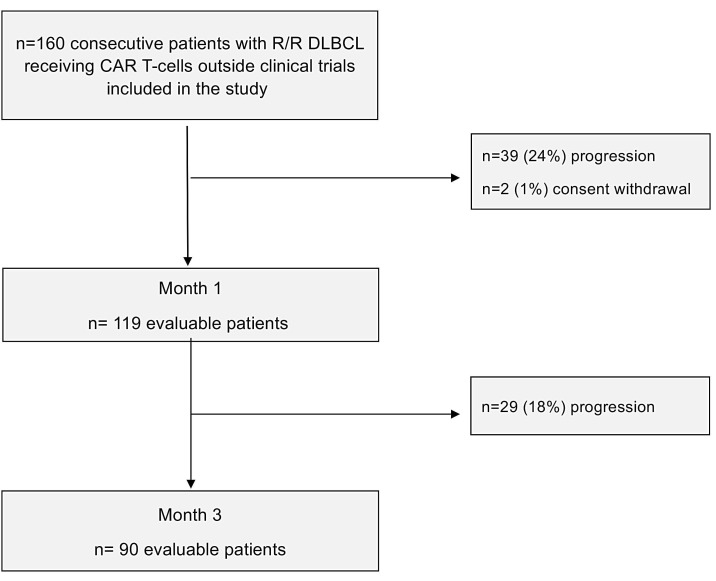
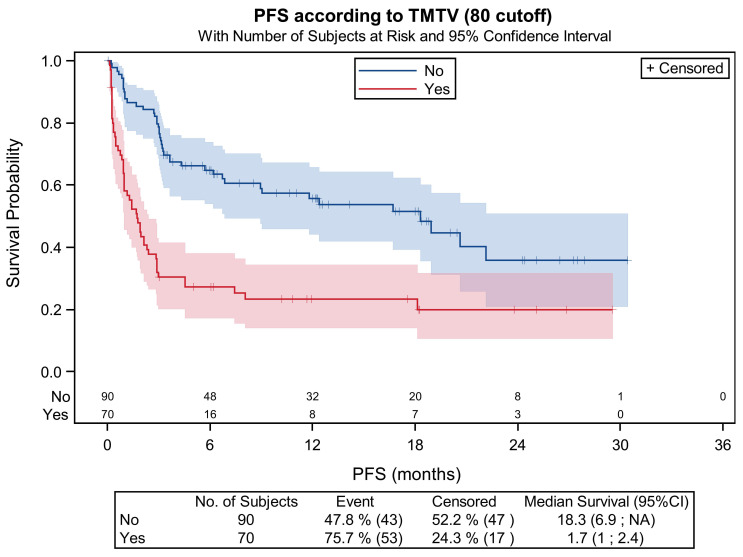
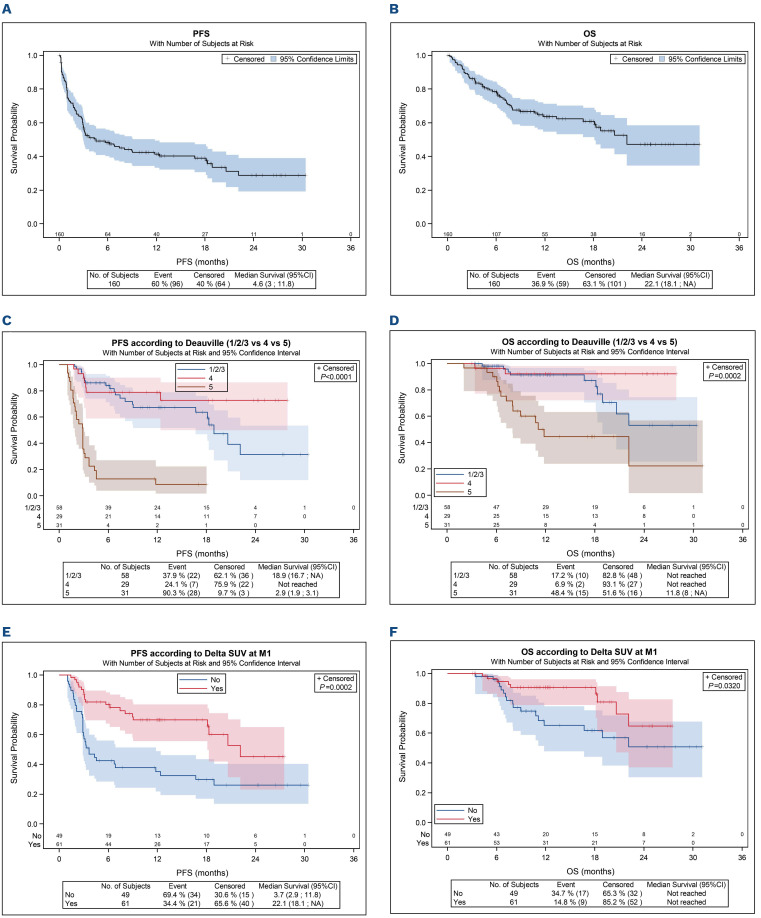
The aim of this study was to evaluate the prognostic impact of the F-fluorodeoxyglucose positron emission tomography response at 1 month (M1) and 3 months (M3) after anti-CD19 chimeric antigen receptor (CAR) T-cell therapy in a multicenter cohort of 160 patients with relapsed/refractory large B-cell lymphomas (R/R LBCL). In total, 119 (75%) patients reached M1 evaluation; 64 (53%, 64/119) had a complete response (CR); 91% were Deauville Score (DS) 1-3. Progressionfree survival (PFS) and overall survival (OS) were significantly worse in patients with DS-5 at M1, than in patients with DS 1-3 (PFS hazard ratio [HR]=6.37, 95% confidence interval [CI]: 3.5-11.5 vs. OS HR=3.79, 95% CI: 1.7-8.5) and DS-4 (PFS HR=11.99, 95% CI: 5.0-28.9 vs. OS HR=12.49, 95% CI: 2.8-55.8). The 1-year PFS rates were 78.9% (95% CI: 58.9-89.9) for DS-4 at M1, similar to 67.3% (95% CI: 51.8-78.8) for patients with DS 1-3 at M1, very different to 8.6% (95% CI: 1.8-22.4) for DS-5, respectively. Only eight of 30 (26%) patients with DS-4 progressed. Response at M3 evaluated in 90 (57%) patients was prognostic for PFS with lower discrimination (HR=3.28, 95% CI: 1.5-7.0; P=0.003) but did not predict OS (HR=0.61, 95% CI: 0.2-2.3; P=0.45). Patients with a high baseline total metabolic tumor volume (TMTV) >80 mL had worse PFS (HR=2.05, 95% CI: 1.2-3.5; P=0.009) and OS (HR=4.52, 95% CI: 2.5-8.1; P<0.001) than patients with low TMTV. Multivariable analyses identified baseline elevated lactate dehydrogenase, DS-5, CAR T cells at M1 for PFS and baseline elevated lactate dehydrogenase, TMTV >80 mL, and DS-5 at M1 for OS. In conclusion, baseline TMTV and response at M1 strongly predicts outcomes of patients with R/R LBCL undergoing CAR T-cell therapy.
本研究旨在评估 160 例复发/难治性大 B 细胞淋巴瘤(R/R LBCL)患者在接受抗 CD19 嵌合抗原受体(CAR)T 细胞治疗后 1 个月(M1)和 3 个月(M3)时的 F-氟脱氧葡萄糖正电子发射断层扫描(PET)反应对预后的影响。共有 119 例(75%)患者达到 M1 评估;64 例(53%,64/119)完全缓解(CR);91%的患者为 Deauville 评分(DS)1-3。M1 时 DS-5 的患者无进展生存(PFS)和总生存(OS)显著差于 DS-1-3 的患者(PFS 危险比[HR]=6.37,95%置信区间[CI]:3.5-11.5 vs. OS HR=3.79,95% CI:1.7-8.5)和 DS-4 的患者(PFS HR=11.99,95% CI:5.0-28.9 vs. OS HR=12.49,95% CI:2.8-55.8)。M1 时 DS-4 的 1 年 PFS 率为 78.9%(95% CI:58.9-89.9),与 M1 时 DS-1-3 的患者的 67.3%(95% CI:51.8-78.8)相似,而与 DS-5 的患者的 8.6%(95% CI:1.8-22.4)非常不同。30 例 DS-4 患者中只有 8 例进展。在 90 例(57%)接受 M3 评估的患者中,反应预测 PFS,但差异较小(HR=3.28,95% CI:1.5-7.0;P=0.003),但不预测 OS(HR=0.61,95% CI:0.2-2.3;P=0.45)。基线总代谢肿瘤体积(TMTV)较高(>80 mL)的患者 PFS(HR=2.05,95% CI:1.2-3.5;P=0.009)和 OS(HR=4.52,95% CI:2.5-8.1;P<0.001)均较差,而 TMTV 较低的患者则较差。多变量分析确定了基线乳酸脱氢酶升高、M1 时 DS-5、CAR T 细胞与 PFS 相关,而基线乳酸脱氢酶升高、TMTV>80 mL 和 M1 时 DS-5 与 OS 相关。总之,基线 TMTV 和 M1 时的反应强烈预测了接受 CAR T 细胞治疗的 R/R LBCL 患者的预后。