Department of Hematology, Fondazione IRCCS Istituto Nazionale dei Tumori, Milano, Italy.
Department of Pathophysiology and Transplantation, University of Milano, Milano, Italy.
Cancer. 2023 Jan 15;129(2):255-263. doi: 10.1002/cncr.34532. Epub 2022 Nov 17.
Autologous anti-CD19 chimeric antigen receptor (CAR) T-cell therapy is an effective treatment for approximately 40% of relapsed/refractory large B cell lymphomas (LBCL), and early identification of patients at risk for relapse or progression after CAR T-cell therapy represents a clinical need.
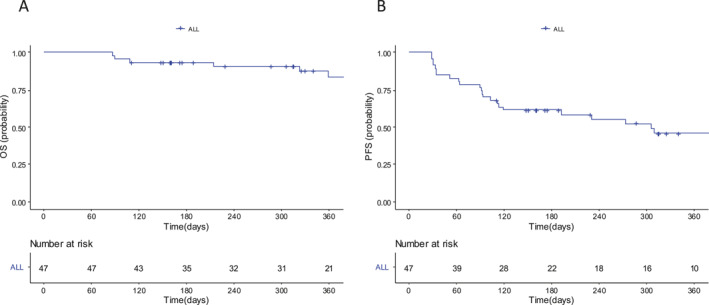
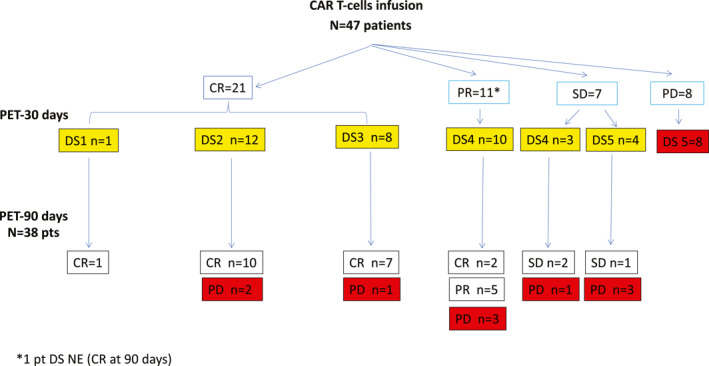
The authors conducted a single-center prospective study on 47 relapsed/refractory LBCL receiving CAR T-cell therapy to evaluate the prognostic value of baseline and after infusion F-fluorodeoxyglucose positron emission tomography (PET)-computed tomography. Qualitative and quantitative metabolic parameters were evaluated before lymphodepletion, at day 30 and 90 post-infusion.
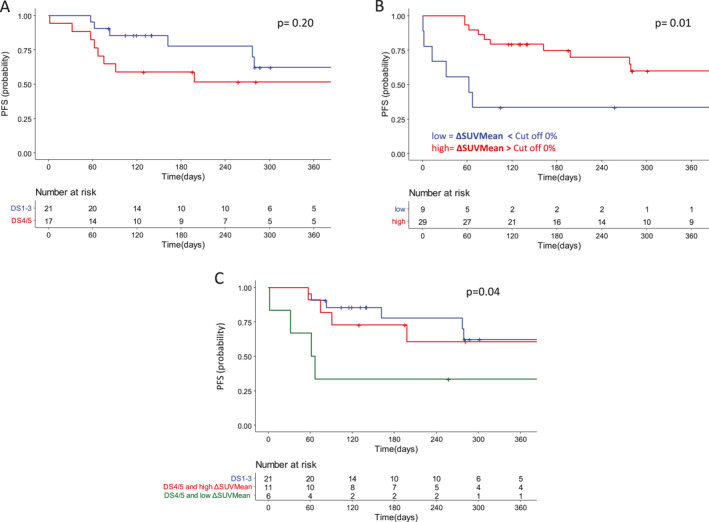
Deep variation of standardized uptake value (SUV) between baseline and day 30 correlated with response at day 90 (hazard ratio [HR], 1.49; 95% confidence interval [CI], 1.01-2.2); p = .04) and better progression-free survival (PFS) (HR, 0.63; 95% CI, 0.41-0.97); p = .04). In the overall population, 1-year PFS was 63% for Deauville score (DS)1-3 and 39% for DS4-5 patients, respectively (p = .02), however, the prognostic role of DS was lost when survivals are analyzed by considering 38 patients not progressing at 30 days. In these patients, in partial response or stable disease, the combination of DS and variation of SUV allowed identification of three groups with different prognosis: patients with DS1-3 and those with DS4-5 and decreased SUV had similar 1-year PFS of 62% and 61%, whereas patients with DS4-5 and increased SUV had a poorer 1-year PFS of 33% (p = .04).
PET parameters and association of DS and variation of SUV at 30 days could help in identify patients at high risk of CAR T-cell failure.
This is a single-center prospective study on 47 lymphoma patients receiving commercial chimeric antigen receptor T-cell therapy aimed to evaluate the prognostic value of baseline and after infusion F-fluorodeoxyglucose positron emission tomography. Among patients in partial remission or stable disease at day 30, the authors observed two subgroups with significantly different prognosis; patients with Deauville score (DS)4-5 and a concomitant reduction of standardized uptake value (SUV) had higher probability of long-lasting response than those with DS4-5 and an increase of SUV .
自体抗 CD19 嵌合抗原受体 (CAR) T 细胞疗法对约 40%的复发/难治性大 B 细胞淋巴瘤 (LBCL) 有效,因此早期识别 CAR T 细胞治疗后有复发或进展风险的患者是临床需求。
作者对 47 例接受 CAR T 细胞治疗的复发/难治性 LBCL 患者进行了单中心前瞻性研究,以评估基线和输注后 F-氟脱氧葡萄糖正电子发射断层扫描 (PET)-计算机断层扫描的预后价值。在淋巴耗竭前、输注后 30 天和 90 天评估定性和定量代谢参数。
基线和 30 天时标准摄取值 (SUV) 的深度变化与 90 天时的反应相关 (危险比 [HR],1.49;95%置信区间 [CI],1.01-2.2);p = 0.04) 和更好的无进展生存期 (PFS) (HR,0.63;95%CI,0.41-0.97);p = 0.04)。在总人群中,Deauville 评分 (DS) 为 1-3 的患者 1 年 PFS 为 63%,DS 为 4-5 的患者为 39%,分别为 (p = 0.02),然而,当考虑到 30 天无进展的 38 名患者时,DS 的预后作用就会丢失。在这些患者中,在部分缓解或稳定疾病中,DS 和 SUV 变化的组合可以识别出具有不同预后的三组:DS 为 1-3 且 SUV 降低的患者 1 年 PFS 相似,为 62%和 61%,而 DS 为 4-5 且 SUV 增加的患者 1 年 PFS 较差,为 33% (p = 0.04)。
PET 参数以及输注后 30 天时 DS 和 SUV 变化的联合可有助于识别 CAR T 细胞治疗失败风险较高的患者。
这是一项针对 47 例接受商业嵌合抗原受体 T 细胞治疗的淋巴瘤患者的单中心前瞻性研究,旨在评估基线和输注后 F-氟脱氧葡萄糖正电子发射断层扫描的预后价值。在 30 天时有部分缓解或稳定疾病的患者中,作者观察到两组具有明显不同的预后;DS 为 4-5 且 SUV 同时降低的患者比 DS 为 4-5 且 SUV 增加的患者有更高的持久缓解概率。