
接受抗CD19嵌合抗原受体T细胞(CAR-T)治疗的复发或难治性原发性纵隔B细胞淋巴瘤患者的结局:CARTHYM研究,一项来自法国国家DESCAR-T注册机构的研究
Outcomes of patients with relapsed or refractory primary mediastinal B-cell lymphoma treated with anti-CD19 CAR-T cells: CARTHYM, a study from the French national DESCAR-T registry.
作者信息
Galtier Jean, Mesguich Charles, Sesques Pierre, Dupont Vivien, Bachy Emmanuel, Di Blasi Roberta, Thieblemont Catherine, Gastinne Thomas, Cartron Guillaume, Brisou Gabriel, Gros François-Xavier, Decroocq Justine, Morschhauser Franck, Rubio Marie-Thérèse, Drieu La Rochelle Laurianne, Le Bras Fabien, Carras Sylvain, Chauchet Adrien, Bay Jacques-Olivier, Joris Magalie, Loschi Mickael, Tanguy-Schmidt Aline, Marquet Alexandra, Camus Vincent, Le Gouill Steven, Houot Roch, Bouabdallah Krimo
机构信息
CHU de Bordeaux, Service d'hématologie Clinique et de thérapie cellulaire Bordeaux France.
CHU de Bordeaux, Service de médecine nucléaire Bordeaux France.
出版信息
Hemasphere. 2025 Feb 18;9(2):e70091. doi: 10.1002/hem3.70091. eCollection 2025 Feb.
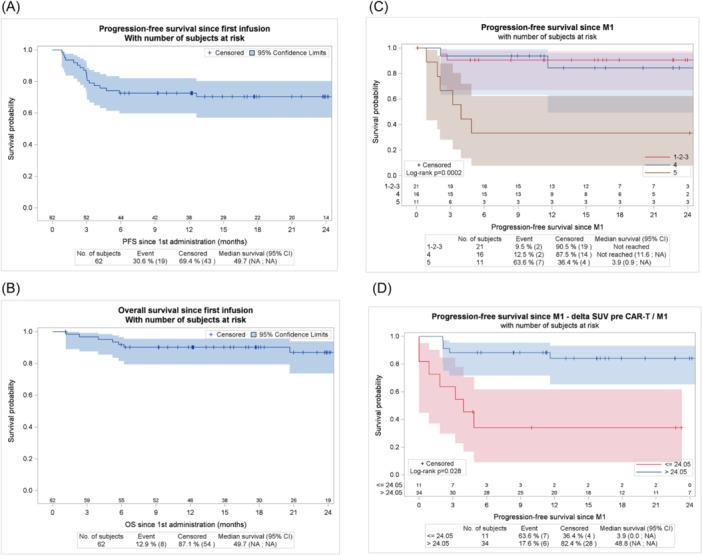
Primary mediastinal B-cell lymphoma (PMBL) is often cured with dose-dense anthracycline-based regimens but the prognosis at relapse or progression remains poor. While anti-CD19 CAR-T cell therapy has dramatically improved outcomes in relapsed or refractory large B-cell lymphoma, far less is known about their efficacy in PMBL. Using the systematic record of all patients treated with CAR-T cells prospectively included in the DESCAR-T registry in France, along with centrally reviewed positon-emission tomography (PET) imaging, we describe the outcomes and key determinants of treatment success in PMBL patients treated over a 6-year period. Among 82 patients infused in the registry we observed a best complete response (CR) rate, 2-year progression-free survival (PFS), and 2-year overall survival (OS) of 68.1%, 57.4%, and 73.8%, respectively. Outcomes were even better for the 62 patients infused with axicabtagene ciloleucel, with best CR rate, 2-year PFS, and 2-year OS reaching 74.5%, 70.4%, and 86.9%, respectively. Achieving a Deauville score of 1-4 or a ΔSUVmax reduction of more than 24% at the 1-month evaluation was associated with excellent outcomes, whereas increased total metabolic tumor volume baseline PET increased the risk of treatment failure. Surprisingly, neither the response to bridging therapy nor the type of bridging therapy (chemotherapy versus immune checkpoint inhibitors) were associated with long-term outcomes. In conclusion, this study confirms that anti-CD19 CAR-T cells as a valid standard-of-care for relapsed and refractory PMBL and highlights key determinants of treatment success.
原发性纵隔B细胞淋巴瘤(PMBL)通常采用基于蒽环类药物的剂量密集方案进行治疗,但复发或进展后的预后仍然很差。虽然抗CD19嵌合抗原受体T细胞(CAR-T)疗法显著改善了复发或难治性大B细胞淋巴瘤的治疗效果,但对于其在PMBL中的疗效知之甚少。利用法国DESCAR-T注册中心前瞻性纳入的所有接受CAR-T细胞治疗患者的系统记录,以及经中心审查的正电子发射断层扫描(PET)成像,我们描述了6年期间接受治疗的PMBL患者的治疗效果及治疗成功的关键决定因素。在该注册中心纳入的82例接受输注的患者中,我们观察到最佳完全缓解(CR)率、2年无进展生存期(PFS)和2年总生存期(OS)分别为68.1%、57.4%和73.8%。接受阿基仑赛治疗的62例患者的治疗效果更佳,最佳CR率、2年PFS和2年OS分别达到74.5%、70.4%和86.9%。在1个月评估时达到Deauville评分1-4或最大标准摄取值(ΔSUVmax)降低超过24%与良好的治疗效果相关,而基线PET时总代谢肿瘤体积增加会增加治疗失败的风险。令人惊讶的是,桥接治疗的反应或桥接治疗的类型(化疗与免疫检查点抑制剂)均与长期治疗效果无关。总之,本研究证实抗CD19 CAR-T细胞是复发和难治性PMBL的有效标准治疗方法,并突出了治疗成功与否的关键决定因素。



 Zotero 插件