Department of Sociology, National University of Singapore, 11 Arts Link, #03-06 AS1, Singapore 117573, Singapore.
School of Sociology and Population Studies, Renmin University of China, No. 59 Zhongguancun Street, Beijing 100872, China.
Int J Environ Res Public Health. 2022 Jun 2;19(11):6809. doi: 10.3390/ijerph19116809.
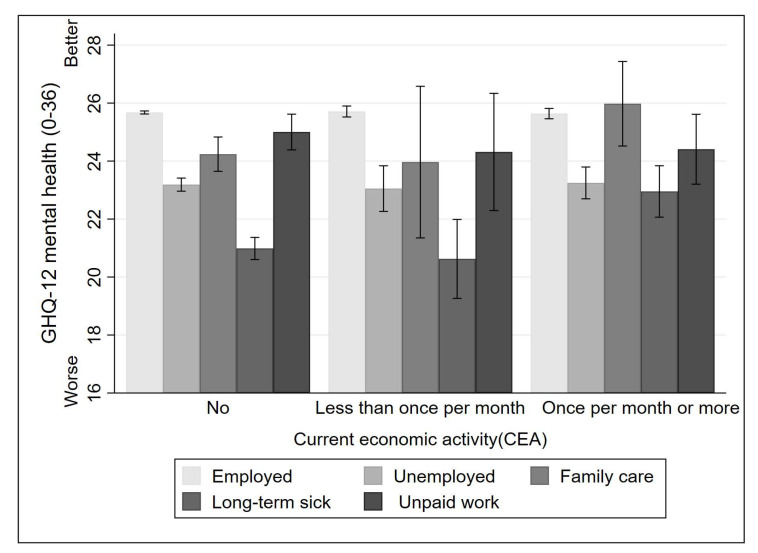
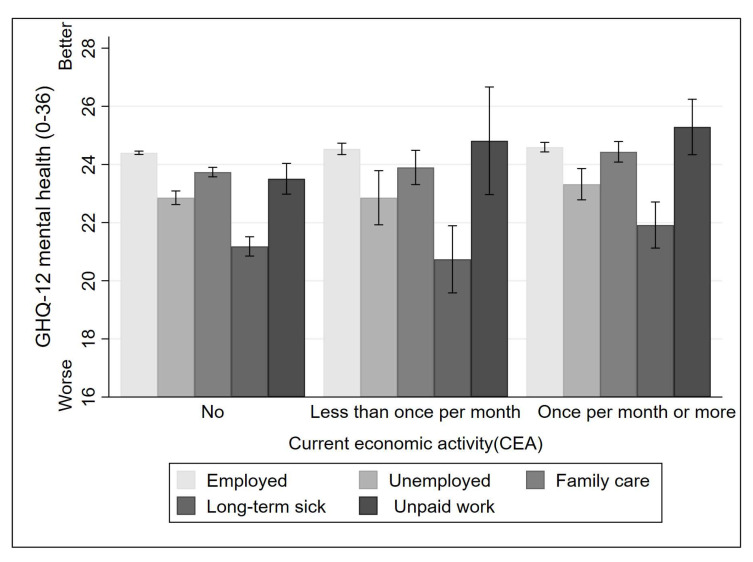
Previous research suggests that volunteering can mitigate the negative mental health impacts of unemployment but has yielded mixed results. This study extends the previous literature by examining whether volunteering can buffer the negative impacts of both unemployment and economic inactivity on mental health. Using nationally representative panel data from the United Kingdom Longitudinal Household Study (2010-2020) and fixed effects models, this study yields three important findings: First, volunteering cannot mitigate the adverse effects of unemployment, regardless of gender. Second, frequent volunteering (at least once per month) can benefit the mental health of economically inactive groups (e.g., family care and long-term sickness). Third, the study reveals the gendered patterns of the impacts of volunteering. Specifically, frequent volunteering can buffer the negative impacts of family care or long-term sickness for men, and the negative impacts of unpaid work for women. Overall, these findings contribute towards a more nuanced understanding of the buffering role of volunteering and its gendered patterns. Policymakers should offer more volunteering opportunities and training to these economically inactive groups to reduce their risk of mental issues.
先前的研究表明,志愿服务可以减轻失业对心理健康的负面影响,但结果喜忧参半。本研究通过考察志愿服务是否可以缓冲失业和不经济活动对心理健康的负面影响,扩展了先前的文献。本研究使用了来自英国家庭纵向研究(2010-2020 年)的全国代表性面板数据和固定效应模型,得出了三个重要发现:第一,志愿服务无法减轻失业对无论男女的不利影响。第二,频繁的志愿服务(至少每月一次)可以使不经济活动群体(如家庭护理和长期疾病)受益。第三,该研究揭示了志愿服务影响的性别模式。具体而言,频繁的志愿服务可以缓冲男性因家庭护理或长期疾病,以及女性因无酬工作而产生的负面影响。总的来说,这些发现有助于更深入地了解志愿服务的缓冲作用及其性别模式。政策制定者应向这些不经济活动群体提供更多的志愿服务机会和培训,以降低他们出现心理问题的风险。