Pinggera Daniel, Rhomberg Paul, Beer Ronny, Thomé Claudius, Petr Ondra
Department of Neurosurgery, Medical University Innsbruck, 6020 Innsbruck, Austria.
Department of Neuroradiology, Medical University Innsbruck, 6020 Innsbruck, Austria.
J Clin Med. 2022 Jun 2;11(11):3169. doi: 10.3390/jcm11113169.
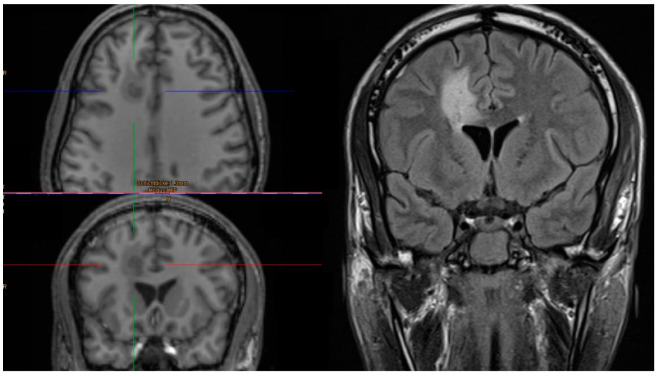
Both neuromonitoring and early magnetic resonance imaging (MRI) provide crucial information for treatment management and prognosis in patients with severe traumatic brain injury (sTBI). So far, neuromonitoring in situ impedes the routine implementation of MRI due to safety concerns. We aimed to evaluate the brain tissue damage induced by inserted neuromonitoring devices and its clinical relevance. Nineteen patients with sTBI and being exposed to at least one MRI with neuromonitoring in situ and one follow-up MRI after neuromonitoring removal were analyzed. All MRIs were reviewed for specific tissue damage. Three females and sixteen males (aged 20-74 years, mean 42.8 years) with an initial median GCS of 5 (range 3-8) were analyzed. No lesion was observed in six patients (31.6%), whereas another six patients (31.6%) demonstrated a detectable probe trajectory. Probe-related tissue damage was visible in seven patients (36.8%) with the size of the lesion prone to further enlarge with increasing cumulative duration of MRI examinations. Upon interdisciplinary evaluation, the lesions were not considered clinically relevant. Neuromonitoring probes in situ during MRI examinations may cause local brain tissue damage, yet without any clinical implications if placed correctly. Therefore, indications must be strictly based on joint decision from all involved disciplines.
神经监测和早期磁共振成像(MRI)均为重度创伤性脑损伤(sTBI)患者的治疗管理和预后提供关键信息。到目前为止,由于安全问题,原位神经监测妨碍了MRI的常规实施。我们旨在评估插入的神经监测设备引起的脑组织损伤及其临床相关性。分析了19例sTBI患者,这些患者在原位神经监测的情况下至少接受了一次MRI检查,并在移除神经监测后进行了一次随访MRI检查。对所有MRI检查均进行了特定组织损伤的评估。分析了3名女性和16名男性(年龄20 - 74岁,平均42.8岁),初始格拉斯哥昏迷量表(GCS)中位数为5(范围3 - 8)。6例患者(31.6%)未观察到病变,而另外6例患者(31.6%)显示出可检测到的探头轨迹。7例患者(36.8%)可见与探头相关的组织损伤,病变大小倾向于随着MRI检查累积时间的增加而进一步扩大。经多学科评估,这些病变被认为与临床无关。MRI检查期间原位神经监测探头可能会导致局部脑组织损伤,但如果放置正确则无任何临床影响。因此,适应证必须严格基于所有相关学科的共同决定。