Chen Mei-Hui, Sung Yueh-Feng, Chien Wu-Chien, Chung Chi-Hsiang, Chen Jeng-Wen
Department of Medical Education and Research, Far-Eastern Memorial Hospital, New Taipei City 220, Taiwan.
Department of Neurology, Tri-Service General Hospital, National Defense Medical Center, Taipei 114, Taiwan.
J Clin Med. 2023 Feb 15;12(4):1530. doi: 10.3390/jcm12041530.
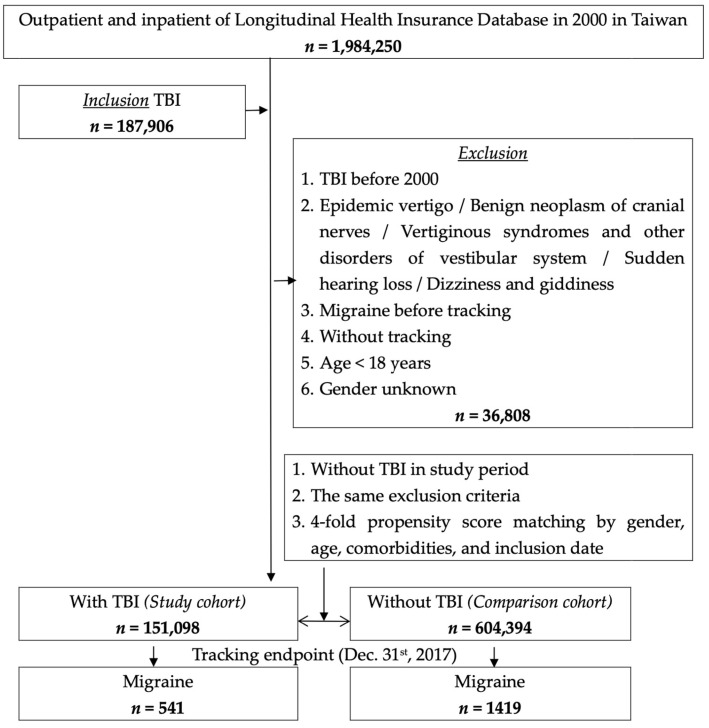
Traumatic brain injury (TBI) causes several long-term disabilities, particularly headaches. An association between TBI and subsequent migraine has been reported. However, few longitudinal studies have explained the link between migraine and TBI. Moreover, the modifying effects of treatment remain unknown. This retrospective cohort study used records from Taiwan's Longitudinal Health Insurance Database 2005 to evaluate the risk of migraine among patients with TBI and to determine the effects of different treatment modalities. Initially, 187,906 patients, aged ≥ 18 years, who were diagnosed as TBI in 2000, were identified. In total, 151,098 patients with TBI and 604,394 patients without TBI were matched at a 1:4 ratio according to baseline variables during the same observation period. At the end of follow-up, 541 (0.36%) and 1491 (0.23%) patients in the TBI and non-TBI groups, respectively, developed migraine. The TBI group exhibited a higher risk of migraine than the non-TBI group (adjusted HR: 1.484). Major trauma (Injury Severity Score, ISS ≥ 16) was associated with a higher migraine risk than minor trauma (ISS < 16) (adjusted HR: 1.670). However, migraine risk did not differ significantly after surgery or occupational/physical therapy. These findings highlight the importance of long-term follow-up after TBI onset and the need to investigate the underlying pathophysiological link between TBI and subsequent migraine.
创伤性脑损伤(TBI)会导致多种长期残疾,尤其是头痛。已有报道称TBI与随后发生的偏头痛之间存在关联。然而,很少有纵向研究解释偏头痛与TBI之间的联系。此外,治疗的调节作用仍不清楚。这项回顾性队列研究使用了台湾2005年纵向健康保险数据库的记录,以评估TBI患者患偏头痛的风险,并确定不同治疗方式的效果。最初,确定了2000年诊断为TBI的187906名年龄≥18岁的患者。总共,151098名TBI患者和604394名非TBI患者根据同一观察期内的基线变量以1:4的比例进行匹配。随访结束时,TBI组和非TBI组分别有541名(0.36%)和1491名(0.23%)患者发生偏头痛。TBI组患偏头痛的风险高于非TBI组(调整后的HR:1.484)。严重创伤(损伤严重度评分,ISS≥16)比轻度创伤(ISS<16)患偏头痛的风险更高(调整后的HR:1.670)。然而,手术后或职业/物理治疗后偏头痛风险没有显著差异。这些发现突出了TBI发病后长期随访的重要性,以及研究TBI与随后偏头痛之间潜在病理生理联系的必要性。