Riveros-Rivera Alain, Penzel Thomas, Gunga Hanns-Christian, Opatz Oliver, Paul Friedemann, Klug Lars, Boschmann Michael, Mähler Anja
Center for Space Medicine and Extreme Environments Berlin, Institute of Physiology, Charité-Universitätsmedizin Berlin, Corporate Member of Freie Universität Berlin, Humboldt-Universität zu Berlin, Berlin, Germany.
Department of Physiological Sciences, Faculty of Medicine, Pontificia Universidad Javeriana, Bogotá, Colombia.
Front Physiol. 2022 May 24;13:899636. doi: 10.3389/fphys.2022.899636. eCollection 2022.
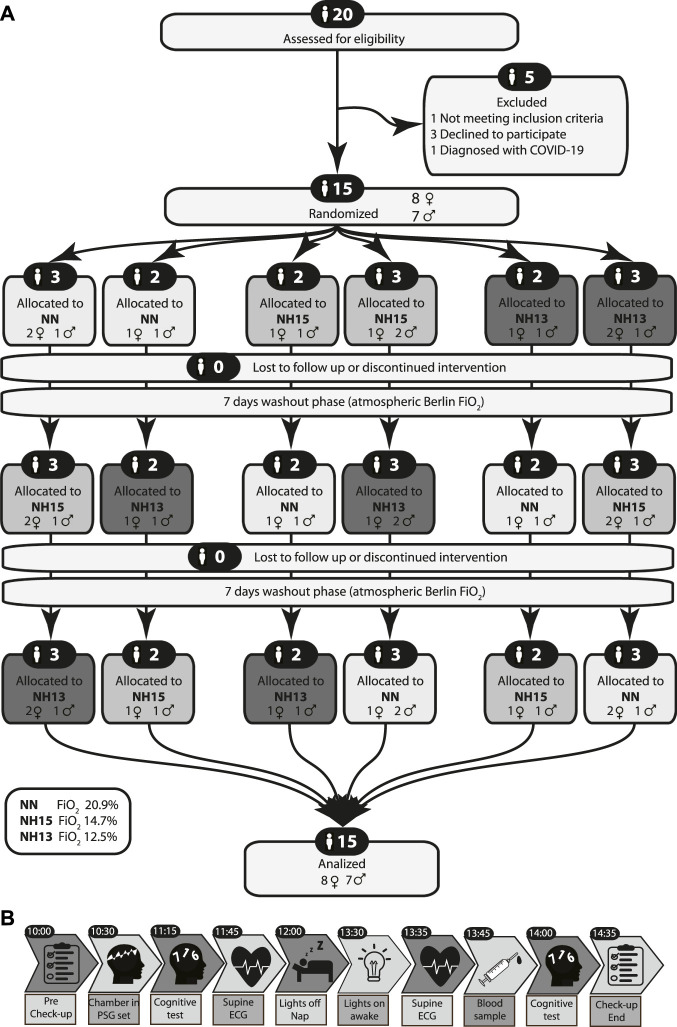
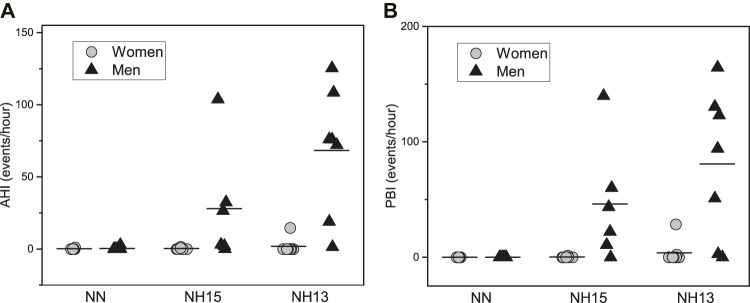
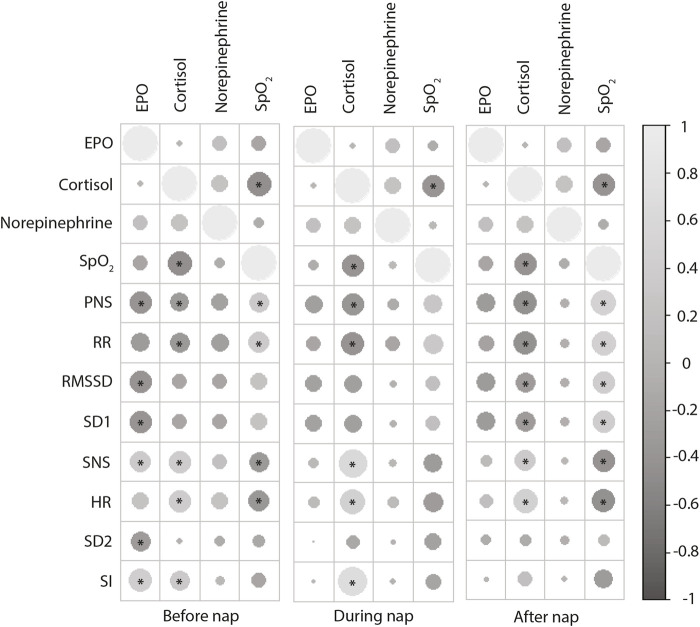
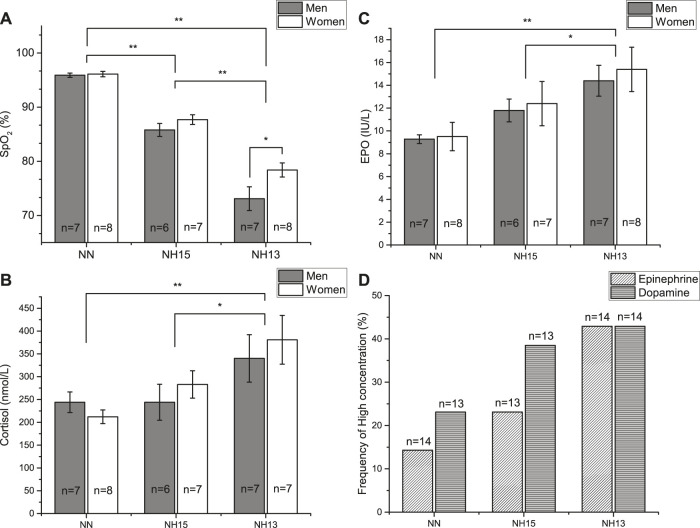
The use of daytime napping as a countermeasure in sleep disturbances has been recommended but its physiological evaluation at high altitude is limited. To evaluate the neuroendocrine response to hypoxic stress during a daytime nap and its cognitive impact. Randomized, single-blind, three period cross-over pilot study conducted with 15 healthy lowlander subjects (8 women) with a mean (SD) age of 29(6) years (Clinicaltrials identifier: NCT04146857, https://clinicaltrials.gov/ct2/show/NCT04146857?cond=napping&draw=3&rank=12). Volunteers underwent a polysomnography, hematological and cognitive evaluation around a 90 min midday nap, being allocated to a randomized sequence of three conditions: normobaric normoxia (NN), normobaric hypoxia at FiO 14.7% (NH15) and 12.5% (NH13), with a washout period of 1 week between conditions. Primary outcome was the interbeat period measured by the RR interval with electrocardiogram. Compared to normobaric normoxia, RR during napping was shortened by 57 and 206 ms under NH15 and NH13 conditions, respectively ( < 0.001). Sympathetic predominance was evident by heart rate variability analysis and increased epinephrine levels. Concomitantly, there were significant changes in endocrine parameters such as erythropoietin (∼6 UI/L) and cortisol (∼100 nmol/L) (NH13 vs. NN, < 0.001). Cognitive evaluation revealed changes in the color-word Stroop test. Additionally, although sleep efficiency was preserved, polysomnography showed lesser deep sleep and REM sleep, and periodic breathing, predominantly in men. Although napping in simulated altitude does not appear to significantly affect cognitive performance, sex-dependent changes in cardiac autonomic modulation and respiratory pattern should be considered before napping is prescribed as a countermeasure.
有人建议将白天小睡作为睡眠障碍的一种应对措施,但对其在高海拔地区的生理评估有限。为了评估白天小睡期间对缺氧应激的神经内分泌反应及其对认知的影响。对15名健康的低地受试者(8名女性)进行了随机、单盲、三阶段交叉试点研究,平均(标准差)年龄为29(6)岁(临床试验标识符:NCT04146857,https://clinicaltrials.gov/ct2/show/NCT04146857?cond=napping&draw=3&rank=12)。志愿者在90分钟的午睡前后接受了多导睡眠图、血液学和认知评估,被随机分配到三种条件的序列中:常压常氧(NN)、FiO₂为14.7%的常压缺氧(NH15)和12.5%的常压缺氧(NH13),各条件之间有1周的洗脱期。主要结局是通过心电图RR间期测量的心动周期。与常压常氧相比,在NH15和NH13条件下,午睡期间的RR分别缩短了57和206毫秒(P<0.001)。心率变异性分析和肾上腺素水平升高表明交感神经占优势。同时,内分泌参数如促红细胞生成素(约6 UI/L)和皮质醇(约100 nmol/L)有显著变化(NH13与NN相比,P<0.001)。认知评估显示在色词Stroop测试中有变化。此外,虽然睡眠效率得以保持,但多导睡眠图显示深度睡眠和快速眼动睡眠较少,且有周期性呼吸,主要见于男性。虽然在模拟海拔高度下小睡似乎不会显著影响认知表现,但在将小睡作为一种应对措施之前,应考虑心脏自主调节和呼吸模式的性别依赖性变化