Elmenhorst Eva-Maria, Rooney Daniel, Benderoth Sibylle, Wittkowski Martin, Wenzel Juergen, Aeschbach Daniel
Department of Sleep and Human Factors Research, Institute of Aerospace Medicine, German Aerospace Center (DLR), Cologne, 51170, Germany.
Institute for Occupational and Social Medicine, Medical Faculty, RWTH Aachen University, Aachen, 52074, Germany.
Nat Sci Sleep. 2022 Feb 11;14:193-205. doi: 10.2147/NSS.S339196. eCollection 2022.
Recuperation during sleep on board of commercial long-haul flights is a safety issue of utmost importance for flight crews working extended duty periods. We intended to explore how sleep and blood oxygenation (in wake versus sleep) are affected by the conditions in an airliner at cruising altitude.
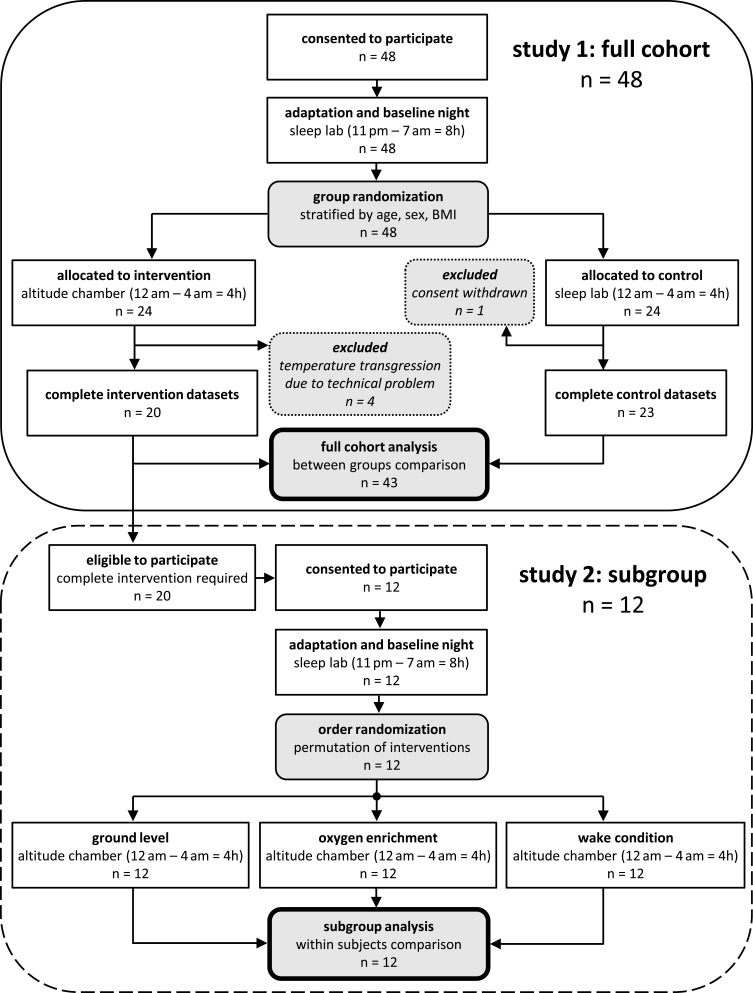
Healthy participants' sleep was compared between 4-h sleep opportunities in the sleep laboratory (n = 23; sleep lab, ie, 53 m above sea level) and in an altitude chamber (n = 20; flight level, ie, 753 hPa, corresponding to 2438 m above sea level). A subgroup of 12 participants underwent three additional conditions in the altitude chamber: 1) 4-h sleep at ground level, 2) 4-h sleep at flight level with oxygen partial pressure equivalent to ground level, 3) 4-h monitored wakefulness at flight level. Sleep structure and blood oxygenation were analysed with mixed ANOVAs.
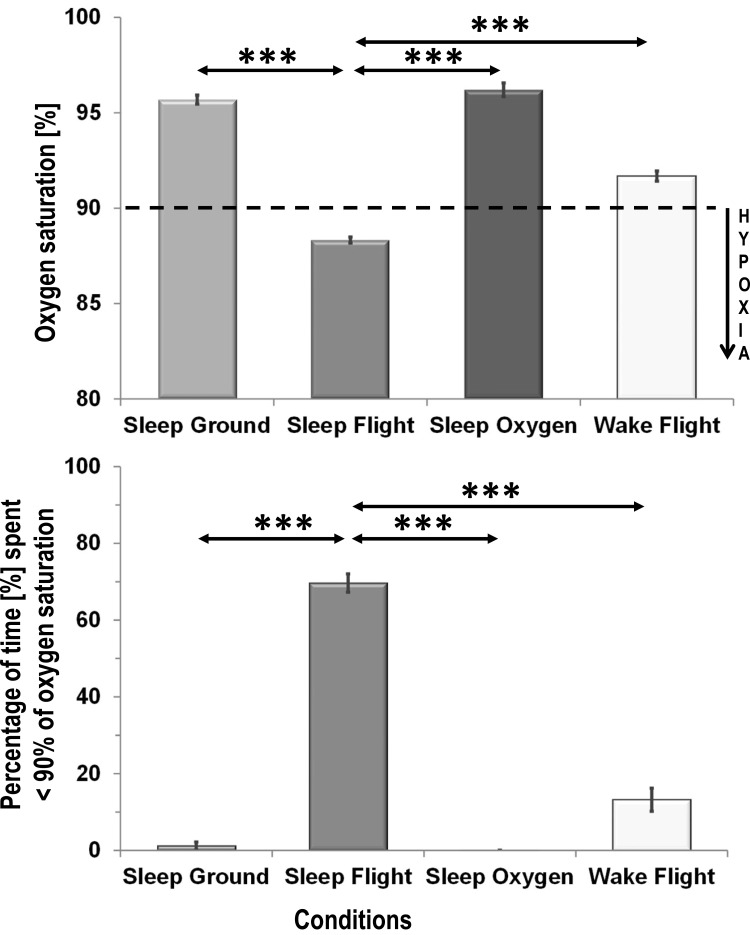
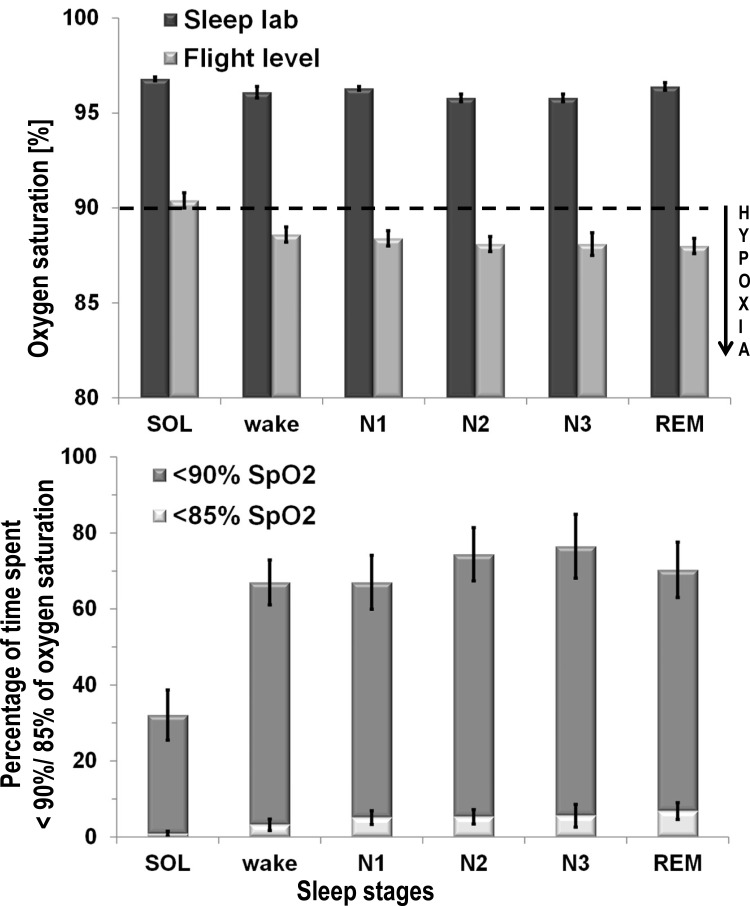
Total sleep time at flight level compared to in the sleep laboratory was shorter (Δ mean ± standard error -11.1 ± 4.2 min) and included less N3 sleep (Δ -17.6 ± 5.4 min), while blood oxygenation was decreased. Participants spent 69.7% (± 8.3%) of the sleep period time but only 13.2% (± 3.0%) of monitored wakefulness in a hypoxic state (<90% oxygen saturation). Oxygen enrichment of the chamber prevented oxygen desaturation.
Sleep - but not wakefulness - under flight conditions induces hypobaric hypoxia which may contribute to impaired sleep. The results caution against the assumption of equivalent crew recovery in-flight and on the ground but hold promise for oxygen enrichment as a countermeasure. The present results have implications for flight safety and possible long-term consequences for health in crews.
对于执行超长执勤期任务的机组人员而言,在商业长途航班上睡眠时的恢复情况是一个至关重要的安全问题。我们旨在探究在巡航高度的客机环境中,睡眠和血液氧合(清醒状态与睡眠状态相比)是如何受到影响的。
将健康参与者在睡眠实验室(n = 23;睡眠实验室,即海拔53米)和高空舱(n = 20;飞行高度,即753百帕,相当于海拔2438米)中4小时睡眠机会的睡眠情况进行比较。12名参与者的一个亚组在高空舱中还经历了另外三种情况:1)在地面水平睡眠4小时,2)在飞行高度睡眠4小时且氧分压与地面水平相当,3)在飞行高度进行4小时的监测清醒状态。使用混合方差分析对睡眠结构和血液氧合进行分析。
与睡眠实验室相比,在飞行高度的总睡眠时间更短(平均差值±标准误为 -11.1 ± 4.2分钟),且N3睡眠更少(差值为 -17.6 ± 5.4分钟),同时血液氧合降低。参与者在睡眠期间有69.7%(± 8.3%)的时间处于低氧状态(氧饱和度<90%),但在监测的清醒状态中只有13.2%(± 3.0%)的时间处于低氧状态。舱内增氧可防止氧饱和度降低。
飞行条件下的睡眠——而非清醒状态——会引发低压缺氧,这可能导致睡眠受损。研究结果警示不要假定机组人员在飞行中和地面上的恢复情况相同,但增氧作为一种应对措施具有前景。目前的结果对飞行安全以及机组人员健康可能产生的长期影响具有启示意义。