Department of Biopharmaceutics and Clinical Pharmacy, School of Pharmacy, The University of Jordan, Amman, Jordan.
Department of Basic Medical Sciences, College of Medicine, University of Sharjah, Sharjah 27272, UAE.
Int J Clin Pract. 2022 Mar 24;2022:7918604. doi: 10.1155/2022/7918604. eCollection 2022.
The healthcare system in Jordan faced substantial burden during the 2020 COVID-19 pandemic including disruption of routine childhood vaccination services.
We sought, for the first time, to describe the impact of the 2020 pandemic on vaccination coverage of Jordanian children in Jordan and to identify the key contributing factors.
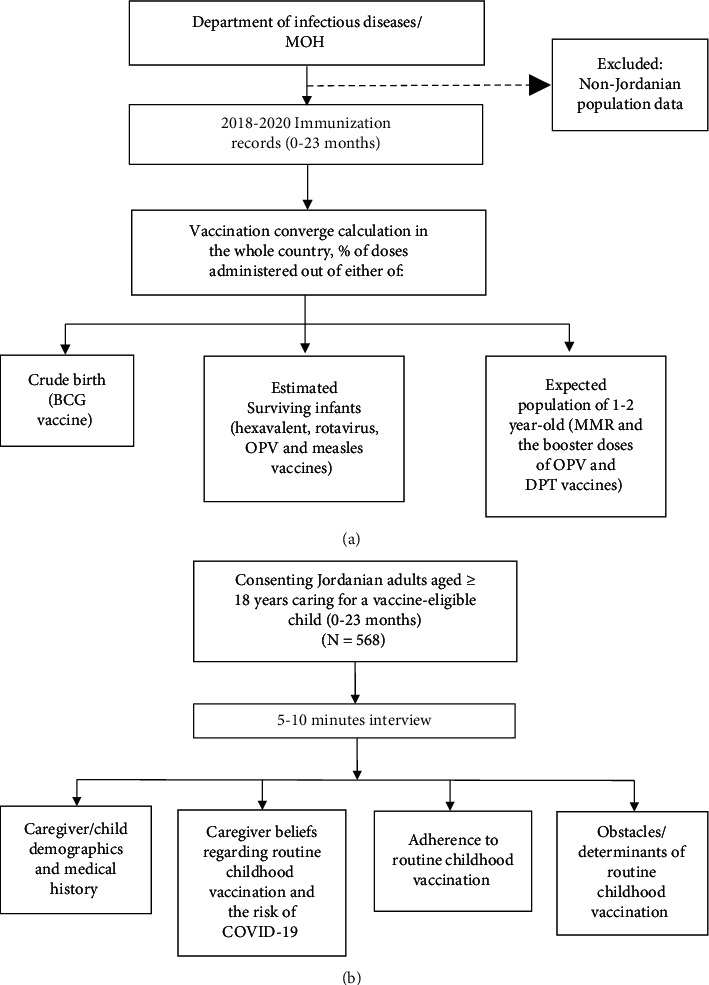
Nationwide vaccination rates were retrieved from the electronic records at the Ministry of Health (2018-2020) enrolling crude births of 220,057 Jordanian children during 2020. Records of doses administered were compared for each month of 2020 with the baseline of 2018-2019. A cross-sectional survey (March-August 2021) was also conducted enrolling a convenient sample of adults aged ≥18 who were Jordanian caregivers for vaccine-eligible children (0-23 months) between 1 January 2020 and the date of the interview. The survey aimed to address caregivers' adherence to routine vaccination during 2020-2021 and to describe the determinants of the current and future adherence to vaccination where multiple logistic regression model was utilized.
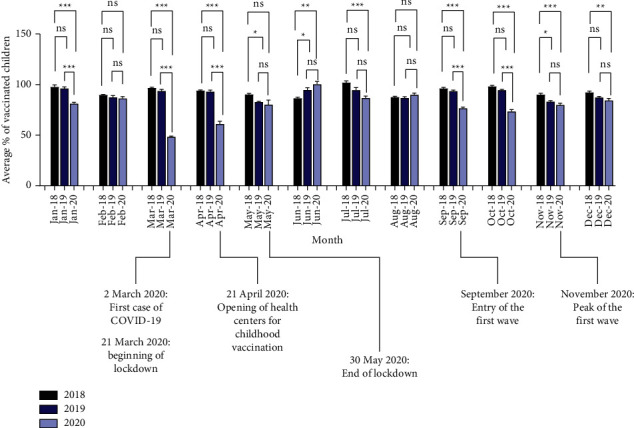
The electronic records revealed a significant decline in vaccination coverage during 2020. The greatest decline was observed during the lockdown period from 21 March 2020 to 21 April 2020 (32.4%-46.8%) followed by the decline observed by the entry of the first wave during September-October 2020 (18.4%-22.8%). A drop of 14-16% was observed for the vaccines recommended under the age of 12 months and of 6-7% for those recommended in 1-2-year-old children. The yearly coverage rates for measles-1 (at 9 months), 2 (at 12 months as part of measles-mumps-rubella (MMR) vaccine), and 3 (at 18 months as part of MMR) were 76%, 90%, and 87%, respectively, and for hexavalent-1, 2, and 3 were 78%, 78%, and 77%, respectively. The results of the survey revealed that the main reason for vaccination delay for at least 1 month from the recommended administration time was the lockdown, followed by child illness and smart lockdowns (regional lockdown/health center closure). Vaccination delay was less likely to be observed in children aged ≥12 months ( value < 0.001; OR: 0.18; CI: 0.11-0.29) or children with chronic diseases ( value < 0.05; OR: 0.5; CI: 0.33-0.88).
The current study demonstrates a decline in vaccination coverage of Jordanian children during the 2020 COVID-19 pandemic. It is important to formulate future strategies to promote catch-up vaccination and to avoid future backsliding of vaccination rates during further waves of the COVID-19 pandemic or other pandemics. These include improving health services, allaying caregivers' concerns about contracting COVID-19, and arranging vaccination campaigns outside health centers.
2020 年 COVID-19 大流行期间,约旦的医疗体系面临巨大负担,包括常规儿童疫苗接种服务中断。
我们首次描述了 2020 年大流行对约旦儿童疫苗接种覆盖率的影响,并确定了主要影响因素。
从卫生部的电子记录中检索到 2020 年的全国疫苗接种率,记录了 2020 年 220057 名约旦儿童的粗出生率。将 2020 年每个月的接种剂量记录与 2018-2019 年的基线进行比较。还进行了一项横断面调查(2021 年 3 月至 8 月),方便招募了年龄在 18 岁及以上的成年人,他们是 2020 年 1 月 1 日至采访日之间有资格接种疫苗的 0-23 个月儿童的约旦疫苗接种者。该调查旨在了解 2020-2021 年期间护理人员对常规疫苗接种的依从性,并描述当前和未来疫苗接种的决定因素,其中利用了多变量逻辑回归模型。
电子记录显示,2020 年疫苗接种率显著下降。最大的降幅发生在 2020 年 3 月 21 日至 4 月 21 日的封锁期间(32.4%-46.8%),其次是 2020 年 9 月至 10 月第一波疫情期间的降幅(18.4%-22.8%)。推荐在 12 个月以下年龄使用的疫苗下降了 14-16%,推荐在 1-2 岁儿童使用的疫苗下降了 6-7%。麻疹-1(9 个月)、麻疹-腮腺炎-风疹(MMR)疫苗 2 剂(12 个月)和 MMR 疫苗 3 剂(18 个月)的年覆盖率分别为 76%、90%和 87%,六价疫苗 1 剂、2 剂和 3 剂的年覆盖率分别为 78%、78%和 77%。调查结果显示,至少有 1 个月从推荐的接种时间推迟接种的主要原因是封锁,其次是儿童疾病和智能封锁(区域封锁/卫生中心关闭)。年龄在 12 个月及以上的儿童( value < 0.001;OR:0.18;CI:0.11-0.29)或患有慢性病的儿童( value < 0.05;OR:0.5;CI:0.33-0.88)不太可能出现接种延迟。
本研究表明,2020 年 COVID-19 大流行期间约旦儿童的疫苗接种率下降。重要的是要制定未来的策略,以促进补种疫苗,并避免在 COVID-19 大流行或其他大流行的进一步浪潮中疫苗接种率再次下降。这些策略包括改善卫生服务、减轻护理人员对感染 COVID-19 的担忧,以及在卫生中心外安排疫苗接种活动。