Department of Medicine, Division of Hematological Malignancies and Cellular Therapy, Duke University Medical Center, Durham, NC, United States.
Department of Thoracic Surgery, Akita University Graduate School of Medicine, Akita, Japan.
Front Immunol. 2022 May 24;13:865486. doi: 10.3389/fimmu.2022.865486. eCollection 2022.
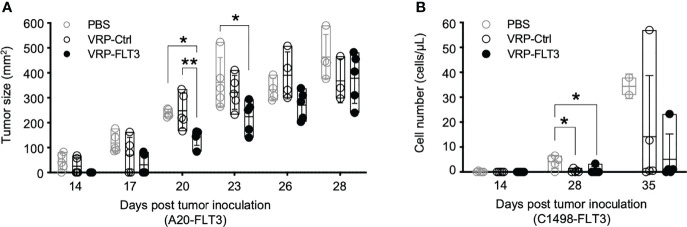
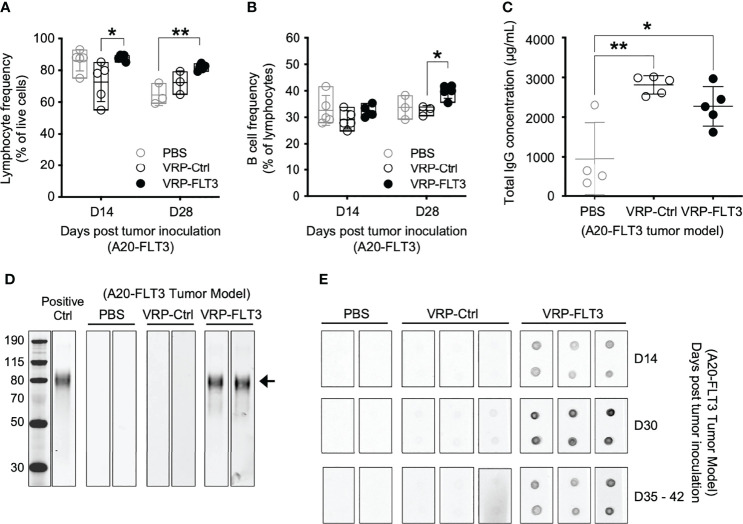
immune responses to myeloid and other blood-borne tumors are notably limited and ineffective, making our ability to promote immune responses with vaccines a major challenge. While focus has been largely on cytotoxic cell-mediated tumor eradication, B-cells and the antibodies they produce also have roles in anti-tumor responses. Indeed, therapeutic antibody-mediated tumor cell killing is routinely employed in patients with hematolymphoid cancers, but whether endogenous antibody responses can be incited to blood-born tumors remains poorly studied. A major limitation of immunoglobulin therapies is that cell surface expression of tumor-associated antigen (TAA) targets is dynamic and varied, making promotion of polyclonal, endogenous B cell responses appealing. Since many TAAs are self-antigens, developing tumor vaccines that enable production of antibodies to non-polymorphic antigen targets remains a challenge. As B cell responses to RNA vaccines are known to occur, we employed the Viral Replicon Particles (VRP) which was constructed to encode mouse FLT3. The VRP-FLT3 vaccine provoked a rapid IgG B-cell response to this self-antigen in leukemia and lymphoma mouse models. In addition, IgGs to other TAAs were also produced. Our data suggest that vaccination with RNA viral particle vectors incites a loss of B-cell tolerance that enables production of anti-tumor antibodies. This proof of principle work provides impetus to employ such strategies that lead to a break in B-cell tolerance and enable production of broadly reactive anti-TAA antibodies as potential future therapeutic agents for patients with hematolymphoid cancers.
对髓系和其他血液来源的肿瘤的免疫反应明显受到限制且效果不佳,这使得我们利用疫苗促进免疫反应的能力成为一个主要挑战。虽然重点主要集中在细胞毒性细胞介导的肿瘤清除上,但 B 细胞及其产生的抗体在抗肿瘤反应中也有作用。事实上,治疗性抗体介导的肿瘤细胞杀伤在血液恶性肿瘤患者中经常使用,但内源性抗体反应是否能激发血液肿瘤仍研究甚少。免疫球蛋白治疗的一个主要限制是肿瘤相关抗原 (TAA) 靶标的细胞表面表达是动态和多样的,这使得促进多克隆、内源性 B 细胞反应具有吸引力。由于许多 TAA 是自身抗原,因此开发能够产生针对非多态性抗原靶标的抗体的肿瘤疫苗仍然是一个挑战。由于已知 RNA 疫苗会引起 B 细胞反应,我们使用了构建来编码小鼠 FLT3 的病毒复制子颗粒 (VRP)。VRP-FLT3 疫苗在白血病和淋巴瘤小鼠模型中迅速引发针对这种自身抗原的 IgG B 细胞反应。此外,还产生了针对其他 TAA 的 IgGs。我们的数据表明,用 RNA 病毒粒子载体进行疫苗接种会引发 B 细胞耐受的丧失,从而能够产生抗肿瘤抗体。这项初步研究工作为采用这种策略提供了动力,这种策略会导致 B 细胞耐受的打破,并能够产生广泛反应性的抗 TAA 抗体,作为血液恶性肿瘤患者的潜在未来治疗剂。