Milner Therapeutics Institute, University of Cambridge, Cambridge, United Kingdom.
Systems Modelling and Translational Biology, Data and Computational Sciences, GSK, London, United Kingdom.
PLoS Comput Biol. 2022 Jun 10;18(6):e1010148. doi: 10.1371/journal.pcbi.1010148. eCollection 2022 Jun.
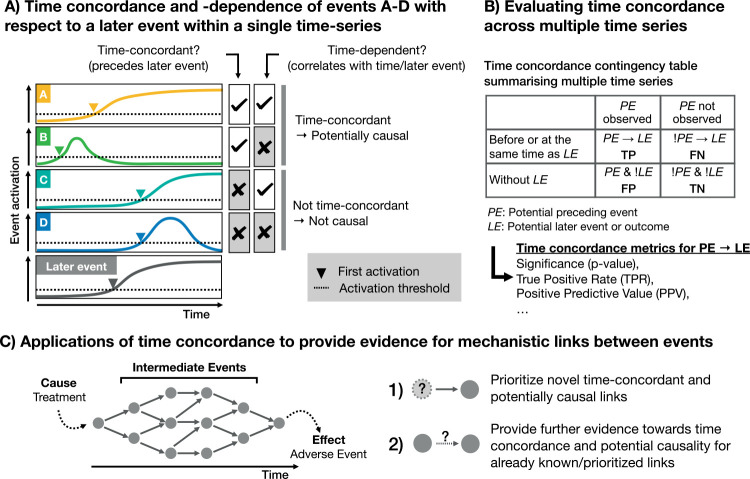
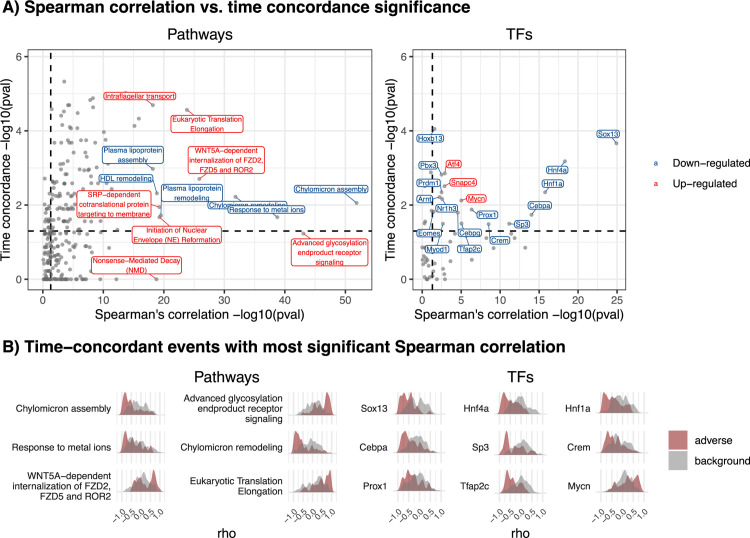
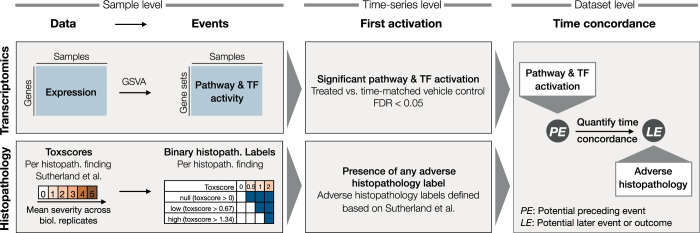
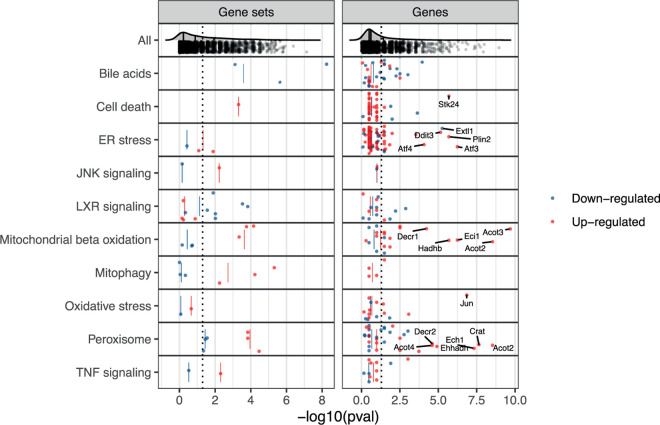
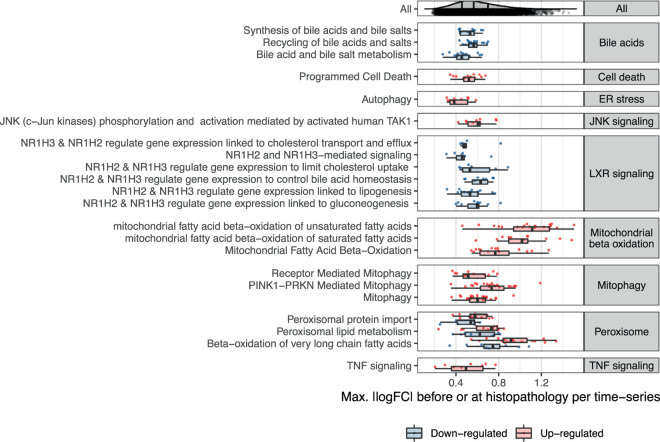
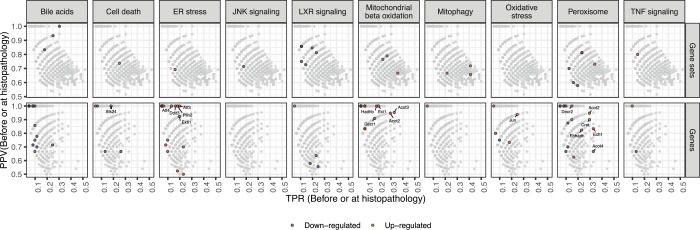
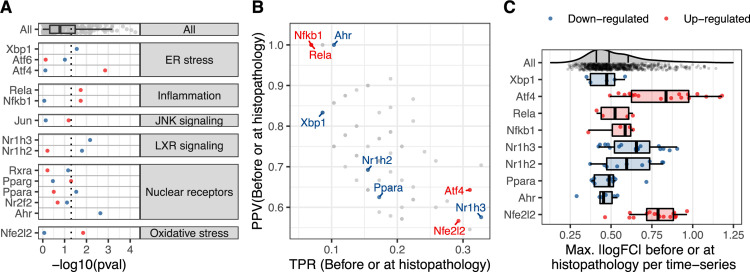
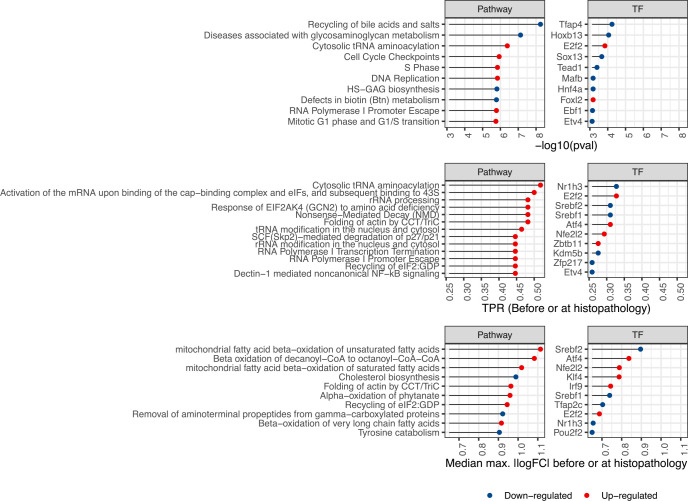
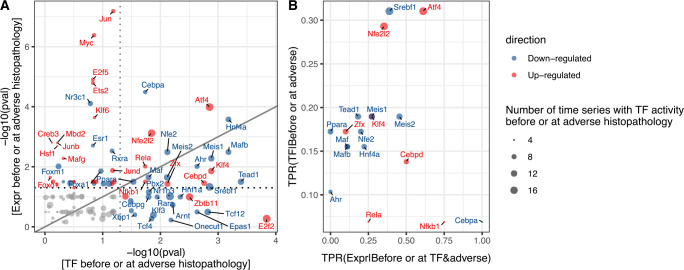
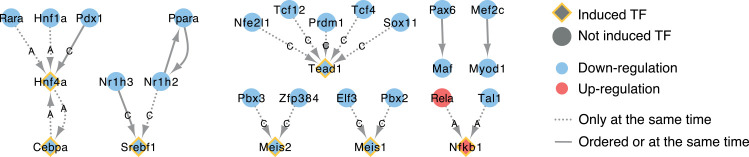
Adverse event pathogenesis is often a complex process which compromises multiple events ranging from the molecular to the phenotypic level. In toxicology, Adverse Outcome Pathways (AOPs) aim to formalize this as temporal sequences of events, in which event relationships should be supported by causal evidence according to the tailored Bradford-Hill criteria. One of the criteria is whether events are consistently observed in a certain temporal order and, in this work, we study this time concordance using the concept of "first activation" as data-driven means to generate hypotheses on potentially causal mechanisms. As a case study, we analysed liver data from repeat-dose studies in rats from the TG-GATEs database which comprises measurements across eight timepoints, ranging from 3 hours to 4 weeks post-treatment. We identified time-concordant gene expression-derived events preceding adverse histopathology, which serves as surrogate readout for Drug-Induced Liver Injury (DILI). We find known mechanisms in DILI to be time-concordant, and show further that significance, frequency and log fold change (logFC) of differential expression are metrics which can additionally prioritize events although not necessary to be mechanistically relevant. Moreover, we used the temporal order of transcription factor (TF) expression and regulon activity to identify transcriptionally regulated TFs and subsequently combined this with prior knowledge on functional interactions to derive detailed gene-regulatory mechanisms, such as reduced Hnf4a activity leading to decreased expression and activity of Cebpa. At the same time, also potentially novel events are identified such as Sox13 which is highly significantly time-concordant and shows sustained activation over time. Overall, we demonstrate how time-resolved transcriptomics can derive and support mechanistic hypotheses by quantifying time concordance and how this can be combined with prior causal knowledge, with the aim of both understanding mechanisms of toxicity, as well as potential applications to the AOP framework. We make our results available in the form of a Shiny app (https://anikaliu.shinyapps.io/dili_cascades), which allows users to query events of interest in more detail.
不良事件的发病机制通常是一个复杂的过程,涉及从分子到表型水平的多种事件。在毒理学中,不良结局途径(AOP)旨在将其正式化为事件的时间序列,其中事件关系应根据定制的 Bradford-Hill 标准,通过因果证据来支持。标准之一是事件是否按照特定的时间顺序一致观察到,在这项工作中,我们使用“首次激活”的概念来研究这种时间一致性,将其作为生成潜在因果机制假说的数据驱动手段。作为一个案例研究,我们分析了来自 TG-GATEs 数据库的大鼠重复剂量研究中的肝脏数据,该数据库包含了 8 个时间点的测量值,从治疗后 3 小时到 4 周不等。我们确定了先前不良组织病理学的基因表达衍生事件,作为药物性肝损伤(DILI)的替代读出。我们发现 DILI 中的已知机制是时间一致的,并进一步表明差异表达的显著性、频率和对数倍变化(logFC)是可以额外优先考虑事件的指标,尽管不一定与机制相关。此外,我们还使用转录因子(TF)表达和调节子活性的时间顺序来识别转录调控的 TF,然后将其与功能相互作用的先验知识相结合,推导出详细的基因调控机制,例如 Hnf4a 活性降低导致 Cebpa 的表达和活性降低。与此同时,还确定了潜在的新事件,例如 Sox13,它具有高度显著的时间一致性,并随着时间的推移持续激活。总的来说,我们展示了如何通过量化时间一致性,从时间分辨转录组学中得出并支持机制假说,以及如何将其与先验因果知识相结合,以达到理解毒性机制的目的,以及对 AOP 框架的潜在应用。我们以 Shiny 应用程序(https://anikaliu.shinyapps.io/dili_cascades)的形式提供我们的结果,用户可以使用该应用程序更详细地查询感兴趣的事件。