Institute of Precision Medicine, Peking University Shenzhen Hospital, Shenzhen 518036, China; Institute of Systems Biomedicine, Department of Pathology, School of Basic Medical Sciences, Peking-Tsinghua Center for Life Sciences, Peking University Health Science Center, Beijing 100191, China.
Department of Neurosurgery, Beijing Tiantan Hospital, Capital Medical University, National Clinical Research Center for Neurological Diseases, Beijing 100070, China.
EBioMedicine. 2022 Jul;81:104097. doi: 10.1016/j.ebiom.2022.104097. Epub 2022 Jun 7.
Most malignant brain gliomas (MBGs) are associated with dismal outcomes, mainly due to their late diagnosis. Current diagnostic methods for MBGs are based on imaging and histological examination, which limits their early detection. Here, we aimed to identify reliable plasma lipid biomarkers for non-invasive diagnosis for MBGs.
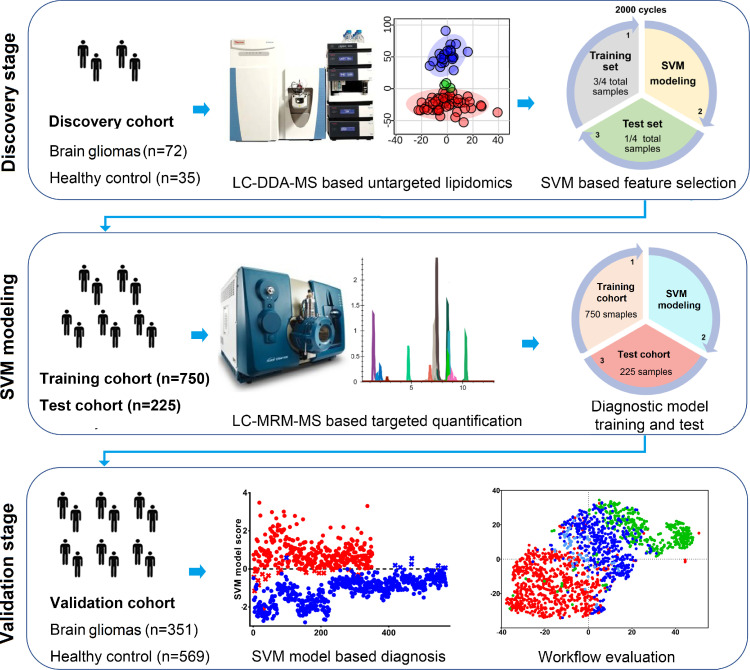
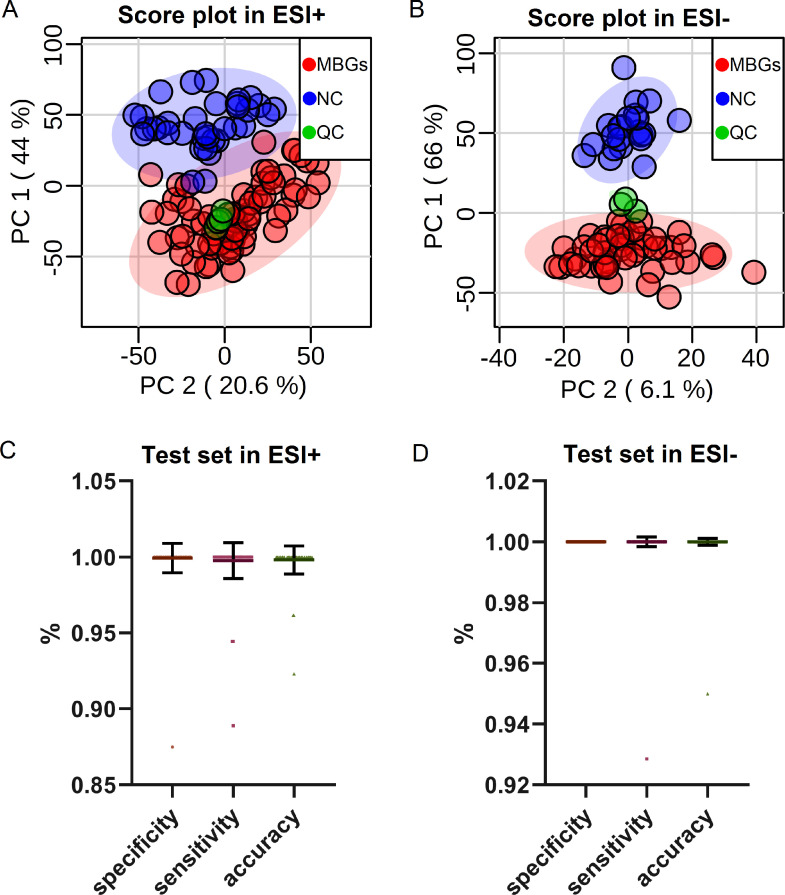
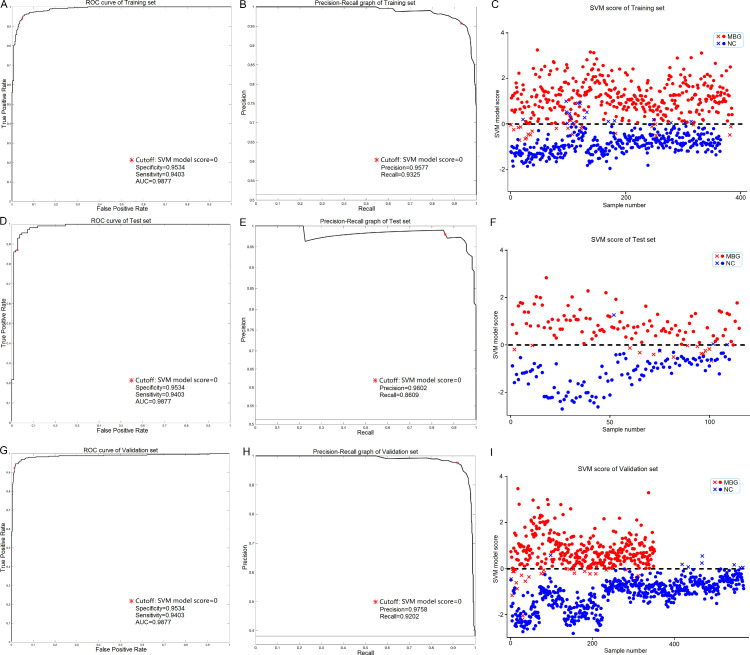
Untargeted lipidomic analysis was firstly performed using a discovery cohort (n=107). The data were processed by a support vector machine (SVM)-based discriminating model to retrieve a panel of candidate biomarkers. Then, a targeted quantification method was developed, and the SVM-based diagnostic model was constructed using a training cohort (n=750) and tested using a test cohort (n=225). Finally, the performance of the diagnostic model was further evaluated in an independent validation cohort (n=920) enrolled from multiple medical centers.
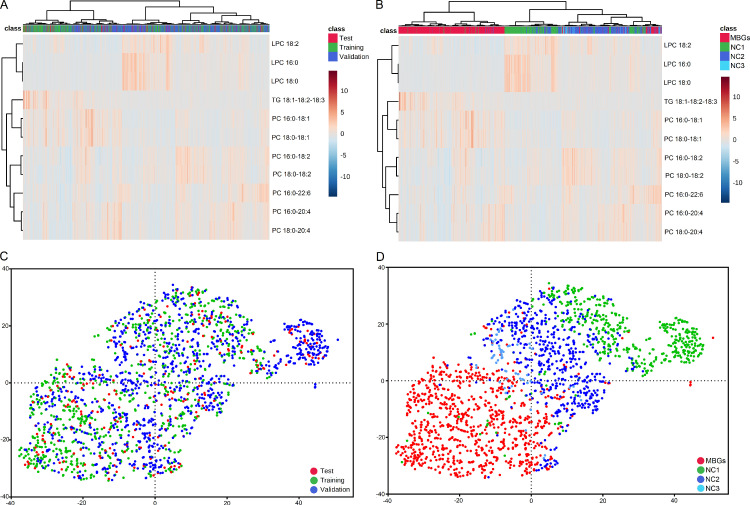
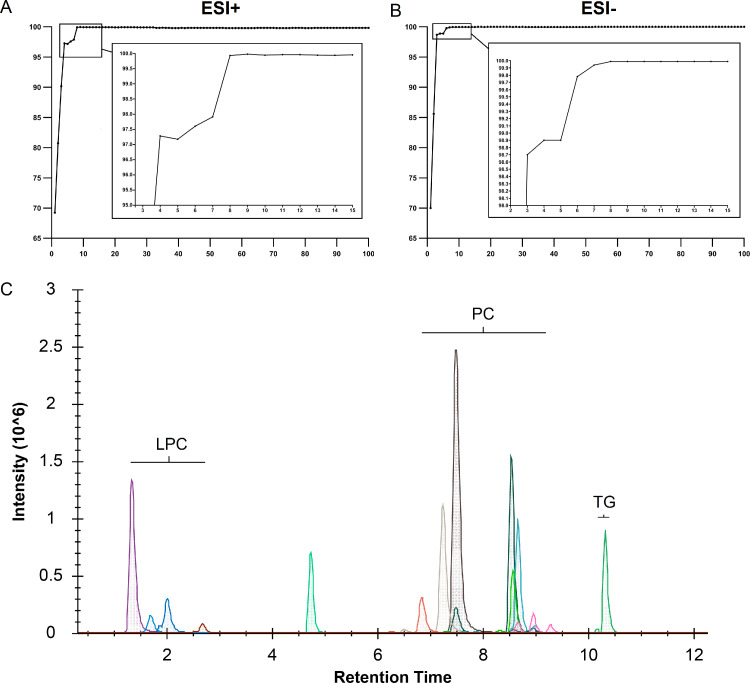
A panel of 11 plasma lipids was identified as candidate biomarkers with an accuracy of 0.999. The diagnostic model developed achieved a high performance in distinguishing MBGs patients from normal controls with an area under the receiver-operating characteristic curve (AUC) of 0.9877 and 0.9869 in the training and test cohorts, respectively. In the validation cohort, the 11 lipid panel still achieved an accuracy of 0.9641 and an AUC of 0.9866.
The present study demonstrates the applicability and robustness of utilizing a machine learning algorithm to analyze lipidomic data for efficient and reliable biomarker screening. The 11 lipid biomarkers show great potential for the non-invasive diagnosis of MBGs with high throughput.
A full list of funding bodies that contributed to this study can be found in the Acknowledgments section.
大多数恶性脑胶质瘤(MBGs)预后不良,主要是由于其诊断较晚。目前 MBGs 的诊断方法主要基于影像学和组织学检查,限制了其早期发现。在这里,我们旨在确定可靠的血浆脂质生物标志物,用于 MBGs 的非侵入性诊断。
首先使用发现队列(n=107)进行非靶向脂质组学分析。数据通过基于支持向量机(SVM)的判别模型进行处理,以检索候选生物标志物组。然后,开发了一种靶向定量方法,并使用训练队列(n=750)构建了基于 SVM 的诊断模型,并使用测试队列(n=225)进行了测试。最后,在来自多个医疗中心的独立验证队列(n=920)中进一步评估了诊断模型的性能。
确定了一组 11 种血浆脂质作为候选生物标志物,准确率为 0.999。该诊断模型在区分 MBGs 患者与正常对照方面具有很高的性能,在训练和测试队列中的曲线下面积(AUC)分别为 0.9877 和 0.9869。在验证队列中,11 种脂质组仍达到 0.9641 的准确率和 0.9866 的 AUC。
本研究证明了利用机器学习算法分析脂质组学数据进行高效可靠的生物标志物筛选的适用性和稳健性。这 11 种脂质生物标志物具有很高的潜力,可用于 MBGs 的非侵入性诊断,具有高通量的特点。
参与这项研究的资助机构的完整清单可在致谢部分找到。