Institut Pasteur, Université Paris Cité, UMR CNRS6047, Unit Evolutionary Biology of the Microbial Cell, F-75015, Paris, France.
Sorbonne Université, Collège doctoral, F-75005, Paris, France.
Nat Commun. 2022 Jun 10;13(1):3358. doi: 10.1038/s41467-022-31038-4.
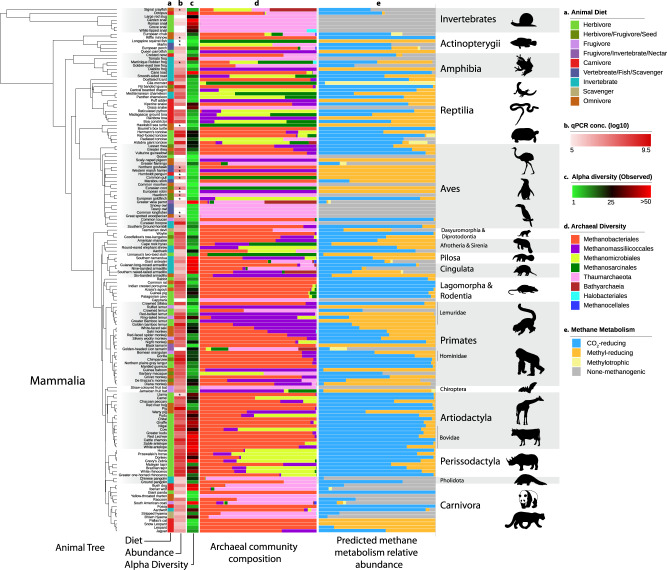
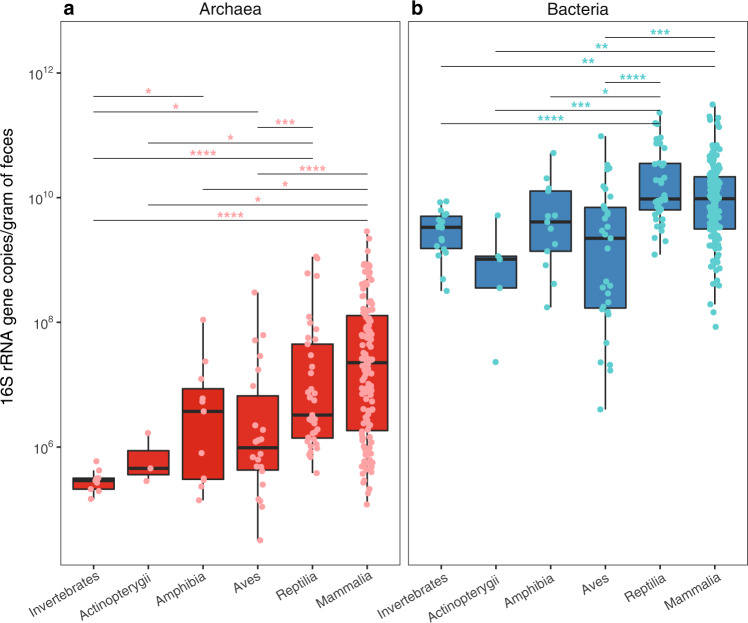
Archaea are common constituents of the gut microbiome of humans, ruminants, and termites but little is known about their diversity and abundance in other animals. Here, we analyse sequencing and quantification data of archaeal and bacterial 16S rRNA genes from 250 species of animals covering a large taxonomic spectrum. We detect the presence of archaea in 175 animal species belonging to invertebrates, fish, amphibians, birds, reptiles and mammals. We identify five dominant gut lineages, corresponding to Methanobrevibacter, Methanosphaera, Methanocorpusculum, Methanimicrococcus and "Ca. Methanomethylophilaceae". Some archaeal clades, notably within Methanobrevibacter, are associated to certain hosts, suggesting specific adaptations. The non-methanogenic lineage Nitrososphaeraceae (Thaumarchaeota) is frequently present in animal samples, although at low abundance, but may have also adapted to the gut environment. Host phylogeny, diet type, fibre content, and intestinal tract physiology are major drivers of the diversity and abundance of the archaeome in mammals. The overall abundance of archaea is more influenced by these factors than that of bacteria. Methanogens reducing methyl-compounds with H can represent an important fraction of the overall methanogens in many animals. Together with CO-reducing methanogens, they are influenced by diet and composition of gut bacteria. Our results provide key elements toward our understanding of the ecology of archaea in the gut, an emerging and important field of investigation.
古菌是人类、反刍动物和白蚁肠道微生物群的常见组成部分,但它们在其他动物中的多样性和丰度知之甚少。在这里,我们分析了涵盖广泛分类范围的 250 种动物的古菌和细菌 16S rRNA 基因的测序和定量数据。我们在属于无脊椎动物、鱼类、两栖动物、鸟类、爬行动物和哺乳动物的 175 种动物物种中检测到古菌的存在。我们确定了五个主要的肠道谱系,对应于甲烷短杆菌、甲烷球菌、甲烷微球菌、甲烷甲烷球菌和“Ca. Methanomethylophilaceae”。一些古菌类群,特别是甲烷短杆菌中的类群,与某些宿主相关,表明存在特定的适应性。非产甲烷菌科(硝化螺旋菌门)虽然丰度较低,但经常存在于动物样本中,但也可能已经适应了肠道环境。宿主进化史、饮食类型、纤维含量和肠道生理学是哺乳动物中古菌多样性和丰度的主要驱动因素。古菌的总体丰度受这些因素的影响比细菌更大。能够利用 H 还原甲基化合物的产甲烷菌可以代表许多动物中总产甲烷菌的重要组成部分。与 CO 还原产甲烷菌一起,它们受饮食和肠道细菌组成的影响。我们的研究结果为了解古菌在肠道中的生态学提供了关键要素,这是一个新兴的重要研究领域。