Xue Jinai, Gao Huiling, Xue Yinghong, Shi Ruixiang, Liu Mengmeng, Han Lijun, Gao Yu, Zhou Yali, Zhang Fei, Zhang Haiping, Jia Xiaoyun, Li Runzhi
College of Agriculture, Institute of Molecular Agriculture and Bioenergy, Shanxi Agricultural University, Taigu, China.
College of Landscape Architecture, Northeast Forestry University, Haerbin, China.
Front Plant Sci. 2022 May 25;13:854103. doi: 10.3389/fpls.2022.854103. eCollection 2022.
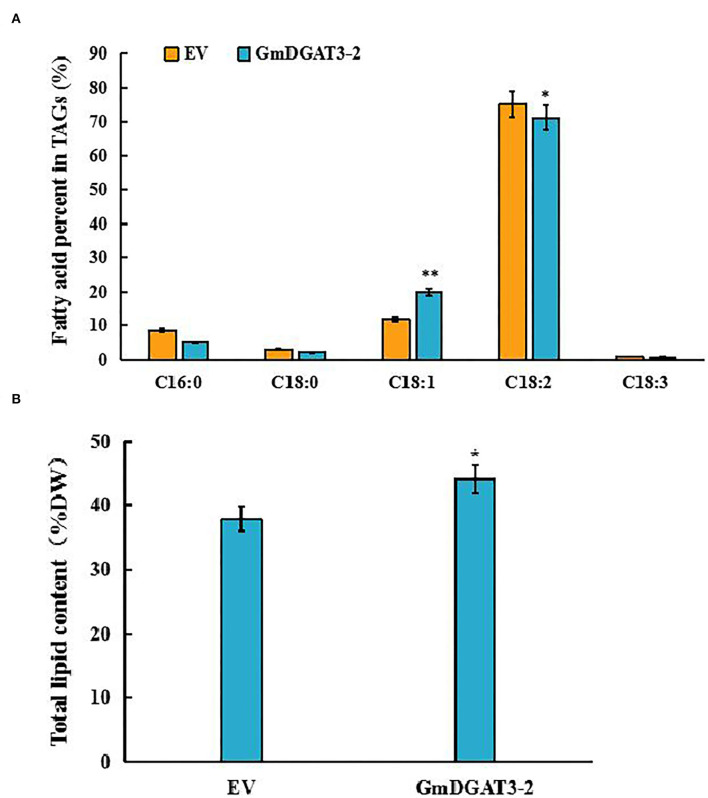
Diacylglycerol acyltransferases (DGAT) function as the key rate-limiting enzymes in biosynthesis of triacylglycerol (TAG) by transferring an acyl group from acyl-CoA to -3 of diacylglycerol (DAG) to form TAG. Here, two members of the gene family, and , were identified from the soybean () genome. Both of them were predicted to encode soluble cytosolic proteins containing the typical thioredoxin-like ferredoxin domain. Quantitative PCR analysis revealed that expression was much higher than in various soybean tissues such as leaves, flowers, and seeds. Functional complementation assay using TAG-deficient yeast () mutant H1246 demonstrated that GmDGAT3-2 fully restored TAG biosynthesis in the yeast and preferentially incorporated monounsaturated fatty acids (MUFAs), especially oleic acid (C18:1) into TAGs. This substrate specificity was further verified by fatty-acid feeding assays and enzyme activity characterization. Notably, transgenic tobacco () data showed that heterogeneous expression of resulted in a significant increase in seed oil and C18:1 levels but little change in contents of protein and starch compared to the EV-transformed tobacco plants. Taken together, GmDGAT3-2 displayed a strong enzymatic activity to catalyze TAG assembly with high substrate specificity for MUFAs, particularly C18:1, playing an important role in the cytosolic pathway of TAG synthesis in soybean. The present findings provide a scientific reference for improving oil yield and FA composition in soybean through gene modification, further expanding our knowledge of TAG biosynthesis and its regulatory mechanism in oilseeds.
二酰甘油酰基转移酶(DGAT)作为三酰甘油(TAG)生物合成中的关键限速酶,通过将酰基从酰基辅酶A转移到二酰甘油(DAG)的sn-3位以形成TAG。在此,从大豆(Glycine max)基因组中鉴定出该基因家族的两个成员,即GmDGAT3-1和GmDGAT3-2。它们均被预测编码含有典型硫氧还蛋白样铁氧化还原蛋白结构域的可溶性胞质蛋白。定量PCR分析表明,在叶片、花和种子等各种大豆组织中,GmDGAT3-2的表达远高于GmDGAT3-1。使用TAG缺陷型酵母(Saccharomyces cerevisiae)突变体H1246进行的功能互补试验表明,GmDGAT3-2完全恢复了酵母中的TAG生物合成,并优先将单不饱和脂肪酸(MUFA),尤其是油酸(C18:1)掺入TAG中。脂肪酸饲喂试验和酶活性表征进一步验证了这种底物特异性。值得注意的是,转基因烟草(Nicotiana tabacum)数据显示,与转空载体烟草植株相比,GmDGAT3-2的异源表达导致种子油和C18:1水平显著增加,但蛋白质和淀粉含量变化不大。综上所述,GmDGAT3-2表现出强大的酶活性,以高底物特异性催化TAG组装,对MUFA尤其是C18:1具有特异性,在大豆TAG合成的胞质途径中发挥重要作用。本研究结果为通过基因修饰提高大豆油产量和脂肪酸组成提供了科学参考,进一步扩展了我们对油籽中TAG生物合成及其调控机制的认识。