Suzuki Hiroyuki, Sakuma Naoko, Kobayashi Momoko, Ogawa Susumu, Inagaki Hiroki, Edahiro Ayako, Ura Chiaki, Sugiyama Mika, Miyamae Fumiko, Watanabe Yutaka, Shinkai Shoji, Awata Shuichi
Research Team for Social Participation and Community Health, Tokyo Metropolitan Institute of Gerontology, Tokyo, Japan.
Research Team for Promoting Independence and Mental Health, Tokyo Metropolitan Institute of Gerontology, Tokyo, Japan.
Front Aging Neurosci. 2022 May 25;14:832158. doi: 10.3389/fnagi.2022.832158. eCollection 2022.
Population aging is likely to increase the number of people with dementia living in urban areas. The Trail Making Test (TMT) is widely used as a cognitive task to measure attention and executive function among older adults. Normative data from a sample of community-dwelling older adults are required to evaluate the executive function of this population. The purpose of this study was to examine the Trail Making Test completion rate and completion time among urban community-dwelling older adults in Japan.
A survey was conducted at a local venue or during a home visit ( = 1,966). Cognitive tests were conducted as a part of the survey, and TMT Parts A (TMT-A) and B (TMT-B) were completed after the completion of the Japanese version of the Mini-Mental State Examination (MMSE-J). Testers recorded TMT completion status, completion time, and the number of errors observed.
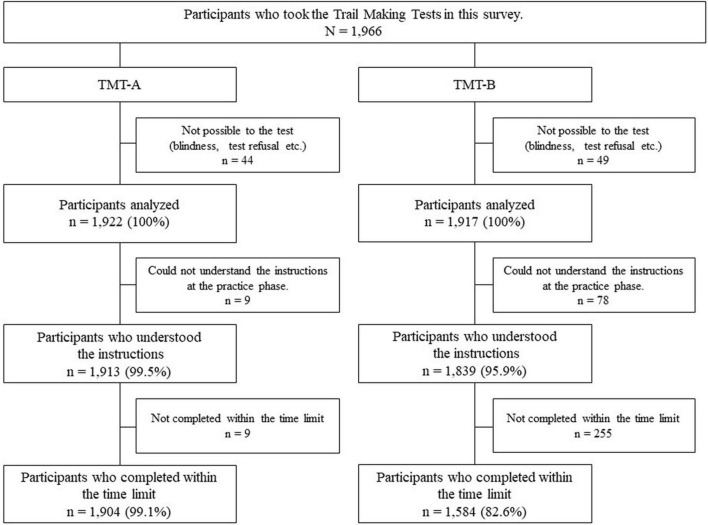
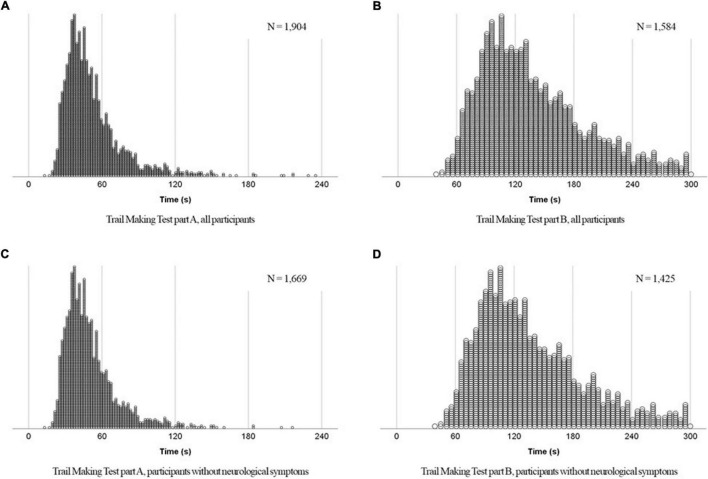
In the TMT-A, 1,913 (99.5%) participants understood the instructions, and 1,904 (99.1%) participants completed the task within the time limit of 240 s. In the TMT-B, 1,839 (95.9%) participants understood the instructions, and 1,584 (82.6%) participants completed the task within the time limit of 300 s. The completion rate of TMT-B was 90.2 and 41.8% for participants with an MMSE-J score of >23 points and ≦23 points, respectively. Results of multiple regression analyses showed that age, education, and the MMSE-J score were associated with completion time in both TMTs.
In both TMTs, completion time was associated with age, education, and general cognitive function. However, not all participants completed the TMT-B, and the completion rate was relatively low among participants with low MMSE-J scores. These findings may help interpret future TMT assessments.
人口老龄化可能会增加城市地区痴呆症患者的数量。连线测验(TMT)作为一项认知任务被广泛用于测量老年人的注意力和执行功能。需要来自社区居住老年人样本的常模数据来评估该人群的执行功能。本研究的目的是调查日本城市社区居住老年人的连线测验完成率和完成时间。
在当地场所或家访期间进行了一项调查(n = 1966)。认知测试作为调查的一部分进行,在完成日语版简易精神状态检查表(MMSE-J)后完成TMT A部分(TMT-A)和B部分(TMT-B)。测试人员记录了TMT的完成状态、完成时间和观察到的错误数量。
在TMT-A中,1913名(99.5%)参与者理解了指导语,1904名(99.1%)参与者在240秒的时间限制内完成了任务。在TMT-B中,1839名(95.9%)参与者理解了指导语,1584名(82.6%)参与者在300秒的时间限制内完成了任务。MMSE-J得分>23分和≤23分的参与者的TMT-B完成率分别为90.2%和41.8%。多元回归分析结果表明,年龄、教育程度和MMSE-J得分与两个TMT的完成时间均相关。
在两个TMT中,完成时间均与年龄、教育程度和一般认知功能相关。然而,并非所有参与者都完成了TMT-B,MMSE-J得分较低的参与者完成率相对较低。这些发现可能有助于解释未来的TMT评估结果。