Division of Immunology, Boston Children's Hospital, Boston, MA, United States.
Front Immunol. 2022 May 27;13:905109. doi: 10.3389/fimmu.2022.905109. eCollection 2022.
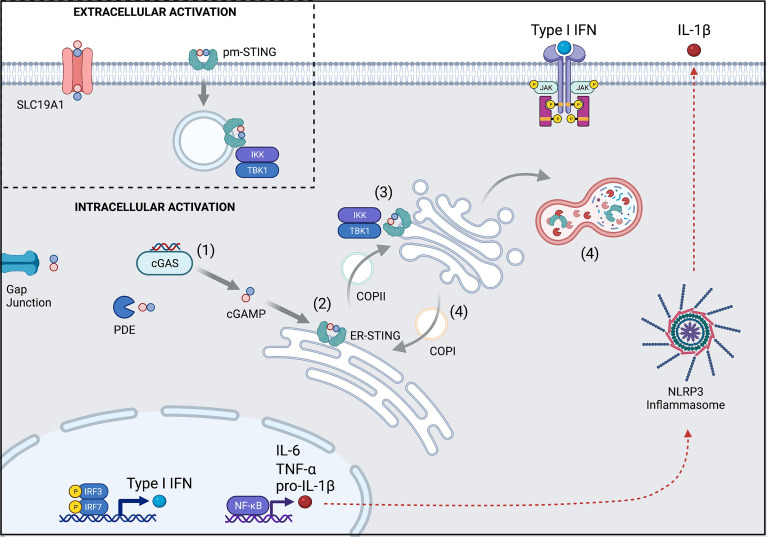
One of the oldest mechanisms of immune defense against pathogens is through detection of foreign DNA. Since human DNA is compartmentalized into the nucleus, its presence in the cytosol heralds a potential threat. The cGAS-STING pathway is one of the most important cytosolic DNA sensing pathways and leads to interferon signaling, inflammasome activation, autophagy, and cell death. While STING signaling is protective at physiologic levels, chronic activation of this pathway can instead drive autoinflammation and autoimmunity. Here we discuss several monogenic disorders of the STING pathway that highlight its impact on both innate and adaptive immunity in the progressive loss of tolerance. The potential relevance of STING signaling in systemic lupus erythematosus is then discussed with a focus on future avenues for monitoring and targeting this pathway.
针对病原体的免疫防御的最古老机制之一是通过检测外来 DNA。由于人类 DNA 被分隔到细胞核内,其在细胞质中的存在预示着潜在的威胁。cGAS-STING 途径是最重要的细胞质 DNA 感应途径之一,可导致干扰素信号转导、炎性小体激活、自噬和细胞死亡。虽然在生理水平上 STING 信号具有保护作用,但该途径的慢性激活反而会导致自身炎症和自身免疫。在这里,我们讨论了几种 STING 途径的单基因疾病,这些疾病突出了其在逐渐失去耐受性的过程中对先天免疫和适应性免疫的影响。然后讨论了 STING 信号在系统性红斑狼疮中的潜在相关性,并重点介绍了监测和靶向该途径的未来途径。