Jones Amy V, MacGregor Stuart, Han Xikun, Francis James, Harris Claire, Kavanagh David, Lotery Andrew, Waheed Nadia
Gyroscope Therapeutics Ltd, London, UK.
Statistical Genetics, QIMR Berghofer Medical Research Institute, Brisbane, Australia.
Ophthalmol Sci. 2022 Jun;2(2). doi: 10.1016/j.xops.2022.100146. Epub 2022 Mar 18.
Risk of advanced age-related macular degeneration (AAMD) is associated with rare genetic variants in the gene encoding Complement factor I (), which is associated with lower circulating CFI protein levels, but the nature of the relationship is unclear.
Can genetic factors be used to infer whether low circulating CFI is associated with AAMD risk?
Two-sample inverse variance weighted Mendelian Randomisation (MR) was used to evaluate evidence for a relationship between CFI levels and AAMD risk, comparing CFI levels from genetically predefined subsets in AAMD and control cohorts.
Published genetic and proteomic data was combined with data from cohorts of Geographic Atrophy (GA) patients in a series of MR analyses.
We derived genetic instruments for systemic CFI level in 3,301 healthy European participants in the INTERVAL study. To evaluate a genetic causal odds ratio (OR) for the effect of CFI levels on AAMD risk, we used results from a genome-wide association study of 12,711 AAMD cases and 14,590 European controls from the International AMD Genomics Consortium (IAMDGC), and CFI levels from patients entered into the research studies SCOPE and SIGHT.
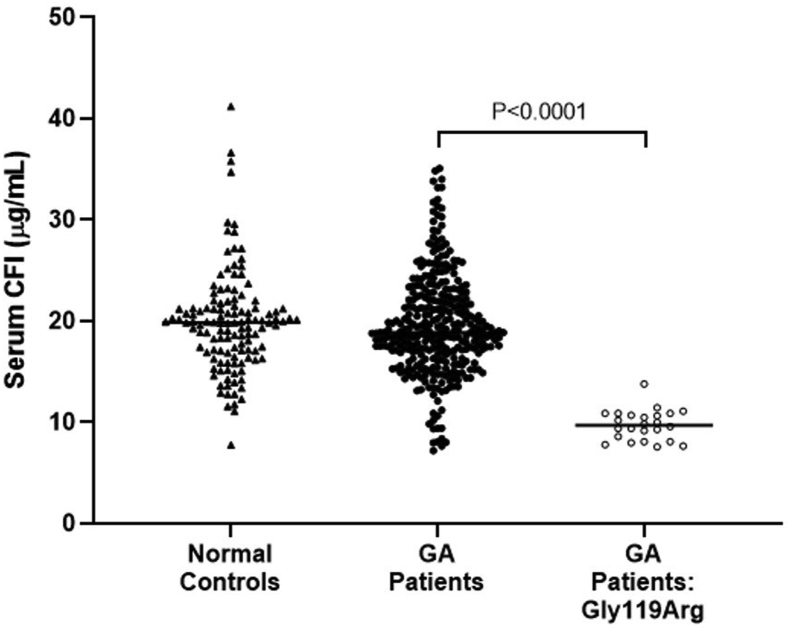
We identified one common variant rs7439493 which was strongly associated with low CFI level, explaining 4.8% of phenotypic variance. Using rs7439493 our MR analysis estimated that AAMD odds increased per standard deviation (SD) decrease in CFI level; OR 1.47 (95% confidence interval (CI) 1.30-1.65, =2.1×10). We identified one rare variant (rs141853578 encoding p.Gly119Arg) which was genome-wide significantly associated with CFI levels after imputation; based on this, a 1 SD decrease in CFI leads to increased AAMD odds of 1.79 (95% CI 1.46-2.19, =1.9×10). The rare variant rs141853578 explained a further 1.7% of phenotypic variance. To benchmark the effect of low CFI levels on AAMD odds using a CFI-specific proteomic assay, we estimated the effect using CFI levels from 24 rs141853578 positive GA patients; each 1 SD (3.5μg/mL) reduction in CFI was associated with 1.67 fold increased odds of AAMD (95% CI 1.40-2.00, =1.85×10).
Excellent concordance in direction and effect size derived from rare and common variant calculations provide good genetic evidence for a potentially causal role of lower CFI level increasing AAMD risk.
晚期年龄相关性黄斑变性(AAMD)的风险与编码补体因子I(CFI)的基因中的罕见遗传变异有关,这与循环CFI蛋白水平降低有关,但这种关系的本质尚不清楚。
遗传因素能否用于推断循环CFI水平低是否与AAMD风险相关?
采用两样本逆方差加权孟德尔随机化(MR)方法评估CFI水平与AAMD风险之间关系的证据,比较AAMD和对照队列中基因预定义亚组的CFI水平。
在一系列MR分析中,将已发表的遗传和蛋白质组学数据与地理萎缩(GA)患者队列的数据相结合。
我们在INTERVAL研究中的3301名健康欧洲参与者中得出了全身CFI水平的遗传工具。为了评估CFI水平对AAMD风险影响的遗传因果优势比(OR),我们使用了来自国际AMD基因组学联盟(IAMDGC)的12711例AAMD病例和14590名欧洲对照的全基因组关联研究结果,以及进入SCOPE和SIGHT研究的患者的CFI水平。
我们鉴定出一个常见变异rs7439493,它与低CFI水平密切相关,解释了4.8%的表型变异。使用rs7439493,我们的MR分析估计,CFI水平每降低一个标准差(SD),AAMD的优势增加;OR为1.47(95%置信区间(CI)1.30-1.65,P = 2.1×10⁻¹²)。我们鉴定出一个罕见变异(rs141853578,编码p.Gly119Arg),在进行归因后,它在全基因组范围内与CFI水平显著相关;基于此,CFI降低1个SD会导致AAMD优势增加1.79(95%CI 1.46-2.19,P = 1.9×10⁻¹²)。罕见变异rs141853578又解释了1.7%的表型变异。为了使用CFI特异性蛋白质组学检测来衡量低CFI水平对AAMD优势的影响,我们使用24名rs141853578阳性GA患者的CFI水平估计了这种影响;CFI每降低1个SD(3.5μg/mL),AAMD的优势增加1.67倍(95%CI 1.40-2.00,P = 1.85×10⁻¹²)。
罕见和常见变异计算得出的方向和效应大小具有高度一致性,为低CFI水平增加AAMD风险的潜在因果作用提供了有力的遗传证据。