Rooks Nynke B, Besier Thor F, Schneider Marco T Y
Auckland Bioengineering Institute, University of Auckland, Auckland, New Zealand.
Department of Engineering Science, Faculty of Engineering, University of Auckland, Auckland, New Zealand.
Front Bioeng Biotechnol. 2022 May 26;10:841882. doi: 10.3389/fbioe.2022.841882. eCollection 2022.
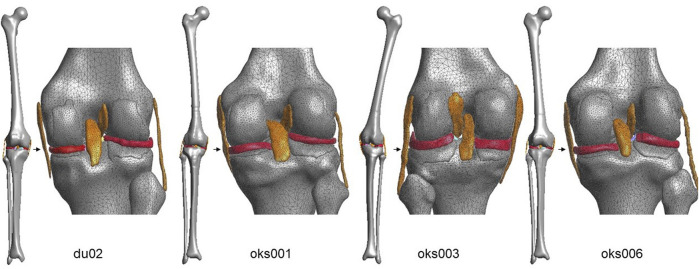
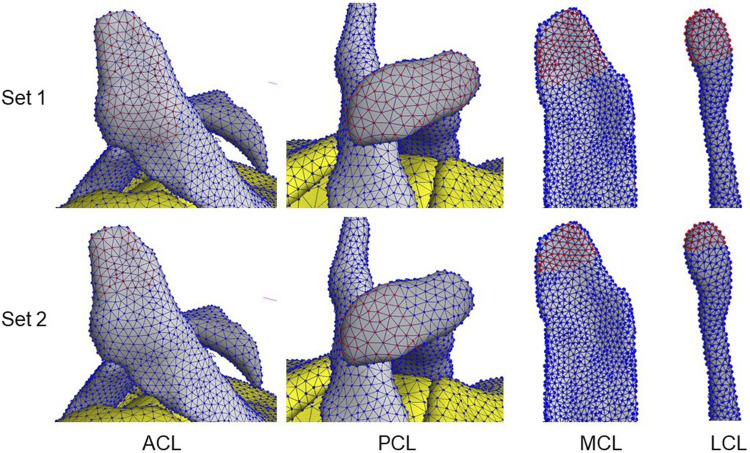
The reproducibility of computational knee joint modeling is questionable, with models varying depending on the modeling team. The influence of model variations on simulation outcomes should be investigated, since knowing the sensitivity of the model outcomes to model parameters could help determine which parameters to calibrate and which parameters could potentially be standardized, improving model reproducibility. Previous sensitivity analyses on finite element knee joint models have typically used one model, with a few parameters and ligaments represented as line segments. In this study, a parameter sensitivity analysis was performed using multiple finite element knee joint models with continuum ligament representations. Four previously developed and calibrated models of the tibiofemoral joint were used. Parameters of the ligament and meniscus material models, the cartilage contact formulation, the simulation control and the rigid cylindrical joints were studied. Varus-valgus simulations were performed, changing one parameter at a time. The sensitivity on model convergence, valgus kinematics, articulating cartilage contact pressure and contact pressure location were investigated. A scoring system was defined to categorize the parameters as having a "large," "medium" or "small" influence on model output. Model outcomes were sensitive to the ligament prestretch factor, Young's modulus and attachment condition parameters. Changes in the meniscus horn stiffness had a "small" influence. Of the cartilage contact parameters, the penalty factor and Augmented Lagrangian setting had a "large" influence on the cartilage contact pressure. In the rigid cylindrical joint, the largest influence on the outcome parameters was found by the moment penalty parameter, which caused convergence issues. The force penalty and gap tolerance had a "small" influence at most. For the majority of parameters, the sensitivity was model-dependent. For example, only two models showed convergence issues when changing the Quasi-Newton update method. Due to the sensitivity of the model parameters being model-specific, the sensitivity of the parameters found in one model cannot be assumed to be the same in other models. The sensitivity of the model outcomes to ligament material properties confirms that calibration of these parameters is critical and using literature values may not be appropriate.
计算膝关节模型的可重复性存在疑问,不同建模团队构建的模型存在差异。应研究模型变化对模拟结果的影响,因为了解模型结果对模型参数的敏感性有助于确定哪些参数需要校准以及哪些参数可能可以标准化,从而提高模型的可重复性。以往对有限元膝关节模型的敏感性分析通常只使用一个模型,且仅有少数参数和韧带被表示为线段。在本研究中,使用具有连续韧带表示的多个有限元膝关节模型进行了参数敏感性分析。使用了四个先前开发并校准的胫股关节模型。研究了韧带和半月板材料模型的参数、软骨接触公式、模拟控制以及刚性圆柱关节。进行了内翻 - 外翻模拟,每次改变一个参数。研究了模型收敛、外翻运动学、关节软骨接触压力和接触压力位置的敏感性。定义了一个评分系统,将参数对模型输出的影响分为“大”、“中”或“小”。模型结果对韧带预拉伸因子、杨氏模量和附着条件参数敏感。半月板角刚度的变化影响“小”。在软骨接触参数中,惩罚因子和增强拉格朗日设置对软骨接触压力影响“大”。在刚性圆柱关节中,发现力矩惩罚参数对结果参数影响最大,会导致收敛问题。力惩罚和间隙公差影响至多“小”。对于大多数参数,敏感性因模型而异。例如,仅两个模型在改变拟牛顿更新方法时出现收敛问题。由于模型参数的敏感性因模型而异,不能假定在一个模型中发现的参数敏感性在其他模型中相同。模型结果对韧带材料特性的敏感性证实了校准这些参数至关重要,使用文献值可能不合适。