Behrendt Tom, Bielitzki Robert, Behrens Martin, Glazachev Oleg S, Schega Lutz
Department for Sport Science, Chair for Health and Physical Activity, Otto-von-Guericke University Magdeburg, Magdeburg, Germany.
Department of Orthopedics, Rostock University Medical Center, Rostock, Germany.
Front Physiol. 2022 May 26;13:899096. doi: 10.3389/fphys.2022.899096. eCollection 2022.
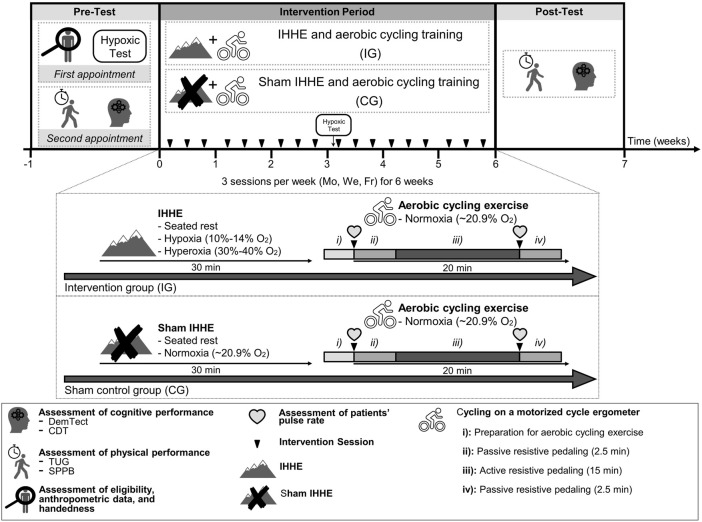
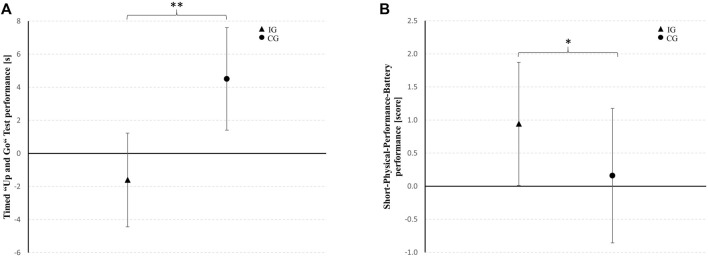
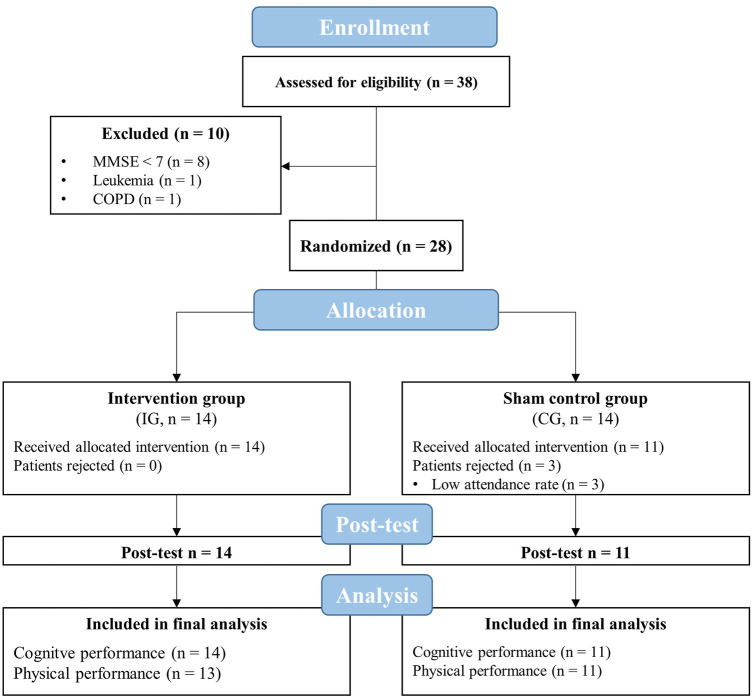
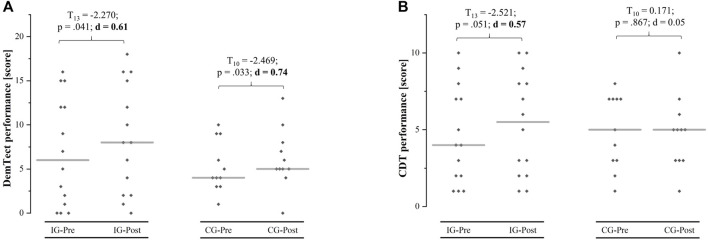
It was recently shown that intermittent hypoxic-hyperoxic exposure (IHHE) applied prior to a multimodal training program promoted additional improvements in cognitive and physical performance in geriatric patients compared to physical training only. However, there is a gap in the literature to which extent the addition of IHHE can enhance the effects of an aerobic training. Therefore, the aim of this study was to investigate the efficacy of IHHE applied prior to aerobic cycling exercise on cognitive and physical performance in geriatric patients. In a randomized, two-armed, controlled, and single-blinded trial, 25 geriatric patients (77-94 years) were assigned to two groups: intervention group (IG) and sham control group (CG). Both groups completed 6 weeks of aerobic training using a motorized cycle ergometer, three times a week for 20 min per day. The IG was additionally exposed to intermittent hypoxic and hyperoxic periods for 30 min prior to exercise. The CG followed the similar procedure breathing sham hypoxia and hyperoxia (i.e., normoxia). Within 1 week before and after the interventions, cognitive performance was assessed with the Dementia-Detection Test (DemTect) and the Clock Drawing Test (CDT), while physical performance was measured using the Timed "Up and Go" Test (TUG) and the Short-Physical-Performance-Battery (SPPB). No interaction effect was found with respect to the DemTect ( = 0.02). An interaction effect with medium effect size ( = 0.08) was found for CDT performance with a higher change over time for IG ( = 0.57) compared to CG ( = 0.05). The ANCOVA with baseline-adjustment indicated between-group differences with a large and medium effect size at post-test for the TUG ( = 0.29) and SPPB ( = 0.06) performance, respectively, in favour of the IG. Within-group post-hoc analysis showed that the TUG performance was worsened in the CG ( = 0.65) and remained unchanged in the IG ( = 0.19). Furthermore, SPPB performance was increased ( = 0.58) in IG, but no relevant change over time was found for CG ( = 0.00). The current study suggests that an additional IHHE prior to aerobic cycling exercise seems to be more effective to increase global cognitive functions as well as physical performance and to preserve functional mobility in geriatric patients in comparison to aerobic exercise alone after a 6-week intervention period.
最近的研究表明,与仅进行体育训练相比,在多模式训练计划之前进行间歇性低氧-高氧暴露(IHHE)能使老年患者的认知和身体表现得到更大改善。然而,关于添加IHHE能在多大程度上增强有氧运动训练效果的文献存在空白。因此,本研究的目的是调查在有氧自行车运动之前应用IHHE对老年患者认知和身体表现的疗效。在一项随机、双臂、对照、单盲试验中,25名老年患者(77 - 94岁)被分为两组:干预组(IG)和假对照组(CG)。两组均使用电动自行车测力计完成6周的有氧运动训练,每周三次,每次20分钟。IG组在运动前还额外接受30分钟的间歇性低氧和高氧暴露。CG组按照类似程序呼吸假低氧和高氧(即常氧)。在干预前后1周内,使用痴呆检测测试(DemTect)和画钟试验(CDT)评估认知表现,同时使用定时起立行走测试(TUG)和简短身体性能量表(SPPB)测量身体表现。未发现DemTect有交互作用(= 0.02)。发现CDT表现有中等效应大小的交互作用(= 0.08),与CG组(= 0.05)相比,IG组随时间的变化更大(= 0.57)。进行基线调整的协方差分析表明,在测试后,TUG(= 0.29)和SPPB(= 0.06)表现的组间差异分别具有大效应大小和中等效应大小,有利于IG组。组内事后分析表明,CG组的TUG表现变差(= 0.65),而IG组保持不变(= 0.19)。此外,IG组的SPPB表现有所提高(= 0.58),但CG组未发现随时间的相关变化(= 0.00)。当前研究表明,在6周的干预期后,与单独进行有氧运动相比,在有氧自行车运动之前额外进行IHHE似乎更有效地提高老年患者的整体认知功能以及身体表现,并保持功能活动能力。