
足细胞计数:一种强大的、全自动的全玻片足细胞定量工具。
PodoCount: A Robust, Fully Automated, Whole-Slide Podocyte Quantification Tool.
作者信息
Santo Briana A, Govind Darshana, Daneshpajouhnejad Parnaz, Yang Xiaoping, Wang Xiaoxin X, Myakala Komuraiah, Jones Bryce A, Levi Moshe, Kopp Jeffrey B, Yoshida Teruhiko, Niedernhofer Laura J, Manthey David, Moon Kyung Chul, Han Seung Seok, Zee Jarcy, Rosenberg Avi Z, Sarder Pinaki
机构信息
Department of Pathology and Anatomical Sciences, University at Buffalo, Buffalo, New York, USA.
Department of Pathology, Johns Hopkins University School of Medicine, Baltimore, Maryland, USA.
出版信息
Kidney Int Rep. 2022 Jun 3;7(6):1377-1392. doi: 10.1016/j.ekir.2022.03.004. eCollection 2022 Jun.
INTRODUCTION
Podocyte depletion is a histomorphologic indicator of glomerular injury and predicts clinical outcomes. Podocyte estimation methods or podometrics are semiquantitative, technically involved, and laborious. Implementation of high-throughput podometrics in experimental and clinical workflows necessitates an automated podometrics pipeline. Recognizing that computational image analysis offers a robust approach to study cell and tissue structure, we developed and validated PodoCount (a computational tool for automated podocyte quantification in immunohistochemically labeled tissues) using a diverse data set.
METHODS
Whole-slide images (WSIs) of tissues immunostained with a podocyte nuclear marker and periodic acid-Schiff counterstain were acquired. The data set consisted of murine whole kidney sections ( = 135) from 6 disease models and human kidney biopsy specimens from patients with diabetic nephropathy (DN) ( = 45). Within segmented glomeruli, podocytes were extracted and image analysis was applied to compute measures of podocyte depletion and nuclear morphometry. Computational performance evaluation and statistical testing were performed to validate podometric and associated image features. PodoCount was disbursed as an open-source, cloud-based computational tool.
RESULTS
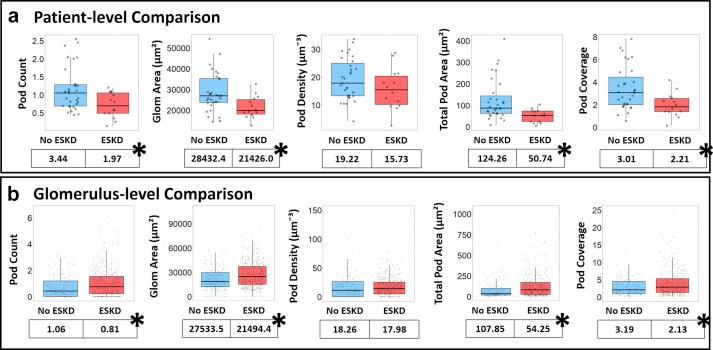
PodoCount produced highly accurate podocyte quantification when benchmarked against existing methods. Podocyte nuclear profiles were identified with 0.98 accuracy and segmented with 0.85 sensitivity and 0.99 specificity. Errors in podocyte count were bounded by 1 podocyte per glomerulus. Podocyte-specific image features were found to be significant predictors of disease state, proteinuria, and clinical outcome.
CONCLUSION
PodoCount offers high-performance podocyte quantitation in diverse murine disease models and in human kidney biopsy specimens. Resultant features offer significant correlation with associated metadata and outcome. Our cloud-based tool will provide end users with a standardized approach for automated podometrics from gigapixel-sized WSIs.
引言
足细胞减少是肾小球损伤的组织形态学指标,并可预测临床结果。足细胞估计方法或足细胞计量学是半定量的,技术要求高且费力。在实验和临床工作流程中实施高通量足细胞计量学需要一个自动化的足细胞计量流程。认识到计算机图像分析为研究细胞和组织结构提供了一种强大的方法,我们使用多样的数据集开发并验证了PodoCount(一种用于免疫组织化学标记组织中足细胞自动定量的计算工具)。
方法
获取用足细胞核标记物免疫染色并用高碘酸-希夫复染的组织全切片图像(WSIs)。数据集包括来自6种疾病模型的小鼠全肾切片(n = 135)和糖尿病肾病(DN)患者的人肾活检标本(n = 45)。在分割的肾小球内,提取足细胞并应用图像分析来计算足细胞减少和核形态计量学的指标。进行计算性能评估和统计测试以验证足细胞计量及相关图像特征。PodoCount作为一种基于云的开源计算工具发布。
结果
与现有方法相比,PodoCount产生了高度准确的足细胞定量结果。足细胞核轮廓识别的准确率为0.98,分割的灵敏度为0.85,特异性为0.99。每个肾小球足细胞计数的误差限制在1个足细胞以内。发现足细胞特异性图像特征是疾病状态、蛋白尿和临床结果的重要预测指标。
结论
PodoCount在多种小鼠疾病模型和人肾活检标本中提供了高性能的足细胞定量。所得特征与相关元数据和结果具有显著相关性。我们基于云的工具将为最终用户提供一种从千兆像素大小的WSIs进行自动足细胞计量的标准化方法。


 Zotero 插件