Biglaiser Glen, McGauvran Ronald J
Department of Political Science, University of North Texas, Denton, TX USA.
Department of Sociology and Political Science, Tennessee Tech University, 1 William L Jones Drive Box 5052, Cookeville, TN 38501 USA.
J Int Relat Dev (Ljubl). 2022;25(3):806-833. doi: 10.1057/s41268-022-00263-1. Epub 2022 Jun 7.
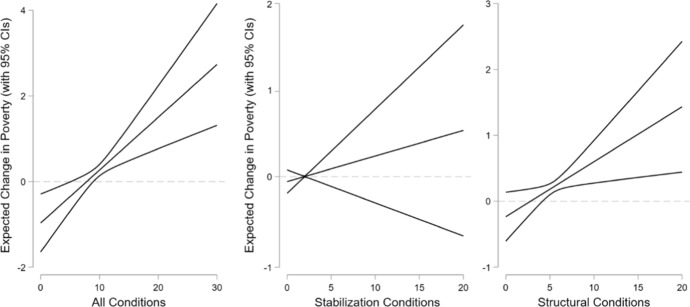
Although the International Monetary Fund (IMF) claims that poverty reduction is one of its objectives, some studies show that IMF borrower countries experience higher rates of poverty. This paper investigates the effects of IMF loan conditions on poverty. Using a sample of 81 developing countries from 1986 to 2016, we find that IMF loan arrangements containing structural reforms contribute to more people getting trapped in the poverty cycle, as the reforms involve deep and comprehensive changes that tend to raise unemployment, lower government revenue, increase costs of basic services, and restructure tax collection, pensions, and social security programmes. Conversely, we observe that loan arrangements promoting stabilisation reforms have less impact on the poor because borrower states hold more discretion over their macroeconomic targets. Further, we disaggregate structural reforms to identify the particular policies that increase poverty. Our findings are robust to different specifications and indicate how IMF loan arrangements affect poverty in the developing world.
The online version contains supplementary material available at 10.1057/s41268-022-00263-1.
尽管国际货币基金组织(IMF)宣称减贫是其目标之一,但一些研究表明,接受IMF贷款的国家贫困率更高。本文研究了IMF贷款条件对贫困的影响。通过对1986年至2016年81个发展中国家的样本进行研究,我们发现,包含结构性改革的IMF贷款安排会导致更多人陷入贫困循环,因为这些改革涉及深刻而全面的变革,往往会导致失业率上升、政府收入下降、基本服务成本增加,以及税收、养老金和社会保障计划的重组。相反,我们观察到,促进稳定化改革的贷款安排对贫困人口的影响较小,因为借款国在宏观经济目标方面拥有更大的自主权。此外,我们对结构性改革进行细分,以确定导致贫困加剧的具体政策。我们的研究结果在不同的设定下都很稳健,并表明了IMF贷款安排如何影响发展中世界的贫困状况。
在线版本包含可在10.1057/s41268-022-00263-1获取的补充材料。