IBD Center, Department of Gastroenterology, Humanitas Clinical and Research Center - IRCCS, Rozzano, Milan, Italy.
Italian National Research Council Institute of Clinical Physiology, Pisa, Italy.
J Crohns Colitis. 2022 Nov 1;16(10):1637-1646. doi: 10.1093/ecco-jcc/jjac082.
Ultrasound elastography [USE] is an innovative, non-invasive, promptly available, ancillary technique that has been proposed in the evaluation of intestinal fibrosis as a monitorable biomarker, in terms of stiffness. The non-invasive estimate of fibrosis by USE appears appealing for dedicated physicians, in order to optimise the treatments for inflammatory bowel disease [IBD] patients [surgical vs non-surgical]. We aimed to systematically review literature evidence on ultrasound elastography in IBD patients.
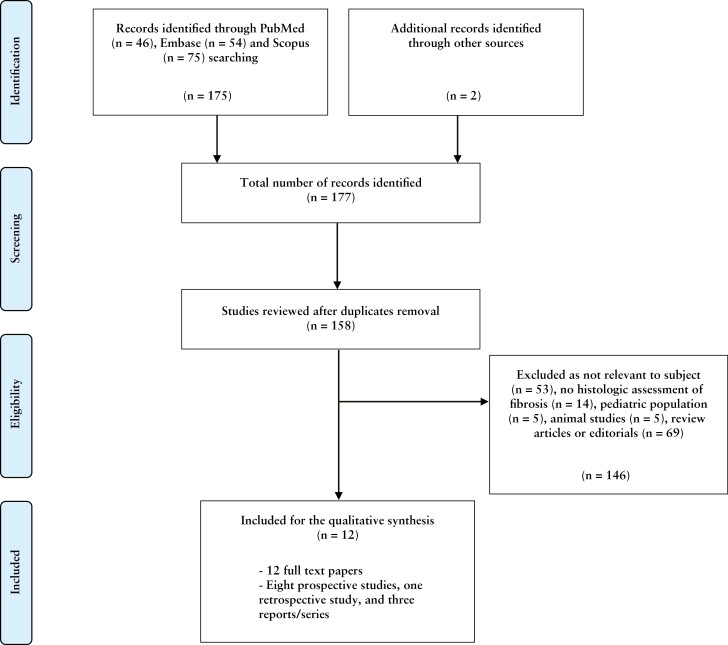
For this qualitative systematic review, we searched PubMed, EMBASE, and Scopus to identify all studies, published until October 2021, investigating the application of USE in IBD patients compared with histopathological assessment.
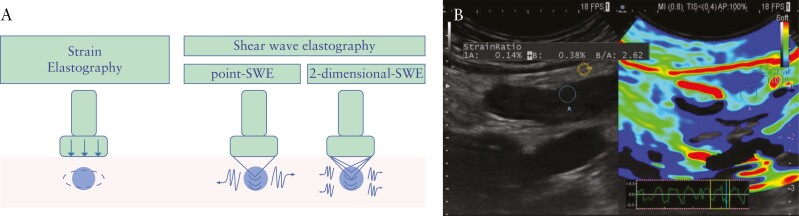
Overall, 12 papers published between 2011 and 2019 were included. A total of 275 IBD patients were included: 272 Crohn's disease [CD] [98.9%] and three ulcerative colitis [UC] [1.1%]. Seven [58.3%] and four [41.6%] studies investigated strain elastography [SE] and shear wave elastography [SWE], respectively; in one study [0.1%] both techniques were addressed. The histological evaluation was largely conducted on surgical specimens and in two studies endoscopic biopsies were also included. The histological assessment was semi-quantitative in all the included studies, except for two where the fibrosis was evaluated only qualitatively. In 10/12 publications USE could accurately distinguish inflammation from fibrosis in the examined bowel tracts.
From the preliminary available data, an overall moderate-to-good accuracy of USE in detecting histological fibrosis [10/12 studies] was found. Point-shear wave elastography has been shown to perform superiorly. Further studies are needed to confirm these evidences.
超声弹性成像[USE]是一种创新的、非侵入性的、即时可用的辅助技术,已被提出用于评估肠道纤维化,作为一种可监测的硬度生物标志物。USE 对纤维化的非侵入性估计对专门的医生很有吸引力,以便优化炎症性肠病[IBD]患者的治疗[手术与非手术]。我们旨在系统地回顾 USE 在 IBD 患者中的文献证据。
对于这项定性系统综述,我们在 PubMed、EMBASE 和 Scopus 中搜索了所有发表至 2021 年 10 月的研究,这些研究调查了 USE 在 IBD 患者中的应用,与组织病理学评估进行了比较。
共纳入了 2011 年至 2019 年期间发表的 12 篇论文。共有 275 例 IBD 患者入组:272 例克罗恩病[CD][98.9%]和 3 例溃疡性结肠炎[UC][1.1%]。分别有 7 项[58.3%]和 4 项[41.6%]研究调查了应变弹性成像[SE]和剪切波弹性成像[SWE],1 项研究[0.1%]同时涉及这两种技术。组织学评估主要在手术标本上进行,在两项研究中还包括了内镜活检。除了两项研究仅对纤维化进行定性评估外,所有纳入的研究均对纤维化进行了半定量评估。在 10/12 篇出版物中,USE 能够准确地区分检查肠道中的炎症与纤维化。
从初步可用的数据来看,USE 在检测组织学纤维化方面具有中等至良好的准确性[10/12 项研究]。点剪切波弹性成像显示出更好的性能。需要进一步的研究来证实这些证据。