Department of Molecular Neurology, Universitätsklinikum Erlangen, Molekulare Neurologie, Friedrich-Alexander-Universität Erlangen-Nürnberg (FAU), Schwabachanlage 6, 91054, Erlangen, Germany.
Fraunhofer IIS, Fraunhofer Institute for Integrated Circuits IIS, Am Wolfsmantel 33, 91058, Erlangen, Germany.
J Neural Transm (Vienna). 2022 Sep;129(9):1189-1200. doi: 10.1007/s00702-022-02514-4. Epub 2022 Jun 13.
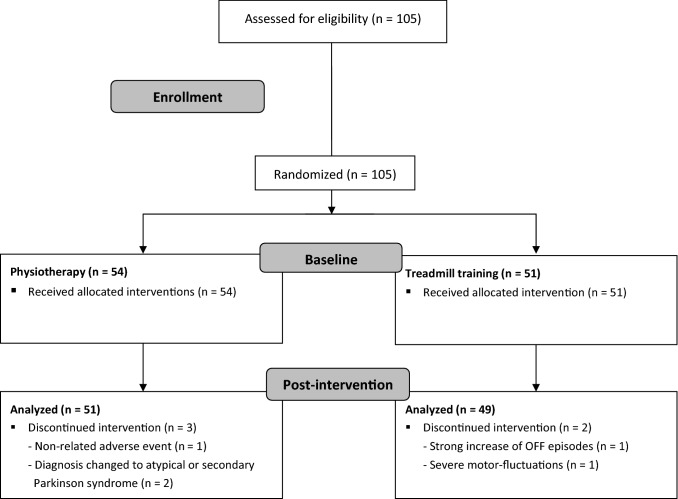
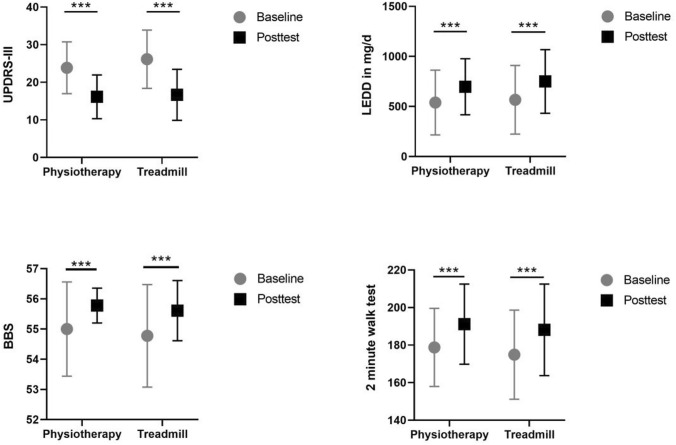
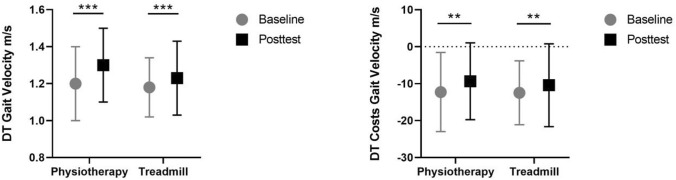
Motor-cognitive dual tasks are used to investigate the interplay between gait and cognition. Dual task walking in patients with Parkinson's disease (PD) results in decreased gait speed and more importantly in an increased fall risk. There is evidence that physical training may improve gait during dual task challenge. Physiotherapy and treadmill walking are known to improve single task gait. The aim of this study was to investigate the impact of individualized physiotherapy or treadmill training on gait during dual task performance. 105 PD patients were randomly assigned to an intervention group (physiotherapy or treadmill). Both groups received 10 individual interventional sessions of 25 min each and additional group therapy sessions for 14 days. Primary outcome measure was the dual task gait speed. Secondary outcomes were additional gait parameters during dual task walking, UPDRS-III, BBS and walking capacity. All gait parameters were recorded using sensor-based gait analysis. Gait speed improved significantly by 4.2% (treadmill) and 8.3% (physiotherapy). Almost all secondary gait parameters, UPDRS-III, BBS, and walking capacity improved significantly and similarly in both groups. However, interaction effects were not observed. Both interventions significantly improved gait in patients with mild to moderate PD. However, treadmill walking did not show significant benefits compared to individualized physiotherapy. Our data suggest that both interventions improve dual task walking and therefore support safe and independent walking. This result may lead to more tailored therapeutic preferences.
运动认知双重任务用于研究步态和认知之间的相互作用。帕金森病(PD)患者的双重任务行走会导致步态速度降低,更重要的是跌倒风险增加。有证据表明,身体训练可能会改善双重任务挑战中的步态。物理疗法和跑步机行走已知可改善单一任务步态。本研究旨在探讨个体化物理治疗或跑步机训练对双重任务表现时步态的影响。105 名 PD 患者被随机分配到干预组(物理治疗或跑步机)。两组均接受 10 次 25 分钟的个体化干预治疗,以及 14 天的额外小组治疗。主要结果测量是双重任务步态速度。次要结果是双重任务行走时的其他步态参数、UPDRS-III、BBS 和行走能力。所有步态参数均使用基于传感器的步态分析进行记录。跑步机组步态速度显著提高 4.2%,物理治疗组提高 8.3%。几乎所有次要步态参数、UPDRS-III、BBS 和行走能力在两组中均显著改善且相似。然而,未观察到交互作用。两种干预措施均显著改善了轻度至中度 PD 患者的步态。然而,与个体化物理治疗相比,跑步机行走并未显示出显著益处。我们的数据表明,两种干预措施都改善了双重任务行走,因此支持安全和独立行走。这一结果可能导致更具针对性的治疗偏好。