Department of Child Health Care, Children's Hospital of Chongqing Medical University, National Clinical Research Center for Child Health and Disorders, Ministry of Education Key Laboratory of Child Development and Disorders, Chongqing Key Laboratory of Child Health and Nutrition, Chongqing, 400014, China.
Children's Medical Big Data Intelligent Application Chongqing University Engineering Research Center, Children's Hospital of Chongqing Medical University, Chongqing, 400014, China.
BMC Psychiatry. 2022 Jun 13;22(1):393. doi: 10.1186/s12888-022-04028-5.
Autism spectrum disorder (ASD) is a group of clinically heterogenic neurodevelopmental disorders, with intellectual disability being one of its common comorbidities. No large-sample, multicenter study has focused on the neurodevelopmental aspect of preschoolers with ASD. This study investigated the neurodevelopmental characteristics of preschoolers with ASD in China and explored the association between them and the core symptoms.
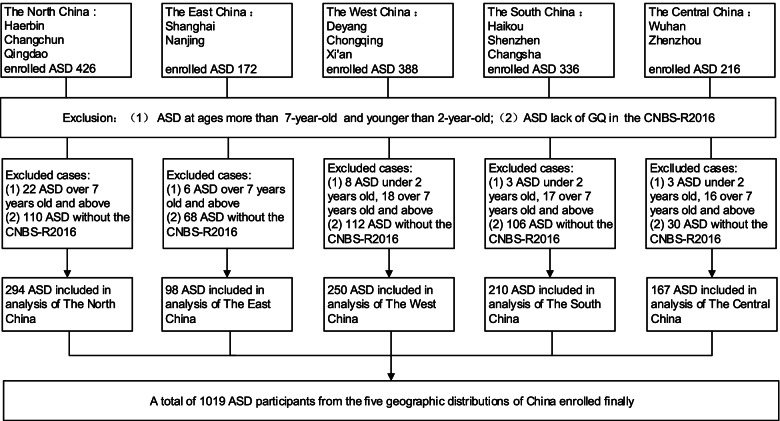
We enrolled 1019 ASD preschoolers aged 2-7 years old from 13 cities around China between May 2018 and December 2019, and used the revised Children Neuropsychological and Behavior Scale (CNBS-R2016) to assess their neurodevelopment. Their autistic core behaviors were evaluated based on their Social Responsiveness Scale (SRS), Autism Behavior Checklist (ABC), Child Autism Rating Scale (CARS), and communication warning behavior (CWB) scores in the CNBS-R2016.
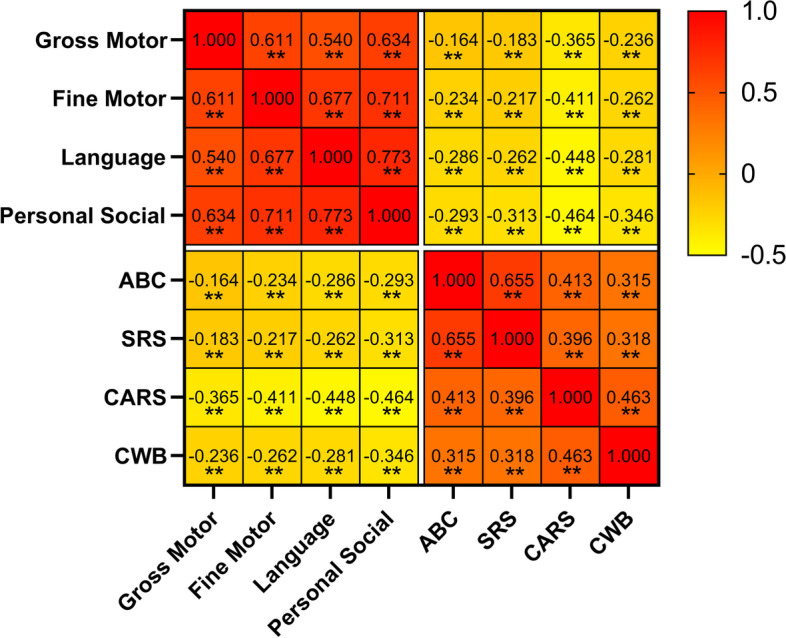
Based on general developmental quotient (GQ) < 70, 68.4% of the preschoolers with ASD had a developmental delay (DD), rated mild in 32.7% of them. The highest DD rate (> 70%) was found in language and personal-social skills, followed by fine motor skills (68.9%). Gross motor skills had the lowest DD rate (34.0%). We found that fine motor, language, and personal-social developmental quotients (DQs) were significantly lower than gross motor skills in no DD (GQ > 70), mild DD (GQ 55-69), and moderate and below DD groups (GQ ≤ 54). Furthermore, the DQs for language and personal-social skills were significantly lower than for gross and fine motor skills in both DD groups. The ABC, SRS, CARS, and CWB scores in the no DD group were the lowest, moderate in the mild DD group, and highest in the moderate and below DD group. Besides, negative correlations were found between the DQs of the four domains and the ABC, SRS, CARS, and CWB scores, of which the language and personal-social skills DQs had the strongest correlations.
Preschoolers with ASD had unbalanced neurodevelopment domain patterns and their neurodevelopmental levels were negatively correlated with the autism core symptoms. Hence, pediatricians should actively evaluate the neurodevelopment of children with ASD and conduct long-term follow-up during their early childhood to promote early diagnosis and develop personalized intervention plans.
ChiCTR2000031194 , registered on 03/23/2020.
自闭症谱系障碍(ASD)是一组临床异质性的神经发育障碍,智力障碍是其常见的共患病之一。目前尚无大样本、多中心研究关注学龄前 ASD 患儿的神经发育情况。本研究旨在探讨中国学龄前 ASD 患儿的神经发育特征,并探讨其与核心症状的关系。
本研究纳入了 2018 年 5 月至 2019 年 12 月期间来自中国 13 个城市的 1019 名 2-7 岁 ASD 学龄前儿童,使用修订后的儿童神经心理行为量表(CNBS-R2016)评估其神经发育情况。根据社会反应量表(SRS)、自闭症行为检查表(ABC)、儿童自闭症评定量表(CARS)和 CNBS-R2016 中的沟通预警行为(CWB)评分评估其自闭症核心行为。
根据一般发育商(GQ)<70 分,68.4%的 ASD 学龄前儿童存在发育迟缓(DD),其中 32.7%为轻度 DD。语言和个人社交技能的 DD 发生率最高(>70%),其次是精细运动技能(68.9%)。粗大运动技能的 DD 发生率最低(34.0%)。我们发现,在无 DD(GQ>70)、轻度 DD(GQ 55-69)和中重度及以下 DD 组(GQ≤54)中,精细运动、语言和个人社交技能的发育商明显低于粗大运动技能。此外,在 DD 组中,语言和个人社交技能的发育商明显低于粗大运动和精细运动技能。在无 DD 组中,ABC、SRS、CARS 和 CWB 评分最低,在轻度 DD 组中评分中度,在中重度及以下 DD 组中评分最高。此外,四个领域的发育商与 ABC、SRS、CARS 和 CWB 评分呈负相关,其中语言和个人社交技能的发育商与上述评分的相关性最强。
ASD 学龄前儿童的神经发育存在不均衡的领域模式,其神经发育水平与自闭症核心症状呈负相关。因此,儿科医生应积极评估 ASD 患儿的神经发育情况,并在其幼儿期进行长期随访,以促进早期诊断并制定个性化的干预计划。
ChiCTR2000031194,于 2020 年 3 月 23 日注册。