Department of Neurosciences, University of California, San Diego, La Jolla.
Department of Pediatrics, University of California, San Diego, La Jolla.
JAMA Pediatr. 2019 Jun 1;173(6):578-587. doi: 10.1001/jamapediatrics.2019.0624.
Universal early screening for autism spectrum disorder (ASD) in primary care is becoming increasingly common and is believed to be a pivotal step toward early treatment. However, the diagnostic stability of ASD in large cohorts from the general population, particularly in those younger than 18 months, is unknown. Changes in the phenotypic expression of ASD across early development compared with toddlers with other delays are also unknown.
To examine the diagnostic stability of ASD in a large cohort of toddlers starting at 12 months of age and to compare this stability with that of toddlers with other disorders, such as developmental delay.
DESIGN, SETTING, AND PARTICIPANTS: In this prospective cohort study performed from January 1, 2006, to December 31, 2018, a total of 2241 toddlers were referred from the general population through a universal screening program in primary care or community referral. Eligible toddlers received their first diagnostic evaluation between 12 and 36 months of age and had at least 1 subsequent evaluation.
Diagnosis was denoted after each evaluation visit as ASD, ASD features, language delay, developmental delay, other developmental issue, typical sibling of an ASD proband, or typical development.
Diagnostic stability coefficients were calculated within 2-month age bands, and logistic regression models were used to explore the associations of sex, age, diagnosis at first visit, and interval between first and last diagnosis with stability. Toddlers with a non-ASD diagnosis at their first visit diagnosed with ASD at their last were designated as having late-identified ASD.
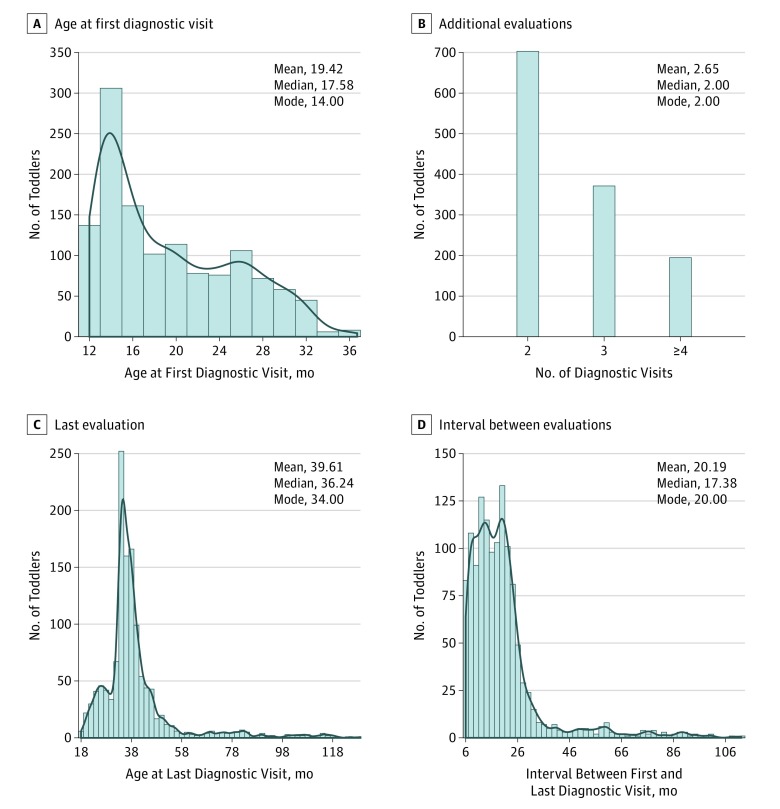
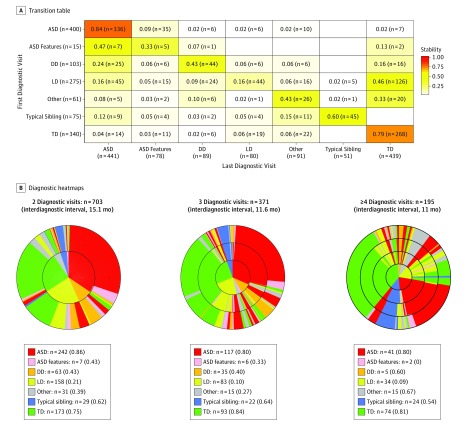
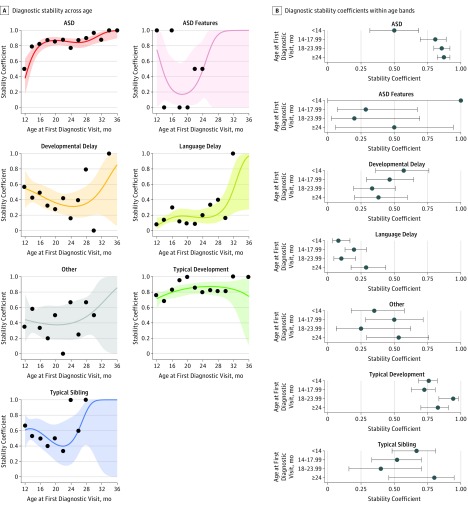
Among the 1269 toddlers included in the study (918 [72.3%] male; median age at first evaluation, 17.6 months [interquartile range, 14.0-24.4 months]; median age at final evaluation, 36.2 months [interquartile range, 33.4-40.9 months]), the overall diagnostic stability for ASD was 0.84 (95% CI, 0.80-0.87), which was higher than any other diagnostic group. Only 7 toddlers (1.8%) initially considered to have ASD transitioned into a final diagnosis of typical development. Diagnostic stability of ASD within the youngest age band (12-13 months) was lowest at 0.50 (95% CI, 0.32-0.69) but increased to 0.79 by 14 months and 0.83 by 16 months (age bands of 12 vs 14 and 16 months; odds ratio, 4.25; 95% CI, 1.59-11.74). A total of 105 toddlers (23.8%) were not designated as having ASD at their first visit but were identified at a later visit.
The findings suggest that an ASD diagnosis becomes stable starting at 14 months of age and overall is more stable than other diagnostic categories, including language or developmental delay. After a toddler is identified as having ASD, there may be a low chance that he or she will test within typical levels at 3 years of age. This finding opens the opportunity to test the impact of very early-age treatment of ASD.
在初级保健中对自闭症谱系障碍(ASD)进行普遍的早期筛查越来越普遍,并且被认为是早期治疗的关键步骤。然而,一般人群中大队列中 ASD 的诊断稳定性,尤其是在 18 个月以下的人群中,尚不清楚。与其他发育迟缓的幼儿相比,ASD 在早期发育过程中表型表达的变化也未知。
在 12 个月大的幼儿中进行大型队列研究,以检查 ASD 的诊断稳定性,并将其与其他障碍(如发育迟缓)的稳定性进行比较。
设计、地点和参与者:这是一项前瞻性队列研究,从 2006 年 1 月 1 日至 2018 年 12 月 31 日进行,共有 2241 名幼儿通过初级保健或社区转介的普遍筛查计划从一般人群中被转诊。符合条件的幼儿在 12 至 36 个月之间接受首次诊断评估,并至少进行了一次后续评估。
每次就诊后,将诊断表示为 ASD、ASD 特征、语言延迟、发育迟缓、其他发育问题、ASD 先证者的典型兄弟姐妹或典型发育。
在每两个月的年龄组内计算诊断稳定性系数,并使用逻辑回归模型探讨性别、年龄、首次就诊时的诊断以及首次和最后诊断之间的间隔与稳定性的关系。首次就诊时被诊断为非 ASD 的幼儿,最后被诊断为 ASD 的,被指定为迟发性 ASD。
在这项研究中,共纳入了 1269 名幼儿(918 名[72.3%]为男性;首次评估的中位年龄为 17.6 个月[四分位距,14.0-24.4 个月];最终评估的中位年龄为 36.2 个月[四分位距,33.4-40.9 个月]),ASD 的整体诊断稳定性为 0.84(95%CI,0.80-0.87),高于任何其他诊断组。只有 7 名幼儿(1.8%)最初被认为患有 ASD,最终被诊断为典型发育。在最年轻的年龄组(12-13 个月),ASD 的诊断稳定性最低,为 0.50(95%CI,0.32-0.69),但到 14 个月时增加到 0.79,到 16 个月时增加到 0.83(12 个月与 14 个月和 16 个月的年龄组;比值比,4.25;95%CI,1.59-11.74)。共有 105 名幼儿(23.8%)在首次就诊时未被诊断为 ASD,但在以后的就诊中被诊断为 ASD。
研究结果表明,ASD 的诊断在 14 个月大时开始稳定,总体比其他诊断类别(包括语言或发育迟缓)更稳定。在幼儿被诊断为 ASD 后,他或她在 3 岁时测试结果可能会在正常范围内的可能性较低。这一发现为测试 ASD 的早期治疗效果提供了机会。