Anderson Katherine M, Bergenfeld Irina, Cheong Yuk Fai, Minh Tran Hung, Yount Kathryn M
Department of Behavioral, Social, and Health Education Sciences, Emory University, 1518 Clifton Rd, Atlanta, GA, 30322, USA.
University of California San Diego, 9500 Gilman Drive, La Jolla, CA, 92093, USA.
SSM Popul Health. 2022 Apr 22;18:101103. doi: 10.1016/j.ssmph.2022.101103. eCollection 2022 Jun.
Sexual violence against women remains a global public health problem, with Southeast Asia having among the highest rates of violence victimization globally. Exposure to violence in adolescence--a highly prevalent experience in Vietnam--is associated with later perpetration of violence against others. However, childhood maltreatment as a latent construct is understudied, with most analyses focusing on theoretical categories, potentially missing key patterns of victimization, particularly poly-victimization. Poor understanding of these experience limits researchers' ability to predict and intervene upon cyclical perpetration of violence. This study aims to identify latent classes of childhood maltreatment, and to test associations between class membership and sexually violent behavior during the first 12 months of university in a sample of Vietnamese men.
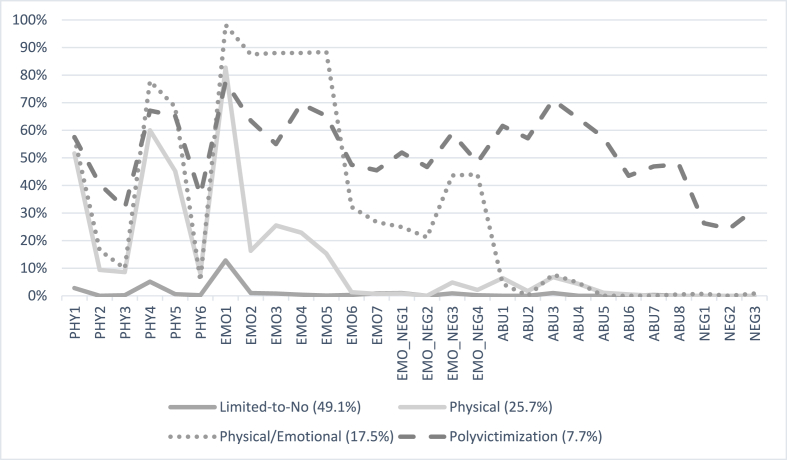
Heterosexual and bisexual men aged 18-24 matriculating into two universities in Hanoi were recruited for the randomized controlled trial of GlobalConsent, a six-module online sexual-violence prevention program. Participants (N = 793) completed a baseline survey, were randomized 1:1 to GlobalConsent or attention control, and were invited to complete post-test surveys at six-months post-baseline and 12-months post-baseline. Validated scales were employed to assess childhood maltreatment and past-six-month sexually violent behavior at each post-test. Latent class analysis identified four classes of childhood maltreatment: Limited-to-no, physical, physical and emotional, and poly-victimization. Associations between childhood maltreatment class and sexually violent behavior demonstrate a threshold effect, wherein poly-victimized men were significantly more likely than men in other classes to have engaged in sexually violent behavior during the 12-month follow-up period.
There is a vital need for screening and intervention with men who have experienced childhood maltreatment in Vietnam to prevent future violence perpetration. Education is needed to break the cycle of violence intergenerationally and in romantic relationships by changing harmful norms around men's sexual privilege and the normalization of childhood maltreatment.
针对妇女的性暴力仍然是一个全球性的公共卫生问题,东南亚是全球暴力受害率最高的地区之一。在越南,青少年时期遭受暴力是一种非常普遍的经历,这与日后对他人实施暴力行为有关。然而,作为一种潜在因素的童年虐待却未得到充分研究,大多数分析集中在理论类别上,可能会遗漏关键的受害模式,尤其是多重受害。对这些经历的了解不足限制了研究人员预测和干预暴力行为循环发生的能力。本研究旨在识别童年虐待的潜在类别,并在越南男性样本中测试类别归属与大学第一年12个月内性暴力行为之间的关联。
招募了18至24岁进入河内两所大学的异性恋和双性恋男性参与GlobalConsent的随机对照试验,这是一个包含六个模块的在线性暴力预防项目。参与者(N = 793)完成了基线调查,被1:1随机分配到GlobalConsent组或注意力控制组,并被邀请在基线后六个月和基线后12个月完成测试后调查。在每次测试后,使用经过验证的量表来评估童年虐待和过去六个月的性暴力行为。潜在类别分析确定了四类童年虐待:极少或无虐待、身体虐待、身体和情感虐待以及多重受害。童年虐待类别与性暴力行为之间的关联显示出一种阈值效应,即在12个月的随访期内,遭受多重受害的男性比其他类别的男性更有可能实施性暴力行为。
迫切需要对越南有童年虐待经历的男性进行筛查和干预,以防止未来的暴力行为。需要开展教育,通过改变围绕男性性特权的有害规范以及童年虐待常态化的现象,打破暴力在代际间和恋爱关系中的循环。