Fereidouni Farshad, Mohammadi Seyed Taghi, Faramarzi Shahraki Vahed, Jahantigh Farhad
MD, Emam Sajad Hospital Clinical Research Center, Yasuj University of Medical Sciences, Yasuj, Iran.
PhD, Department of Physics, Center of Basic Science, Khatam ol-Anbia (PBU) University, Tehran, Iran.
J Biomed Phys Eng. 2022 Jun 1;12(3):285-296. doi: 10.31661/jbpe.v0i0.1272. eCollection 2022 Jun.
The application of radar systems in telecommunications and aerospace science is important. However, engineering department's staff various tissues are always under chronic radiation generated by the radar fields which may affect health.
This study aims to evaluate the risk of radar wave exposure and to explore the effects and limitations.
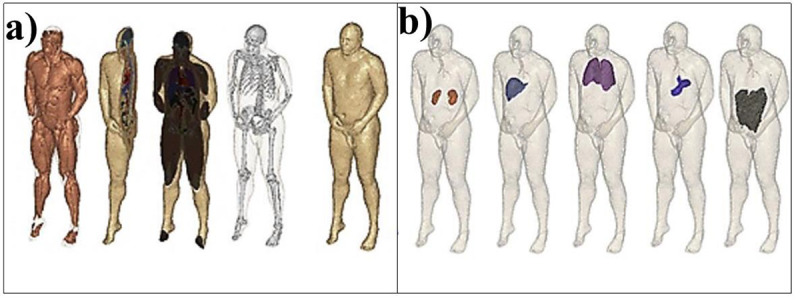
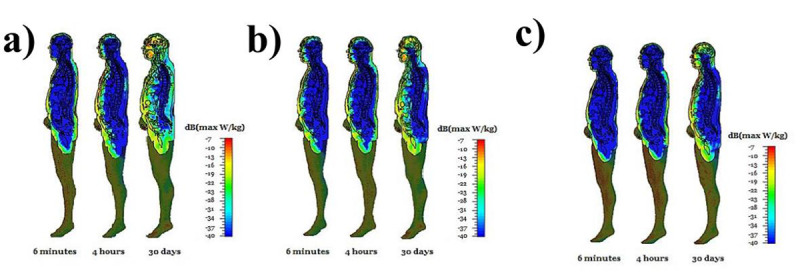
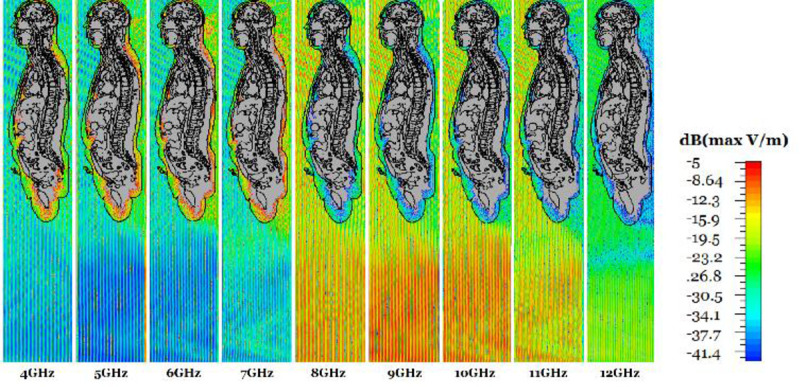
In this simulation study, an adult body model versus 1 watt source with a distance of 50 centimeters exposure has been simulated using the CST STUDIO SUITE. Furthermore, various physical and electrical properties of each tissue and organ for different frequencies and exposure times have been studied. The exposure dose limitations have been considered using the International Commission on Non-Ionizing Radiation Protection (ICNIRP) safety and health guide report.
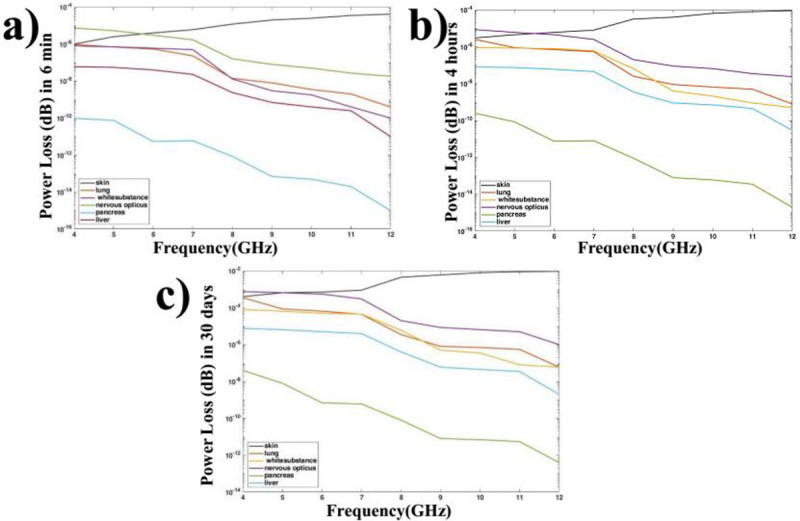
Total body absorbed doses for 4 GHz, 8 GHz, and 12 GHz frequency, and 6 min, 4 h, and 30 days exposure time, have been calculated as 1.136×10, 1.598×10, 1.58×10, 1.521×10, 3.122×10, 4.52×10, 4.1×10, 10, and 10, respectively.
It has shown that the internal organs of the body and head will be under more risk by reducing radar frequencies from 12 GHz to 4 GHz. On the other hand, the higher frequency can cause a higher risk to the human skin. In addition, the maximum Specific Absorption Rate (SAR) for each case has been calculated. The results show that for this normalized source, the safety criteria have been respected, but for a higher source, the calculations must be repeated.
雷达系统在电信和航天科学中的应用十分重要。然而,工程部门的工作人员的各种组织总是处于雷达场产生的慢性辐射之下,这可能会影响健康。
本研究旨在评估雷达波暴露的风险,并探索其影响和局限性。
在本模拟研究中,使用CST STUDIO SUITE模拟了一个成人人体模型与一个距离为50厘米、功率为1瓦的源的暴露情况。此外,还研究了不同频率和暴露时间下各组织和器官的各种物理和电学特性。使用国际非电离辐射防护委员会(ICNIRP)的安全与健康指南报告来考虑暴露剂量限制。
已计算出4吉赫兹、8吉赫兹和12吉赫兹频率以及6分钟、4小时和30天暴露时间下的全身吸收剂量,分别为1.136×10、1.598×10、1.58×10、1.521×10、3.122×10、4.52×10、4.1×10、10和10。
结果表明,将雷达频率从12吉赫兹降低到4吉赫兹时,人体的内部器官和头部将面临更大风险。另一方面,较高频率会对人体皮肤造成更高风险。此外,还计算了每种情况下的最大比吸收率(SAR)。结果表明,对于这种归一化源,安全标准得到了遵守,但对于更高的源,必须重复计算。