Yoshinaga Ryuji, Tomita Kohei, Wakayama Kosuke, Furuta Shintaro, Miyamoto Kotaro, Matsuda Yohei, Matsuo Takashi, Oku Koji
Department of Rehabilitation, National Hospital Organization Nagasaki Medical Center: 2-1001-1 Kubara, Omura-city, Nagasaki 856-8562, Japan.
Department of Physical Therapy Science, Nagasaki University Graduate School of Biomedical Sciences, Japan.
J Phys Ther Sci. 2022 Jun;34(6):416-421. doi: 10.1589/jpts.34.416. Epub 2022 Jun 6.
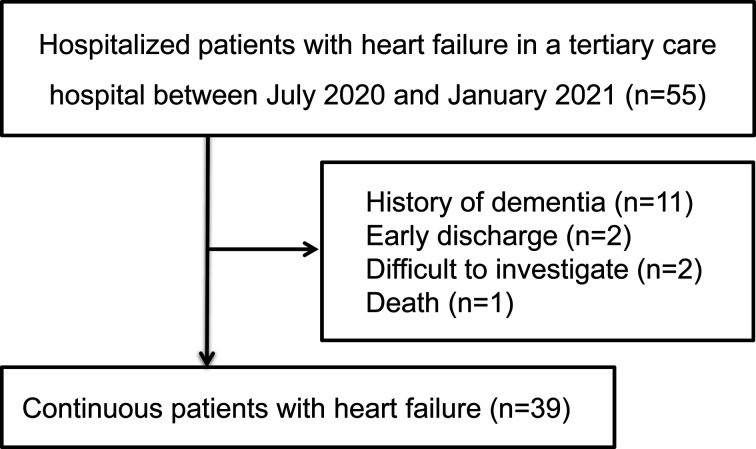
[Purpose] The characteristics of heart failure in hospitalized patients with poor self-care behaviors are unknown. We investigated factors associated with self-care behaviors by using the European Heart Failure Self-Care Behaviour Scale (EHFScBS) in heart failure patients based on three comprehensive concepts. [Participants and Methods] This was a cross-sectional single-center study of heart failure patients hospitalized at a tertiary-care hospital. We investigated age, gender, family living together/apart, employment, and the Specific Activity Scale (SAS). A physical therapist provided the EHFScBS one time to determine the patients' pre-hospital self-care behavior status. The 12 items of the EHFScBS were classified into the following three categories: Maintenance, Monitoring, and Management. [Results] The median age of the 39 consecutive patients was 81 years. A multiple regression analysis revealed that the factors exhibiting significant associations were the SAS score (β=0.504) for Management and age (β=-0.403) for the total EHFScBS score (adjusted by the number of hospitalizations for heart failure). Maintenance and Monitoring were not significantly associated with the survey items. [Conclusion] These data indicate that self-care education for hospitalized patients with heart failure leads to individualized approaches based on characteristics such as age and physical activity capacity.
[目的] 自我护理行为较差的住院心力衰竭患者的特征尚不清楚。我们基于三个综合概念,使用欧洲心力衰竭自我护理行为量表(EHFScBS)对心力衰竭患者自我护理行为的相关因素进行了调查。[参与者与方法] 这是一项对一家三级护理医院住院的心力衰竭患者进行的横断面单中心研究。我们调查了年龄、性别、是否与家人同住、就业情况以及特定活动量表(SAS)。一名物理治疗师提供一次EHFScBS以确定患者院前自我护理行为状态。EHFScBS的12个项目分为以下三类:维持、监测和管理。[结果] 39例连续患者的中位年龄为81岁。多元回归分析显示,表现出显著关联的因素是管理方面的SAS评分(β=0.504)以及总EHFScBS评分方面的年龄(β=-0.403)(根据心力衰竭住院次数进行调整)。维持和监测与调查项目无显著关联。[结论] 这些数据表明,针对住院心力衰竭患者的自我护理教育会导致基于年龄和身体活动能力等特征的个性化方法。