Davidescu Lavinia, Ursol Grigoriy, Korzh Oleksii, Deshmukh Vikranth, Kuryk Lesia, Nortje Monja-Marie, Godlevska Olga, Devouassoux Gilles, Khodosh Eduard, Israel Elliot, Moussy Alain, Mansfield Colin D, Hermine Olivier, Chanez Pascal
Department of Pulmonology, University of Oradea, Oradea, Romania.
Medical and Diagnostic Center of Private Enterprise of Private Production Company "Acinus", Kropyvnytskyi, Ukraine.
J Asthma Allergy. 2022 Jun 7;15:737-747. doi: 10.2147/JAA.S337284. eCollection 2022.
Masitinib is an oral tyrosine kinase inhibitor that selectively targets mast cell activity and platelet-derived growth factor receptor (PDGFR) signaling, both of which are implicated in various mechanisms of asthma pathogenesis.
Assessment of masitinib as an add-on to standard maintenance therapy as compared with placebo in the treatment of oral corticosteroid-dependent severe asthma.
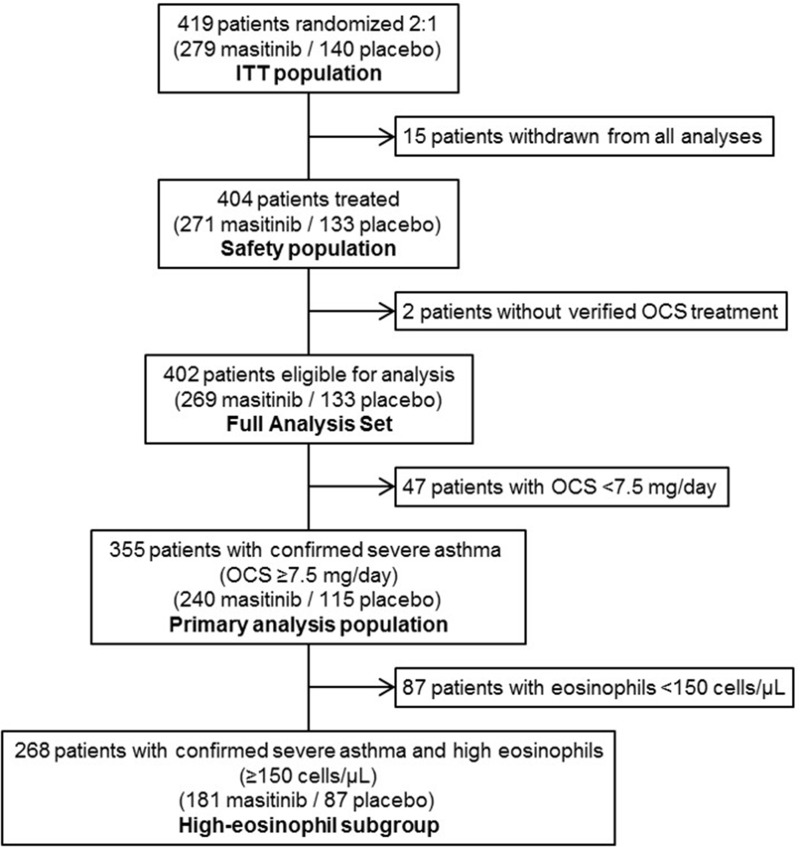
We conducted a randomized (2:1), placebo-controlled study of masitinib (6 mg/kg/d) in adults with severe asthma uncontrolled by high dose inhaled corticosteroids and long-acting beta-adrenoreceptor agonists plus oral corticosteroids (OCS) (≥7.5 mg/d). No minimum baseline blood eosinophil count was specified. Following a protocol amendment, the primary endpoint was reduction of annualized severe asthma exacerbation rate adjusted for the overall time on treatment (SAER). Subgroup analysis according to yearly cumulative OCS intake was also performed, a higher OCS dose indicating more severe asthma that is harder to control.
Following an average exposure of approximately 13 months, masitinib (n = 240) reduced the SAER by 35% relative to placebo (n = 115) (rate ratio (RR) 0.65 (95% CI [0.47-0.90]; P = 0.010)). For patients with eosinophil ≥150 cell/µL, masitinib (n = 181) reduced SAER by 38% relative to placebo (n = 87); RR 0.62 (95% CI [0.42-0.91]; P = 0.016). Benefit of masitinib was shown to increase in the most severely affected patients (OCS intake of >1000 mg/year), with a significant (P < 0.01) reduction in SAER of 50%-70%. Safety was consistent with the known masitinib profile.
Orally administered masitinib reduces the risk of asthma exacerbations in severe asthma patients, with an acceptable safety profile. Masitinib may potentially provide a new treatment option for oral corticosteroid-dependent severe asthma.
马西替尼是一种口服酪氨酸激酶抑制剂,可选择性靶向肥大细胞活性和血小板衍生生长因子受体(PDGFR)信号传导,这两者均与哮喘发病机制的多种机制有关。
评估与安慰剂相比,马西替尼作为标准维持治疗的附加药物在治疗口服糖皮质激素依赖的重度哮喘中的疗效。
我们对重度哮喘患者进行了一项随机(2:1)、安慰剂对照研究,这些患者使用高剂量吸入性糖皮质激素、长效β-肾上腺素能受体激动剂加口服糖皮质激素(OCS)(≥7.5 mg/d)无法得到控制。未规定最低基线血嗜酸性粒细胞计数。在方案修订后,主要终点是根据治疗总时间调整的年化重度哮喘加重率(SAER)降低。还根据每年累积OCS摄入量进行了亚组分析,较高的OCS剂量表明哮喘更严重且更难控制。
平均暴露约13个月后,马西替尼组(n = 240)与安慰剂组(n = 115)相比,SAER降低了35%(率比(RR)0.65(95%CI[0.47 - 0.90];P = 0.010))。对于嗜酸性粒细胞≥150个细胞/µL的患者,马西替尼组(n = 181)与安慰剂组(n = 87)相比,SAER降低了38%;RR 0.62(95%CI[0.42 - 0.91];P = 0.016)。在受影响最严重的患者(每年OCS摄入量>1000 mg)中,马西替尼的益处更为明显,SAER显著降低(P < 0.01)50% - 70%。安全性与已知的马西替尼特征一致。
口服马西替尼可降低重度哮喘患者哮喘加重的风险,安全性可接受。马西替尼可能为口服糖皮质激素依赖的重度哮喘提供一种新的治疗选择。