Han Peipei, Hou Lin, Liang Zhenwen, Chen Wuxiong, Li Junxue, Cheng Yazhou, Zhou Wenjing, Zeng Siya, Pan Jiangtao, Xu Lanshan, Wang Yi, Chen Yangyi, Guo Qi
Department of Rehabilitation Medicine, Shanghai University of Medicine and Health Sciences Affiliated Zhoupu Hospital, Shanghai, People's Republic of China.
College of Rehabilitation Sciences, Shanghai University of Medicine and Health Sciences, Shanghai, People's Republic of China.
Nat Sci Sleep. 2022 Jun 7;14:1089-1096. doi: 10.2147/NSS.S361925. eCollection 2022.
Few longitudinal studies have explored exploring the relationship between sleep duration and sarcopenia. Evidence concerning the relationship between sleep duration and sarcopenia is limited and inconsistent. The purpose of this 3-year prospective study was to explore whether sleep duration was associated with sarcopenia onset in suburb-dwelling older Chinese individuals.
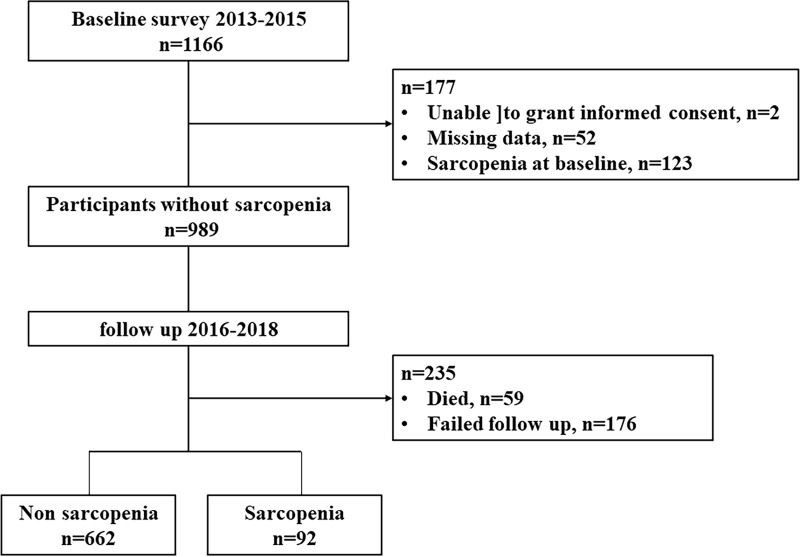
This was a prospective study that included 754 Chinese suburb-dwelling men and women aged ≥60 years (men n=327, mean age 65.24± 4.87 years) who were not initially diagnosed with sarcopenia. We defined sarcopenia using the diagnostic algorithm recommended by the Asian Working Group for Sarcopenia. Self-reported sleep duration was a component of the interview measured by trained interviewers. Subjects were categorized into 3 groups at baseline [short: <6 h, medium: 6-8 h, and long: >8 h].
The incidence of sarcopenia during the 3-year follow-up was 12.2%. Multivariate logistic regression analyses showed that after adjustments for potential confounders long sleep duration was independently associated with sarcopenia incidence from baseline through the 3-year follow-up: when using the 6-8 h sleep duration group as a reference, the adjusted ORs for sarcopenia of the groups who slept <6 and >8 hours were 2.74 (95% CI 1.05-7.13) and 1.84 (95% CI 1.07-3.14).
Both short and long sleep durations were associated with a greater incidence of sarcopenia. Thus, sleep duration should be considered when developing prevention and management strategies for sarcopenia.
很少有纵向研究探讨睡眠时间与肌肉减少症之间的关系。关于睡眠时间与肌肉减少症之间关系的证据有限且不一致。这项为期 3 年的前瞻性研究的目的是探讨睡眠时间是否与居住在郊区的中国老年人的肌肉减少症发病有关。
这是一项前瞻性研究,纳入了 754 名年龄≥60 岁的居住在郊区的中国男性和女性(男性 n = 327,平均年龄 65.24±4.87 岁),他们最初未被诊断出患有肌肉减少症。我们使用亚洲肌肉减少症工作组推荐的诊断算法来定义肌肉减少症。自我报告的睡眠时间是由训练有素的访谈者在访谈中测量的一个组成部分。在基线时,受试者被分为 3 组[短:<6 小时,中:6 - 8 小时,长:>8 小时]。
在 3 年的随访期间,肌肉减少症的发病率为 12.2%。多因素逻辑回归分析表明,在对潜在混杂因素进行调整后,从基线到 3 年随访期间,长睡眠时间与肌肉减少症发病率独立相关:以睡眠时间为 6 - 8 小时的组作为参照,睡眠时间<6 小时和>8 小时组发生肌肉减少症的校正 OR 分别为 2.74(95%CI 1.05 - 7.13)和 1.84(95%CI 1.07 - 3.14)。
短睡眠时间和长睡眠时间均与更高的肌肉减少症发病率相关。因此,在制定肌肉减少症的预防和管理策略时应考虑睡眠时间。