Turner Institute for Brain and Mental Health, School of Psychological Sciences, Monash University, Monash, Victoria, Australia.
The Sleep Health Foundation, Blacktown, New South Wales, Australia.
J Sleep Res. 2023 Feb;32(1):e13655. doi: 10.1111/jsr.13655. Epub 2022 Jun 14.
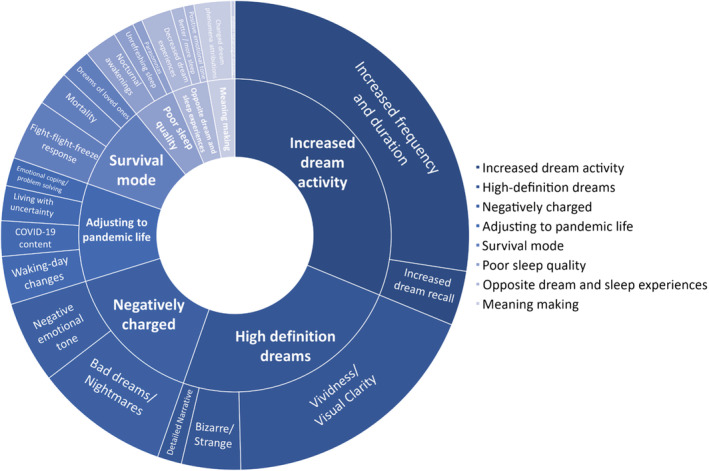
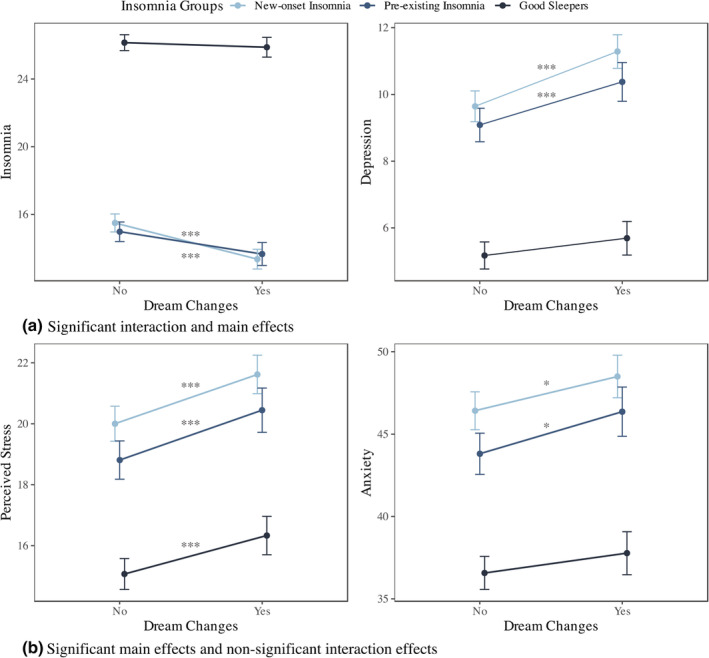
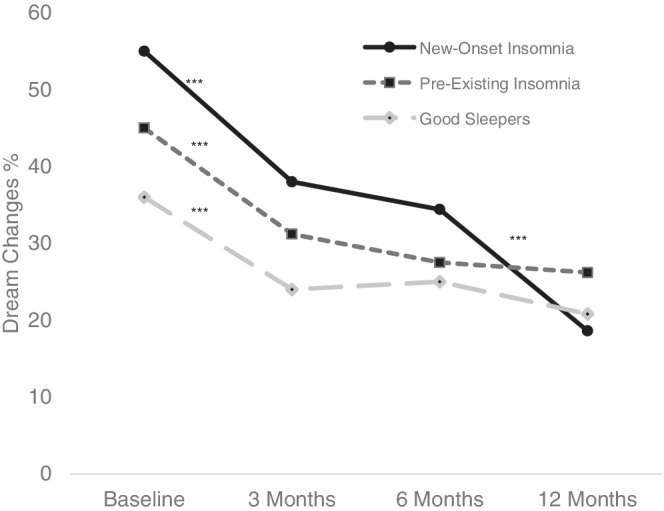
Dreaming and insomnia are important markers of distress in times of crisis. Here, we present a longitudinal, mixed-methods study examining changes in dreaming between individuals with and without insomnia symptoms and their relationship to mental health during the COVID-19 pandemic. A global survey examining insomnia symptoms, dreams and mental health was launched in April 2020 and followed participants over 12 months. Of 2240 participants, 1009 (45%) reported dream changes at baseline. A higher proportion of participants with new-onset insomnia reported dream changes (55%) than those with pre-existing insomnia (45%) or good sleepers (36%). Overall, thematic analysis identified key dream change themes of increased dream activity, with participants dreaming vividly, in high-definition, and with a strong negative charge. Themes around survival, adjusting to pandemic life, meaning-making and poor sleep quality were also noted. Linguistic Inquiry Word Count showed that individuals with insomnia used more negative words to describe their dream changes than good sleepers. Specifically, the new-onset insomnia group used more anxious and death-related words than those who slept well. Notably, all groups experienced a significant reduction in dream activity by 3-month follow-up. Lastly, dream changes were associated with worse mental health symptoms over time, and this effect was more pronounced in individuals with insomnia. Our results highlight that insomnia symptoms, especially new-onset insomnia, are associated with more negative dream changes during collective stressful events, potentially compounding daytime distress and mental health symptoms over time. During times of crisis, dreaming and insomnia may reveal an important target for mental health interventions.
在危机时期,做梦和失眠是困扰的重要标志。在这里,我们进行了一项纵向、混合方法的研究,研究了患有和不患有失眠症状的个体之间的梦境变化及其与 COVID-19 大流行期间心理健康的关系。2020 年 4 月,我们发起了一项关于失眠症状、梦境和心理健康的全球调查,并在 12 个月内对参与者进行了随访。在 2240 名参与者中,有 1009 名(45%)在基线时报告了梦境变化。与有预先存在的失眠症或睡眠良好的参与者相比,新出现失眠症的参与者报告梦境变化的比例更高(55%比 45%和 36%)。总体而言,主题分析确定了关键的梦境变化主题,即梦境活动增加,参与者的梦境生动、高清,且带有强烈的负面情绪。还注意到与生存、适应大流行生活、寻找意义和睡眠质量差有关的主题。语言探究词频显示,与睡眠良好的个体相比,患有失眠症的个体在描述梦境变化时使用了更多的负面词汇。具体来说,与睡眠良好的个体相比,新出现失眠症的个体使用了更多焦虑和与死亡相关的词汇。值得注意的是,所有组在 3 个月随访时梦境活动都显著减少。最后,随着时间的推移,梦境变化与心理健康症状的恶化有关,而这种影响在失眠症患者中更为明显。我们的研究结果表明,在集体压力事件中,失眠症状,尤其是新出现的失眠症,与更消极的梦境变化有关,这可能会随着时间的推移加重白天的困扰和心理健康症状。在危机时期,做梦和失眠可能揭示了心理健康干预的一个重要目标。